




- Home/
- COVID-19: Students Turn Good Samaritans For Women In West Bengal, Helping Them Get Sanitary Pads Amid Lockdown
COVID-19: Students Turn Good Samaritans For Women In West Bengal, Helping Them Get Sanitary Pads Amid Lockdown
Written by Barkha Mathur | Updated: April 08, 2020 18:05 IST
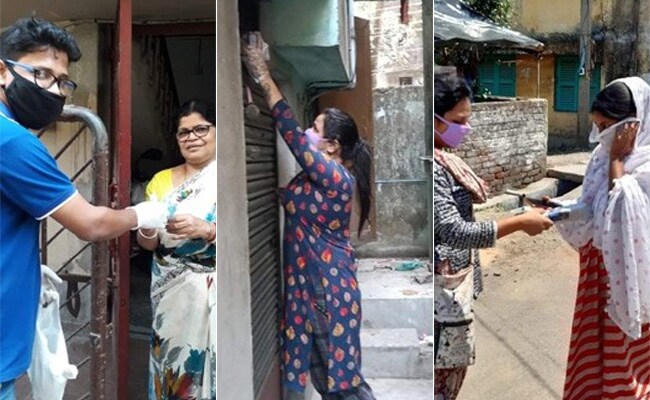
Students in West Bengal are distributing sanitary napkins to women 24/7 during ongoing lockdown
New Delhi:
With an aim to help menstruating women during the current nationwide lockdown, students and young volunteers in all districts of West Bengal have started an initiative of home delivering sanitary napkins. The lockdown has been enforced by the central government to break the chain of transmission of the coronavirus which has spread to almost all the countries in the world infecting more than 14.46 lakh people and causing more than 83,000 fatalities. According to Dipsita Dhar, PhD scholar at Jawaharlal Nehru University and All India Joint Secretary of a Students' Federation of India (SFI), a students' union body affiliated to a left political party,
We started by providing foodgrains to people in need but we soon realised that sanitary napkin is a very important item that everybody is ignoring. Essentials do not just mean rice, pulses and medicines but sanitary pads as well and it would be difficult for women to get pads at this time of crisis. Given the stigma attached to menstruation in India, it does not seem that women would ask someone to get them pads. So we decided to bring pads to their doorstep. All they have to do is call in.
Dipsita further added that one helpline number has been started by student volunteers in each district and anyone who needs a pad at any time of the day can call in. The volunteers have stocked up sanitary pads and are giving it to the women for free.
When 47-year-old Pinki Mitra called up the volunteers in Kolkata for sanitary pads for her daughter, a volunteer made it available to her within half an hour. Ms. Mitra said
When we got to know that lockdown is going to imposed in four hours, I asked my husband to get some vegetables and milk for 3-4 days but I forgot mentioning sanitary napkins. I did not occur to me that I have a daughter and she will need some pads during this period of lockdown. Unfortunately, she got her periods on the Day 3 of the lockdown but thanks to these children, my daughter did not have to stay in an uncomfortable state for long. I called the number my daughter had received in a WhatsApp message and they brought a packet soon.
According to Ms. Dhar, the initiative has helped more than 4,000 women till Friday (April 3). While the students are providing pads for free to women in need, Ms. Dhar said that the district and state authorities must make sure that such a basic necessity is provided to women and girls of the state.
Published: April 08, 2020 18:05 IST
also read
Solar Is The Best Economic Investment, Says Ecologist Who Has Paid Zero Power Bill For Last Three Years
Written by Aastha Ahuja, Edited by Sonia BhaskarMonthly Power Bill Of Just Rs 130, Here's How A Couple In Kochi Did It
Written by Aastha Ahuja, Edited by Sonia BhaskarHimachal Pradesh's The Kalgidhar Society Saves Rs. 3.4 Crore Per Annum By Harnessing The Power Of Solar
Written by Aastha Ahuja, Edited by Sonia Bhaskar



NDTV in partnership with Luminous has launched an awareness campaign ‘Be A Bijli Donor’ to promote the idea of ‘save power for more power’. The idea is to conserve energy today in order to get more power tomorrow.
We inherently know that saving energy results in low energy bills, but we also need to understand that a unit of energy saved today makes it available for people still living in the dark or facing regular power cuts.
Saving power or conserving energy is about knowing the sources of energy, and areas of wastage and thereby eliminating these through technology and lifestyle changes. For instance, a 100 W (Watt) incandescent (ICL) bulb can be replaced with a 9 W LED bulb offering similar performance in terms of light output, but at far lower consumption of energy.
While a 100 W ICL bulb, used for four hours a day, consumes 146 units of energy per year, a 9 W LED bulb requires only 13.5 units per year. Clearly, switching to LED is a smart choice as it provides the same output while consuming 90 per cent less energy.
The focus of the campaign is to instill the idea of ‘save power for more power’ and in order to do so, the initiative will create awareness about energy efficient products and services, smart ways to reduce power consumption, alternate sources of energy like solar energy and the need to conserve energy. The idea is to address the rising need for energy conservation in India.
As part of the campaign, we will highlight the stories of individuals and organisations who are championing the cause of energy conservation by switching to renewable sources of energy, adopting innovations to reduce energy consumption while enjoying the same output.
The initiative will provide a platform for all stakeholders to share their ideas and work towards the common goal of, ‘Save power for more power’.
Comments