




- Home/
- From Mud Houses To Ritzy Runways, Silai School Women's New Journey
From Mud Houses To Ritzy Runways, Silai School Women's New Journey
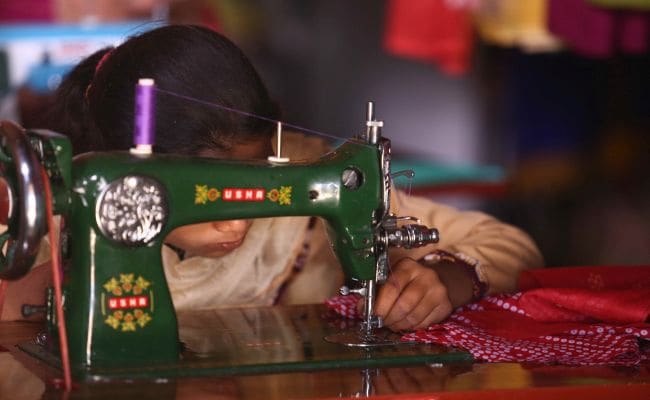
Delhi: For the last three years, USHA Silai School programme has empowered given many underprivileged women in India and created opportunities that these women, given their circumstances, never imagined existed. It has given them a sense of equality, independence and the right to not just dream but actually have a fair chance to chase those dreams. Most of these women have led lives devoid of basics, for them poverty is life and hardships the only reality. Resigned to their fate, they never believed that life could be devoid of difficulties and filled with happiness and independence. So when a small step taken to enroll in to a silai school opened up avenues so far non-existent, these women not just grabbed it but they also made the most of it.
Partnering up with various NGOs across the country, the initiative through its silai schools trains women across India to develop their stitching skills. Once trained the women use their skills to earn a livelihood and become financially independent. Most women part of this Kushalta ke Kadam initiative, are now entrepreneurs in their own right. They are not just earning a living by using their skill but are passing on their new learnings to other women in their community. So the success of the initiative is not just that few women learn stitching and use it to make money. The success lies in what these women do after they walk out of the silai school. Apart from setting up their own tailoring units, they set up schools of their own to train more women and create similar opportunities for others in their community.
Call it empathy or just a desire to change the circumstances and not be held hostage, but these women have taken Kushalta ke Kadam and decided to be the beacon for others to follow. And because of that they have earned equality and respect not just within their homes but also in the world outside.
In order to take the campaign to a new height, Kushalta Ke Kadam in collaboration with IMG Reliance decided to come up with a fashion brand that these silai school pass outs will produce in partnership with designers and experts.
'Amrich' by Amit Vijaya and Richard Pandav , the label assigned to Rajasthan, took another approach to embrace the fashion culture of their region.
.
Lastly a designer known for his personal zeitgeist, Sreejith Jeevan, was assigned to Puducherry region to help conceptualise a collection that will be true to the French influenced city.
"We are looking at all types of sewing techniques," he said. "This process is very exciting. All the women are from different villages and since they are already entrepreneurs they have a creative sense of their own which I think is vital to the complete process."
Being generally inspired by the windows which are highly prevalent in the Puducherry architecture, his region's collection should most likely see the use of box pleats and pin tucks as a metaphor to the windowpanes and colorful patches to signify the colorful window panels.
The women are being provided with the required resources to design and produce a fashion line and to be showcased at the major trend-setting event in Mumbai.
"For the last 6 seasons of Lakme Fashion Week, we have been dedicating one day to showcase a sustainable fashion," said Jaspreet Chandok, Vice President and Head of Fashion IMG Reliance.
As the USHA Silai School women become the flag bearers of this design journey, the wait is now for the final show where these women will get the chance to showcase not just their skills and hardwork but tell their stories through the garments they design.
Also Read: Moving Towards A Fearless Future, Soni From Nithari Village Takes Charge Of Her Life
Partnering up with various NGOs across the country, the initiative through its silai schools trains women across India to develop their stitching skills. Once trained the women use their skills to earn a livelihood and become financially independent. Most women part of this Kushalta ke Kadam initiative, are now entrepreneurs in their own right. They are not just earning a living by using their skill but are passing on their new learnings to other women in their community. So the success of the initiative is not just that few women learn stitching and use it to make money. The success lies in what these women do after they walk out of the silai school. Apart from setting up their own tailoring units, they set up schools of their own to train more women and create similar opportunities for others in their community.
Call it empathy or just a desire to change the circumstances and not be held hostage, but these women have taken Kushalta ke Kadam and decided to be the beacon for others to follow. And because of that they have earned equality and respect not just within their homes but also in the world outside.
In order to take the campaign to a new height, Kushalta Ke Kadam in collaboration with IMG Reliance decided to come up with a fashion brand that these silai school pass outs will produce in partnership with designers and experts.
The aim is to provide a larger stage to these talented rural women. A stage where these women under expert guidance will step into the bigger world of business. The genesis of the idea was sown in July 2017. The country was first divided into four regions - Rajasthan, Bengal, Gujarat and Puducherry and an assessment process was carried out to select USHA Silai School women, from these locations, who matched a pre-decided criteria. In order to assist women to produce high-quality garments that echoed the ethos of the four regions, one fashion designer was assigned to each region.This year, we have fashion designers and experts with whom we are trying to identify the latent potential of the women who have already received training in sewing, said Dr. Priya Somaya, the Executive Director of USHA Social Services.
Assigned to Gujarat, Mr Dave took inspiration from the black sewing machine to conceptualise his clothing line. Working simply on human energy and not electricity, the black foot sewing machine stands as the most sustainable way to make garments in his opinion. Thus, his region would most likely highlight inspiration from the basic black color to minute details of the equipment.What excited me the most was the opportunity to work at the grass root level and assisting in refining the raw skills of these women, said Soham Dave, designer and owner of a fashion brand.
'Amrich' by Amit Vijaya and Richard Pandav , the label assigned to Rajasthan, took another approach to embrace the fashion culture of their region.
Hesitant at first about the skill levels of these women, the duo were surprised to see the enthusiasm and desire to learnWe were amazed to know that the USHA Silai School programme has been going on for so many years and has helped many women earn their livelihood from it, said Mr Vijaya.
.
Their final collection has drawn inspiration from the traditional poshak of Jaipur and deconstruct the look to present a collection of chic secedes.For us, it was really exciting to hear about the underground culture of training women in tailoring. So, we said 'yes' to the opportunity of working with them, he added.
Being assigned to West Bengal, Mr Sarkar's final collection might be an amalgamation of Indian and western silhouettes. As his collection primarily uses a lot of fabric base like khadi, jamdani, and motif weave while incorporating floral motif prints, embroidery and texture to the attires, it would be a nice surprise to see what his group brings to the runway.We divided our group in three sections. First of those who are skilled in stitching and can do intricate work, second of those who are fast in stitching and can do lengthy work and finally third is the hand embroidery group, said Sayantan Sarkar, designer and owner of the Sayantan Sarkar Design Studio in Kolkata.
Lastly a designer known for his personal zeitgeist, Sreejith Jeevan, was assigned to Puducherry region to help conceptualise a collection that will be true to the French influenced city.
"We are looking at all types of sewing techniques," he said. "This process is very exciting. All the women are from different villages and since they are already entrepreneurs they have a creative sense of their own which I think is vital to the complete process."
Being generally inspired by the windows which are highly prevalent in the Puducherry architecture, his region's collection should most likely see the use of box pleats and pin tucks as a metaphor to the windowpanes and colorful patches to signify the colorful window panels.
The women are being provided with the required resources to design and produce a fashion line and to be showcased at the major trend-setting event in Mumbai.
"For the last 6 seasons of Lakme Fashion Week, we have been dedicating one day to showcase a sustainable fashion," said Jaspreet Chandok, Vice President and Head of Fashion IMG Reliance.
As the USHA Silai School women become the flag bearers of this design journey, the wait is now for the final show where these women will get the chance to showcase not just their skills and hardwork but tell their stories through the garments they design.
Also Read: Moving Towards A Fearless Future, Soni From Nithari Village Takes Charge Of Her Life
Published: February 02, 2018 15:45 IST
also read
Solar Is The Best Economic Investment, Says Ecologist Who Has Paid Zero Power Bill For Last Three Years
Written by Aastha Ahuja, Edited by Sonia BhaskarMonthly Power Bill Of Just Rs 130, Here's How A Couple In Kochi Did It
Written by Aastha Ahuja, Edited by Sonia BhaskarHimachal Pradesh's The Kalgidhar Society Saves Rs. 3.4 Crore Per Annum By Harnessing The Power Of Solar
Written by Aastha Ahuja, Edited by Sonia Bhaskar



NDTV in partnership with Luminous has launched an awareness campaign ‘Be A Bijli Donor’ to promote the idea of ‘save power for more power’. The idea is to conserve energy today in order to get more power tomorrow.
We inherently know that saving energy results in low energy bills, but we also need to understand that a unit of energy saved today makes it available for people still living in the dark or facing regular power cuts.
Saving power or conserving energy is about knowing the sources of energy, and areas of wastage and thereby eliminating these through technology and lifestyle changes. For instance, a 100 W (Watt) incandescent (ICL) bulb can be replaced with a 9 W LED bulb offering similar performance in terms of light output, but at far lower consumption of energy.
While a 100 W ICL bulb, used for four hours a day, consumes 146 units of energy per year, a 9 W LED bulb requires only 13.5 units per year. Clearly, switching to LED is a smart choice as it provides the same output while consuming 90 per cent less energy.
The focus of the campaign is to instill the idea of ‘save power for more power’ and in order to do so, the initiative will create awareness about energy efficient products and services, smart ways to reduce power consumption, alternate sources of energy like solar energy and the need to conserve energy. The idea is to address the rising need for energy conservation in India.
As part of the campaign, we will highlight the stories of individuals and organisations who are championing the cause of energy conservation by switching to renewable sources of energy, adopting innovations to reduce energy consumption while enjoying the same output.
The initiative will provide a platform for all stakeholders to share their ideas and work towards the common goal of, ‘Save power for more power’.
Comments