




- Home/
- Gomi Devi: Lifting Up The Veil To Pick Up The Reins Of Her Life
Gomi Devi: Lifting Up The Veil To Pick Up The Reins Of Her Life
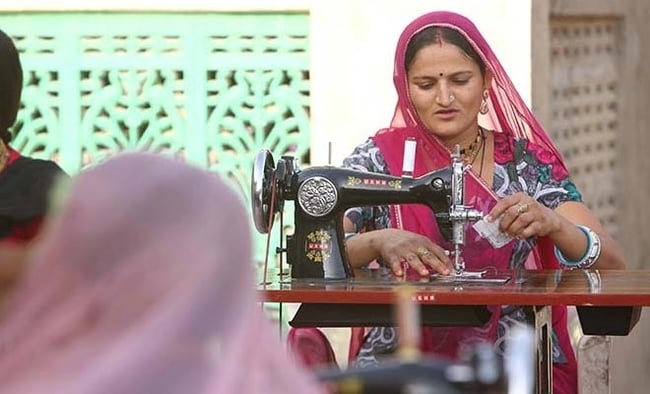
Barmer, Rajasthan: At the tender of age of 15 when most teenagers are brimming with hope, optimism and looking forward to embrace life, Gomi found herself staring at a future that was being imposed on her. Living in a remote village in Barmer district of Rajasthan, Gomi never got to explore life or have the luxury of choice. She was married off and within 12 months into her marriage, Gomi had her first child.
"My husband was addicted to opium. He was always under its influence" said Gomi. "He didn't have a job and I didn't know how to go on living with an addict who had no livelihood."
So at the age of 26, Gomi was a mother of a child and wife of an opium addict. Belonging to the Suthar community which consists of people who engage in animal husbandry, agriculture and carpentry work, she, like most in the village came under the Below Poverty Level category. She knew in order to sustain herself and become the person putting food on the table, she had to find work. It was around this time that an opportunity knocked at her doorstep.
Usha International's initiative of Silai School is a programme that enables underprivileged women to find three earning avenues by teaching them how to repair sewing machines, tailor clothes and train other women to do the same.
According to Mohan Lal, the Programme Coordinator at Usha Silai School, many of the women who attend the residential training have lived their lives within the fortification of their houses and behind their longs veils. Uneducated, these women lack the confidence of stepping out of their house without their male counterparts making it harder to convince them to join the school.
"I learnt a lot from the school and then started helping young girls who didn't know stitching," she said.
Since then, Gomi has also become a member of another self-help group that travels to nearby villages performing street plays to raise awareness about vaccination for children. Being an active member, she has also convinced 10 other women to join them.
"These women have lived their lives covered in veils and have never stepped out of their villages," she said. "They were reluctant at first but I convinced them and took them to Bikarner with me. Now we perform street plays together."
Gomi has become an icon of change in aland where women have led lived hiding their face, lived silently and held no authority. Inspired by her state's Chief Minister Vasundhara Raje, Gomi is constantly trying to encourage as many women as possible to step outside their boundaries and explore the possibility of a better life.
Also Read: In The Land Of Pristine Forest - Kanha, Women Find An Alternative Source Of Livelihood Through Silai Schools
"My husband was addicted to opium. He was always under its influence" said Gomi. "He didn't have a job and I didn't know how to go on living with an addict who had no livelihood."
So at the age of 26, Gomi was a mother of a child and wife of an opium addict. Belonging to the Suthar community which consists of people who engage in animal husbandry, agriculture and carpentry work, she, like most in the village came under the Below Poverty Level category. She knew in order to sustain herself and become the person putting food on the table, she had to find work. It was around this time that an opportunity knocked at her doorstep.
"I thought that since I already knew sewing taking this training would help me hone the skill. It would also help me become financially independent," said Gomi who eventually went on to receive the 7-day training of sewing and embroidery.When I was visiting my mother's home, I was approached by a man from a self-help group. He told me about the Usha Silai School and took me there, said Gomi who was interested in joining the school by then.
Usha International's initiative of Silai School is a programme that enables underprivileged women to find three earning avenues by teaching them how to repair sewing machines, tailor clothes and train other women to do the same.
According to Mohan Lal, the Programme Coordinator at Usha Silai School, many of the women who attend the residential training have lived their lives within the fortification of their houses and behind their longs veils. Uneducated, these women lack the confidence of stepping out of their house without their male counterparts making it harder to convince them to join the school.
On her own initiative, Gomi, underwent the training and got certified to start her own school.Many of the women coming (to the Silai school) have complicated lives. We try to make it easier for them to adjust to the school's surroundings. As the training is intense, we sit with the women in the evenings and sing songs.
"I learnt a lot from the school and then started helping young girls who didn't know stitching," she said.
Charging a very reasonable fee, Gomi has begun teaching plenty of young girls and women and is earning approximately Rs. 7000 a month. She said,I have started a school in my house and the students pay me Rs 50 for a month.
According to her, stitching became the means to fulfill her family's demands, paying her children's tuition fee, and all the time driving home the point within her social circle that the women too can hold jobs. Gomi has used her new source of income to also help her husband fight off his addiction.It's easier (for students) to receive training within the village. They can stitch clothes at home and earn from selling them. As opposed to when they work as daily-wage laborers, they have to travel far and work in the sun all day.
Since then, Gomi has also become a member of another self-help group that travels to nearby villages performing street plays to raise awareness about vaccination for children. Being an active member, she has also convinced 10 other women to join them.
"These women have lived their lives covered in veils and have never stepped out of their villages," she said. "They were reluctant at first but I convinced them and took them to Bikarner with me. Now we perform street plays together."
Gomi has become an icon of change in aland where women have led lived hiding their face, lived silently and held no authority. Inspired by her state's Chief Minister Vasundhara Raje, Gomi is constantly trying to encourage as many women as possible to step outside their boundaries and explore the possibility of a better life.
Also Read: In The Land Of Pristine Forest - Kanha, Women Find An Alternative Source Of Livelihood Through Silai Schools
Published: July 12, 2017 19:20 IST
also read
Solar Is The Best Economic Investment, Says Ecologist Who Has Paid Zero Power Bill For Last Three Years
Written by Aastha Ahuja, Edited by Sonia BhaskarMonthly Power Bill Of Just Rs 130, Here's How A Couple In Kochi Did It
Written by Aastha Ahuja, Edited by Sonia BhaskarHimachal Pradesh's The Kalgidhar Society Saves Rs. 3.4 Crore Per Annum By Harnessing The Power Of Solar
Written by Aastha Ahuja, Edited by Sonia Bhaskar



NDTV in partnership with Luminous has launched an awareness campaign ‘Be A Bijli Donor’ to promote the idea of ‘save power for more power’. The idea is to conserve energy today in order to get more power tomorrow.
We inherently know that saving energy results in low energy bills, but we also need to understand that a unit of energy saved today makes it available for people still living in the dark or facing regular power cuts.
Saving power or conserving energy is about knowing the sources of energy, and areas of wastage and thereby eliminating these through technology and lifestyle changes. For instance, a 100 W (Watt) incandescent (ICL) bulb can be replaced with a 9 W LED bulb offering similar performance in terms of light output, but at far lower consumption of energy.
While a 100 W ICL bulb, used for four hours a day, consumes 146 units of energy per year, a 9 W LED bulb requires only 13.5 units per year. Clearly, switching to LED is a smart choice as it provides the same output while consuming 90 per cent less energy.
The focus of the campaign is to instill the idea of ‘save power for more power’ and in order to do so, the initiative will create awareness about energy efficient products and services, smart ways to reduce power consumption, alternate sources of energy like solar energy and the need to conserve energy. The idea is to address the rising need for energy conservation in India.
As part of the campaign, we will highlight the stories of individuals and organisations who are championing the cause of energy conservation by switching to renewable sources of energy, adopting innovations to reduce energy consumption while enjoying the same output.
The initiative will provide a platform for all stakeholders to share their ideas and work towards the common goal of, ‘Save power for more power’.
Comments