




- Home/
- India Sees 55% Increase In Digital Transactions In A Year; Mobile Banking Jumps 122%
India Sees 55% Increase In Digital Transactions In A Year; Mobile Banking Jumps 122%

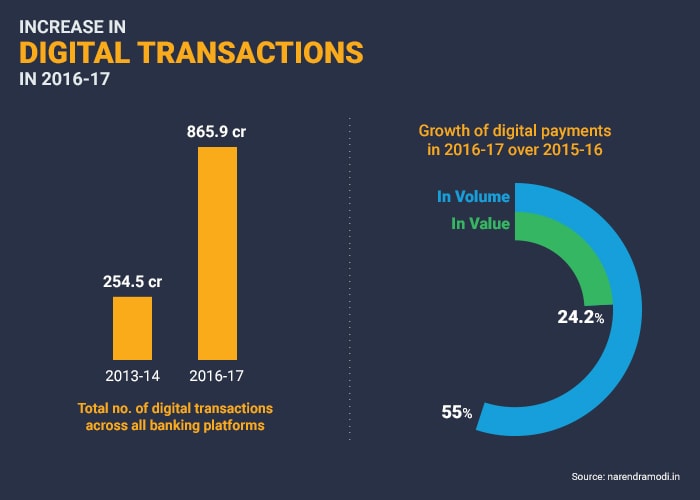
New Delhi: India's shift towards a digital economy where dependency on cash is significantly reduced, is taking gradual, successful steps. As per data released by Prime Minister Narendra Modi on his website, cashless transactions have picked up ever since demonetisation had come to effect and initiatives were being taken by various wings of the government, encouraging people to go cashless. In the financial year of 2016-17, there were a total of 865.9 crore digital transactions across all banking platforms. This is a significant rise from the 2013-14 number of 254.5 crore digital transactions. Within a period of 3 years, the amount of digital transactions has more than tripled. Recently, Niti Aayog principal advisor Ratan Watal shared similar statistics, stating that digital payments grew 55 per cent in volume and 24.2 per cent in value in 2016-17 over 2015-16.

The present Union government has laid stress on the importance of adopting cashless methods of transactions, to ensure that every transaction leaves a trace. Citing how cash is also a potential contributor to amassment of black money, the Union government pulled Rs 500 and Rs 1,000 notes out of circulation in November 2016. Since then, several initiatives have been taken by the government to encourage more people to adopt cashless methods of payment.Though wholesome digitisation of the economy is still a distant dream, the number of people conducting digital transactions throughout the country has definitely increased.
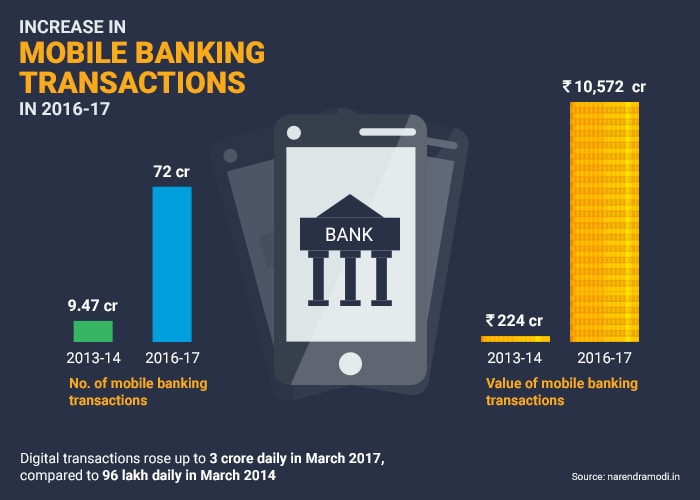
The government has repeatedly stressed on the importance of using mobile banking and has urged people to use their mobile phones for banking purposes. The government maintained that India's 117 crore strong base of mobile phone users can do much better in terms of utilising mobile banking applications. The Bharat Interface for Money (BHIM) app, which enables users to make payments across bank accounts is a significant achievement for the cashless mission, already being downloaded by over 2 crore people. The Prime Minister's website stated that over 72 crore transactions were done using mobile banking in 2016-17, compared to 9.47 crore in 2013-14. The value of mobile banking transactions increased to Rs 10,572 crore from 224 crore in 2013-14. Digital transactions rose up to 3 crore daily in March 2017, compared to 96 lakh daily in March 2014. The increase is huge and shows that mobile banking has caught on very well with people, given how easy it is to conduct transactions using mobile phones and reduces dependency on physical bank visits or cash transfers.
When demonetisation had taken place and India was urged to go cashless, a concern was the availability of internet connectivity, a necessary requirement for cashless transactions. To address this issue, the government worked towards the laying of optical fibre cables for broadband networks and asked the public telecom operators BSNL, as well as private companies such as Reliance and Bharti Airtel to ensure better internet connectivity, especially in rural and semi-urban areas. The total broadband network in 2017 amounts to 2,05,404 kilometres, compared to the merely 358 kilometres in 2013-14 This will ensure that internet connectivity in many parts of the country is much better and helps people in conducting cashless transactions without any hiccups.
The rise in digital transactions can be attributed to the government's various initiatives taken to promote the benefits of digital transactions. From announcing a range of incentives for those who adopt cashless payments, to organizing Digi Dhan melas and Digi Dhan Vyapar Yojanas to bring traders and consumers under the cashless system, the government has promoted the benefits of cashless in a comprehensive manner. It is up to the government now to ensure that the momentum of rise in cashless transactions keeps increasing and the necessary infrastructure required for digitisation of economy is in place. It will be particularly challenging for the government to successfully implement the habit of going cashless in rural areas, which have been traditionally dependent on cash. However, with due infrastructure and policies in place, India's transition to a cashless economy could become a reality with time.
Also Read: Google Awaits RBI's Approval To Launch Its Digital Payment Service In India
The present Union government has laid stress on the importance of adopting cashless methods of transactions, to ensure that every transaction leaves a trace. Citing how cash is also a potential contributor to amassment of black money, the Union government pulled Rs 500 and Rs 1,000 notes out of circulation in November 2016. Since then, several initiatives have been taken by the government to encourage more people to adopt cashless methods of payment.Though wholesome digitisation of the economy is still a distant dream, the number of people conducting digital transactions throughout the country has definitely increased.
The government has repeatedly stressed on the importance of using mobile banking and has urged people to use their mobile phones for banking purposes. The government maintained that India's 117 crore strong base of mobile phone users can do much better in terms of utilising mobile banking applications. The Bharat Interface for Money (BHIM) app, which enables users to make payments across bank accounts is a significant achievement for the cashless mission, already being downloaded by over 2 crore people. The Prime Minister's website stated that over 72 crore transactions were done using mobile banking in 2016-17, compared to 9.47 crore in 2013-14. The value of mobile banking transactions increased to Rs 10,572 crore from 224 crore in 2013-14. Digital transactions rose up to 3 crore daily in March 2017, compared to 96 lakh daily in March 2014. The increase is huge and shows that mobile banking has caught on very well with people, given how easy it is to conduct transactions using mobile phones and reduces dependency on physical bank visits or cash transfers.
When demonetisation had taken place and India was urged to go cashless, a concern was the availability of internet connectivity, a necessary requirement for cashless transactions. To address this issue, the government worked towards the laying of optical fibre cables for broadband networks and asked the public telecom operators BSNL, as well as private companies such as Reliance and Bharti Airtel to ensure better internet connectivity, especially in rural and semi-urban areas. The total broadband network in 2017 amounts to 2,05,404 kilometres, compared to the merely 358 kilometres in 2013-14 This will ensure that internet connectivity in many parts of the country is much better and helps people in conducting cashless transactions without any hiccups.
The rise in digital transactions can be attributed to the government's various initiatives taken to promote the benefits of digital transactions. From announcing a range of incentives for those who adopt cashless payments, to organizing Digi Dhan melas and Digi Dhan Vyapar Yojanas to bring traders and consumers under the cashless system, the government has promoted the benefits of cashless in a comprehensive manner. It is up to the government now to ensure that the momentum of rise in cashless transactions keeps increasing and the necessary infrastructure required for digitisation of economy is in place. It will be particularly challenging for the government to successfully implement the habit of going cashless in rural areas, which have been traditionally dependent on cash. However, with due infrastructure and policies in place, India's transition to a cashless economy could become a reality with time.
Also Read: Google Awaits RBI's Approval To Launch Its Digital Payment Service In India
Published: July 14, 2017 10:58 IST
also read
Solar Is The Best Economic Investment, Says Ecologist Who Has Paid Zero Power Bill For Last Three Years
Written by Aastha Ahuja, Edited by Sonia BhaskarMonthly Power Bill Of Just Rs 130, Here's How A Couple In Kochi Did It
Written by Aastha Ahuja, Edited by Sonia BhaskarHimachal Pradesh's The Kalgidhar Society Saves Rs. 3.4 Crore Per Annum By Harnessing The Power Of Solar
Written by Aastha Ahuja, Edited by Sonia Bhaskar



NDTV in partnership with Luminous has launched an awareness campaign ‘Be A Bijli Donor’ to promote the idea of ‘save power for more power’. The idea is to conserve energy today in order to get more power tomorrow.
We inherently know that saving energy results in low energy bills, but we also need to understand that a unit of energy saved today makes it available for people still living in the dark or facing regular power cuts.
Saving power or conserving energy is about knowing the sources of energy, and areas of wastage and thereby eliminating these through technology and lifestyle changes. For instance, a 100 W (Watt) incandescent (ICL) bulb can be replaced with a 9 W LED bulb offering similar performance in terms of light output, but at far lower consumption of energy.
While a 100 W ICL bulb, used for four hours a day, consumes 146 units of energy per year, a 9 W LED bulb requires only 13.5 units per year. Clearly, switching to LED is a smart choice as it provides the same output while consuming 90 per cent less energy.
The focus of the campaign is to instill the idea of ‘save power for more power’ and in order to do so, the initiative will create awareness about energy efficient products and services, smart ways to reduce power consumption, alternate sources of energy like solar energy and the need to conserve energy. The idea is to address the rising need for energy conservation in India.
As part of the campaign, we will highlight the stories of individuals and organisations who are championing the cause of energy conservation by switching to renewable sources of energy, adopting innovations to reduce energy consumption while enjoying the same output.
The initiative will provide a platform for all stakeholders to share their ideas and work towards the common goal of, ‘Save power for more power’.
Comments