




- Home/
- Know The Tax Implications of Investing in Mutual Funds?
Know The Tax Implications of Investing in Mutual Funds?
| Updated: March 17, 2016 14:23 IST

Highlights
- Shreya, a successful business woman, firmly believes in savings and has invested her money in Fixed Deposits and Mutual Funds. Her understanding is that all the interest earning from Deposits would attract an income tax of 10% in case the interest income is above Rs. 10,000/- p.a. She is unsure of the tax implication on mutual funds.
Shreya, a successful business woman, firmly believes in savings and has invested her money in Fixed Deposits and Mutual Funds. Her understanding is that all the interest earning from Deposits would attract an income tax of 10% in case the interest income is above Rs. 10,000/- p.a. She is unsure of the tax implication on mutual funds.
While filing the income tax returns, the tax consultant mentions that Shreya will have to pay more tax on the interest income earned and on the mutual fund which she had redeemed in the previous year. She wants to understand the tax implications on her investments.
An investor in mutual funds could earn the returns broadly in 2 forms:
Illustration disclaimer: The above example is only for illustration purposes & shall not be construed as indicative yields/returns of any of the Schemes of Canara Robeco Mutual Fund.
Dividends:
The dividends would attract "Dividend Distribution Tax" (DDT), which would be deducted at source by Mutual Funds and then distributed further to the investors. There is no dividend distribution tax applicable on dividends declared by Equity Oriented Mutual Funds. DDT is applicable only on non-equity oriented mutual funds (Debt funds, Gold funds etc).
Dividends received from mutual funds are tax-free in the hands of the investor.
Illustration disclaimer: The above example is only for illustration purposes & shall not be construed as indicative yields/returns of any of the Schemes of Canara Robeco Mutual Fund.
Dividend Distribution Tax (DDT) - Applicable tax rates for the Financial Year 2015-16
Dividends are declared on face value of the mutual fund units i.e. Rs. 10/-. If a mutual fund declares a dividend of 40%, it means an investor would get Rs. 4/- as dividend for every unit he is holding.
The post DDT amount of Rs. 2.85 would be passed on to the investor, which is tax-free in his hands.
Illustration disclaimer: The above example is only for illustration purposes & shall not be construed as indicative yields/returns of any of the Schemes of Canara Robeco Mutual Fund.
Taxation on interest income: The common misunderstanding on treatment of interest income earned from bank deposits is that it is exempted if the interest earned is less than Rs 10,000/-p.a.
But in reality, the interest earned through deposits is fully taxable. It is taxed at marginal tax rate. This means that the interest income will be treated as "income from other sources" and will get added to the total income while computing the tax liability. The investor would end up paying tax based on his income tax slab. So effectively, an investor with an annual income of more than Rs. 10 Lakhs would fall in 30% income tax slab and would end up paying close to 30% tax on the interest income from deposits as well.
Mutual Funds are subject to market risks, read the scheme document carefully.
Disclaimer: All information in this article has been provided by Canara Robeco and NDTV Profit is not responsible for the accuracy and completeness of the same.
While filing the income tax returns, the tax consultant mentions that Shreya will have to pay more tax on the interest income earned and on the mutual fund which she had redeemed in the previous year. She wants to understand the tax implications on her investments.
An investor in mutual funds could earn the returns broadly in 2 forms:
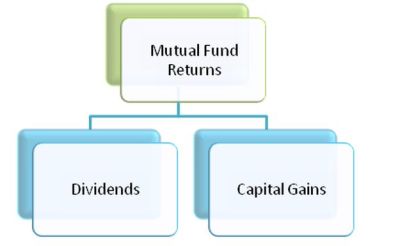
Illustration disclaimer: The above example is only for illustration purposes & shall not be construed as indicative yields/returns of any of the Schemes of Canara Robeco Mutual Fund.
Dividends:
The dividends would attract "Dividend Distribution Tax" (DDT), which would be deducted at source by Mutual Funds and then distributed further to the investors. There is no dividend distribution tax applicable on dividends declared by Equity Oriented Mutual Funds. DDT is applicable only on non-equity oriented mutual funds (Debt funds, Gold funds etc).
Dividends received from mutual funds are tax-free in the hands of the investor.

Illustration disclaimer: The above example is only for illustration purposes & shall not be construed as indicative yields/returns of any of the Schemes of Canara Robeco Mutual Fund.
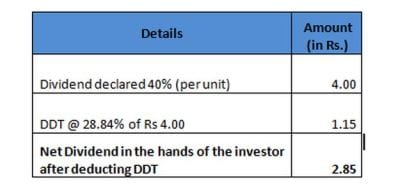
Dividend Distribution Tax (DDT) - Applicable tax rates for the Financial Year 2015-16
Dividends are declared on face value of the mutual fund units i.e. Rs. 10/-. If a mutual fund declares a dividend of 40%, it means an investor would get Rs. 4/- as dividend for every unit he is holding.
The post DDT amount of Rs. 2.85 would be passed on to the investor, which is tax-free in his hands.
Taxation on interest income: The common misunderstanding on treatment of interest income earned from bank deposits is that it is exempted if the interest earned is less than Rs 10,000/-p.a.
But in reality, the interest earned through deposits is fully taxable. It is taxed at marginal tax rate. This means that the interest income will be treated as "income from other sources" and will get added to the total income while computing the tax liability. The investor would end up paying tax based on his income tax slab. So effectively, an investor with an annual income of more than Rs. 10 Lakhs would fall in 30% income tax slab and would end up paying close to 30% tax on the interest income from deposits as well.
Mutual Funds are subject to market risks, read the scheme document carefully.
Disclaimer: All information in this article has been provided by Canara Robeco and NDTV Profit is not responsible for the accuracy and completeness of the same.
Published: February 26, 2016 21:37 IST
also read
Solar Is The Best Economic Investment, Says Ecologist Who Has Paid Zero Power Bill For Last Three Years
Written by Aastha Ahuja, Edited by Sonia BhaskarMonthly Power Bill Of Just Rs 130, Here's How A Couple In Kochi Did It
Written by Aastha Ahuja, Edited by Sonia BhaskarHimachal Pradesh's The Kalgidhar Society Saves Rs. 3.4 Crore Per Annum By Harnessing The Power Of Solar
Written by Aastha Ahuja, Edited by Sonia Bhaskar



NDTV in partnership with Luminous has launched an awareness campaign ‘Be A Bijli Donor’ to promote the idea of ‘save power for more power’. The idea is to conserve energy today in order to get more power tomorrow.
We inherently know that saving energy results in low energy bills, but we also need to understand that a unit of energy saved today makes it available for people still living in the dark or facing regular power cuts.
Saving power or conserving energy is about knowing the sources of energy, and areas of wastage and thereby eliminating these through technology and lifestyle changes. For instance, a 100 W (Watt) incandescent (ICL) bulb can be replaced with a 9 W LED bulb offering similar performance in terms of light output, but at far lower consumption of energy.
While a 100 W ICL bulb, used for four hours a day, consumes 146 units of energy per year, a 9 W LED bulb requires only 13.5 units per year. Clearly, switching to LED is a smart choice as it provides the same output while consuming 90 per cent less energy.
The focus of the campaign is to instill the idea of ‘save power for more power’ and in order to do so, the initiative will create awareness about energy efficient products and services, smart ways to reduce power consumption, alternate sources of energy like solar energy and the need to conserve energy. The idea is to address the rising need for energy conservation in India.
As part of the campaign, we will highlight the stories of individuals and organisations who are championing the cause of energy conservation by switching to renewable sources of energy, adopting innovations to reduce energy consumption while enjoying the same output.
The initiative will provide a platform for all stakeholders to share their ideas and work towards the common goal of, ‘Save power for more power’.
Comments