




- Home/
- Rajasthan's Naya Gav Fought against Odds to Embrace Digital Economy
Rajasthan's Naya Gav Fought against Odds to Embrace Digital Economy
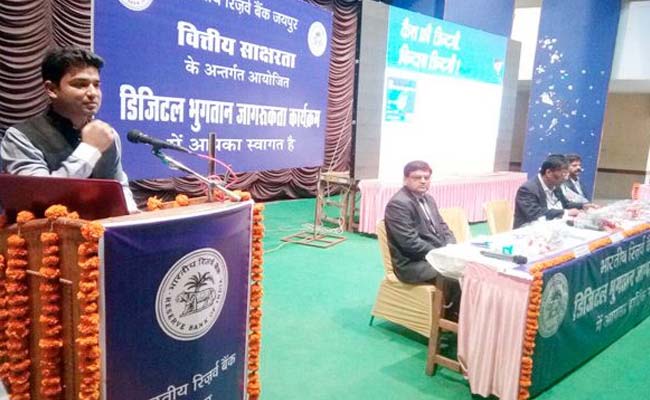
New Delhi : At first sight, there isn't much difference between Naya Gav in Rajasthan and countless other villages in the state. This small village in Ajmer, Rajasthan, has a population of 1,600 people and is characterised by small houses and only 5 shops. But what truly separates Naya Gav from similar villages in Rajasthan and India is its adoption of a cashless economy, scripting a success story earlier unheard of. Naya Gav's achievement has not been without a fair share of problems, but a collaborative effort by the district's schools, administration and banks ensured that the village successfully adopts the cashless model.
Prior to the demonitisation announcement of November 2016, Naya Gav too was dependent on cash based transactions and did not feel the need to switch to a cashless model. The scenario however, changed post the demonitisation announcement. The Union Government's push for a cashless economy and bringing the rural population under a cashless umbrella prompted the district administration of Ajmer to choose Naya Gav as an experimental model for establishment of a functioning cashless village.
"We knew there would be challenges but given that the villagers at Naya Gav had bank accounts and debit cards, it was a sensible choice. All that was needed was properly educating the villagers on how cashless transactions work and why it was a beneficial choice," said Gaurav Goyal, District Collector, Ajmer.
Also Read: Digital Payments: Services That Do Not Need Cash Anymore
The first step towards helping Naya Gav become cashless was to help explain the villagers the concept of a functioning cashless economy. Despite having bank accounts, villagers in Naya Gav were oblivious to the use of debit cards due to the absence of any Point-of-Sale (POS) machines in the shops or ATMs in the vicinity of the village. The district administration resorted to the help of students from two nearby schools to help in educating the villagers on how money is withdrawn using a debit card, how debit cards can be used for purchases and how mobile and internet banking works. The students were aided by officials from the nearby Bank of Baroda branch, who also went from door-to-door to ensure that villagers who did not possess a bank account possessed one, with a functioning debit card. The bank also helped the 5 shops purchase PoS machines so that villagers could conduct cashless transactions during purchase. Over a period of 50 days, the bank officials managed to educate the villagers on conducting cashless transactions.
But the absence of an important component for cashless transactions had the administration in a fix, which was good internet connectivity. Despite the presence of a BSNL tower nearby, frequent power cuts often resulted in the loss of connectivity. The district administration reached out to BSNL for the installation of a better battery that would provide substantial backup.
"Internet connectivity is the most important component of going cashless. Poor internet connectivity hampered the cashless transactions of Naya Gav villagers initially, but as soon as the connectivity improved, villagers began utilising the PoS machines, as well as the nearest ATM at the bank of Baroda branch in Hamara," said Mr. Goyal.
Nearly 50 days after the demonitisation announcement, the district of Ajmer was awarded the Scroll of Honor by the Prime Minister Narendra Modi himself for encouraging cashless transactions in the villages of the district. Naya Gav became a focal point in Ajmer's becoming a cashless district, transforming itself from a cash dependent village to a digital based one. But the district administration maintains that the task is still incomplete as continuous monitoring is needed to ensure that the villagers adhere to the model of digital economy and any grievances related to the same are immediately addressed.
"The issues related to network connectivity are being improved. When we began the journey towards a cashless economy, we knew that we'd face hardships in bringing the villagers under a cashless system. But since December 2016, villagers have also shown interest in adopting the cashless model. We are continuously monitoring all the villages in the district to ensure that the cashless initiative remains functional," said Mr. Goyal.
Published: June 02, 2017 15:10 IST
also read
Solar Is The Best Economic Investment, Says Ecologist Who Has Paid Zero Power Bill For Last Three Years
Written by Aastha Ahuja, Edited by Sonia BhaskarMonthly Power Bill Of Just Rs 130, Here's How A Couple In Kochi Did It
Written by Aastha Ahuja, Edited by Sonia BhaskarHimachal Pradesh's The Kalgidhar Society Saves Rs. 3.4 Crore Per Annum By Harnessing The Power Of Solar
Written by Aastha Ahuja, Edited by Sonia Bhaskar



NDTV in partnership with Luminous has launched an awareness campaign ‘Be A Bijli Donor’ to promote the idea of ‘save power for more power’. The idea is to conserve energy today in order to get more power tomorrow.
We inherently know that saving energy results in low energy bills, but we also need to understand that a unit of energy saved today makes it available for people still living in the dark or facing regular power cuts.
Saving power or conserving energy is about knowing the sources of energy, and areas of wastage and thereby eliminating these through technology and lifestyle changes. For instance, a 100 W (Watt) incandescent (ICL) bulb can be replaced with a 9 W LED bulb offering similar performance in terms of light output, but at far lower consumption of energy.
While a 100 W ICL bulb, used for four hours a day, consumes 146 units of energy per year, a 9 W LED bulb requires only 13.5 units per year. Clearly, switching to LED is a smart choice as it provides the same output while consuming 90 per cent less energy.
The focus of the campaign is to instill the idea of ‘save power for more power’ and in order to do so, the initiative will create awareness about energy efficient products and services, smart ways to reduce power consumption, alternate sources of energy like solar energy and the need to conserve energy. The idea is to address the rising need for energy conservation in India.
As part of the campaign, we will highlight the stories of individuals and organisations who are championing the cause of energy conservation by switching to renewable sources of energy, adopting innovations to reduce energy consumption while enjoying the same output.
The initiative will provide a platform for all stakeholders to share their ideas and work towards the common goal of, ‘Save power for more power’.
Comments