




- Home/
- After She Lost Her Son Kalpana Kamadi Decided To Reinvent Herself
After She Lost Her Son Kalpana Kamadi Decided To Reinvent Herself
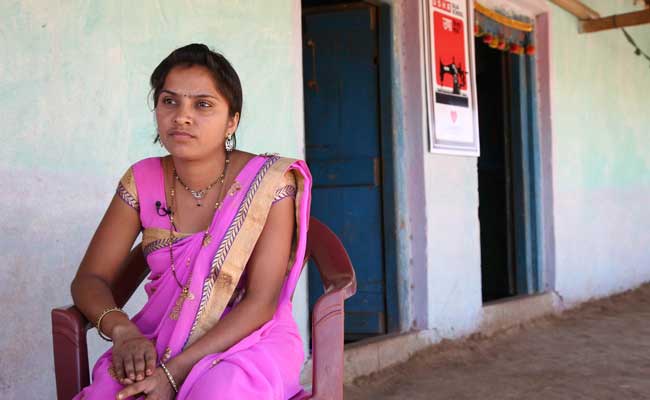
Dhule, Maharashtra: Dhule is currently the sixth poorest district of Maharashtra. Apart from poor Human Development Index, the district also has the highest percentage of girls getting married below the age of 18 years, a big reason for high rate of dropouts from school. Lack of education, limited employment opportunity and poverty is what defines the lives of most inhabitants of this district. Kalpana Kamadi, a resident of this region, has had similar struggles of her own. Sustaining her modest household needs became a daily worry and making ends meet was a constant battle. Poverty struck hard when her son fell ill and had to be hospitalised. Kalpana and her husband could not afford the treatment and failed to foot the medical bills. They soon lost their son.
"We realised the importance of money because at that time (during her son's illness) I was running everywhere but I could not collect enough money to save my son.
After her son's demise, Kalpana and her husband decided to work as labourers. When working as part-time laborers didn't help their financial situation either, she enrolled herself for the USHA Silai School training. A community based initiative, USHA Silai School aims to turn village women into entrepreneurs and teach sewing in their respective communities. The initiative trains over 10,000 women every day across India.
The training not only enabled her to start her own sewing school where she began training more women in her village but it also gave her the opportunity to attain things which she was deprived of earlier.
"Earlier I used to be at home at all times. Even for going to market, I would have to ask for money from my husband and that wouldn't be sufficient either."
Once Kalpana started her own Silai school, she charged Rs. 500 to 600 (approximately) per student and taught them to sew blouses for women. Selling blouses became another source of income for her.
"Till date, I have earned Rs.1.5 lakhs (approximately). Now I also own a car for which I pay the installments from my own earnings."
From being someone who has never had her own bank account, Kalpana today maintains her own savings account. Becoming an entrepreneur, she now feels empowered and takes pride in being financially independent.
"There was a time when no one would respect a woman in my village. We were just supposed to be at home and cook for our families. Now, I have created my own identity and people call me 'madam'," says Kalpana.
Looking back, the only regret Kalpana has is not having had this opportunity earlier.
"Now I wish I had this money when my son was unwell. I could have saved him. I have the money now but nothing can bring him back," laments Kalpana, who hopes more young women get sewing training and have a chance to fight poverty and live a self-sufficient life.
Published: May 26, 2017 20:07 IST
also read
Solar Is The Best Economic Investment, Says Ecologist Who Has Paid Zero Power Bill For Last Three Years
Written by Aastha Ahuja, Edited by Sonia BhaskarMonthly Power Bill Of Just Rs 130, Here's How A Couple In Kochi Did It
Written by Aastha Ahuja, Edited by Sonia BhaskarHimachal Pradesh's The Kalgidhar Society Saves Rs. 3.4 Crore Per Annum By Harnessing The Power Of Solar
Written by Aastha Ahuja, Edited by Sonia Bhaskar



NDTV in partnership with Luminous has launched an awareness campaign ‘Be A Bijli Donor’ to promote the idea of ‘save power for more power’. The idea is to conserve energy today in order to get more power tomorrow.
We inherently know that saving energy results in low energy bills, but we also need to understand that a unit of energy saved today makes it available for people still living in the dark or facing regular power cuts.
Saving power or conserving energy is about knowing the sources of energy, and areas of wastage and thereby eliminating these through technology and lifestyle changes. For instance, a 100 W (Watt) incandescent (ICL) bulb can be replaced with a 9 W LED bulb offering similar performance in terms of light output, but at far lower consumption of energy.
While a 100 W ICL bulb, used for four hours a day, consumes 146 units of energy per year, a 9 W LED bulb requires only 13.5 units per year. Clearly, switching to LED is a smart choice as it provides the same output while consuming 90 per cent less energy.
The focus of the campaign is to instill the idea of ‘save power for more power’ and in order to do so, the initiative will create awareness about energy efficient products and services, smart ways to reduce power consumption, alternate sources of energy like solar energy and the need to conserve energy. The idea is to address the rising need for energy conservation in India.
As part of the campaign, we will highlight the stories of individuals and organisations who are championing the cause of energy conservation by switching to renewable sources of energy, adopting innovations to reduce energy consumption while enjoying the same output.
The initiative will provide a platform for all stakeholders to share their ideas and work towards the common goal of, ‘Save power for more power’.
Comments