




- Home/
- Whats All The Fuss About? Who Needs To Be Convinced That Play Is Good For Children?
Whats All The Fuss About? Who Needs To Be Convinced That Play Is Good For Children?
Written by Deepika Mogilishetty | Updated: June 11, 2025 10:19 IST
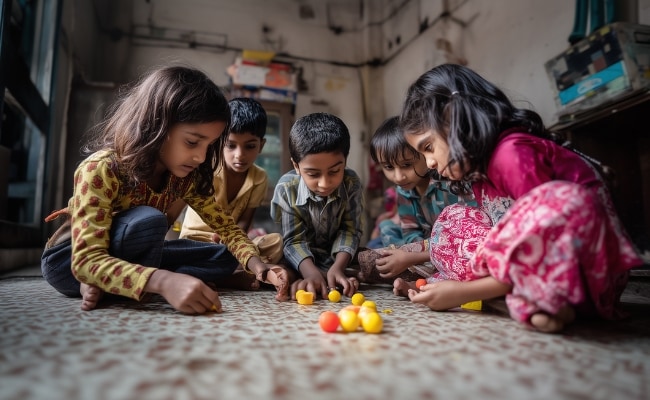
New Delhi: She sat on the ground among her friends, tossing marbles and stones of various colours light pink, brown, grey, blue and green in the air, she trying to catch them all simultaneously, eyes twinkling, and giggles when they then fell on the ground and rolled away. This was Bhoomi, age seven, when asked what message she would give adults about play, she says: ‘You know, I will fall and get hurt when I play. Getting hurt is part of playing. Just because I may get hurt, don't stop me from playing.' Bhoomi shared this at the Voices of Play conference — an event uniquely led by children, reminding us adults of something we've somehow forgotten.
June 11th is International Day of Play. Bhoomi's message is a call to action to every caring adult. In her message, she captured the single most significant barrier to play - the mindset of the caring adult. She also revealed a deep wisdom, which, perhaps, comes from the clarity of childhood - she values play and is fine with what comes with it, taking the risk of getting hurt once in a while.
Back in 1992, India joined almost every country in the world and ratified the UN Convention on the Rights of the Child. Article 31 of which recognises the right of the child to engage in play and recreational activities appropriate to the age of the child.
“Birds fly, fish swim, children play”, said Gary Landreth, a neuroscientist and play therapist. Caught your attention, didn't it? Made you pause, smile and think - ah! That's obvious. If it is this obvious, why is there a need for a special day, the International Day of Play, to be called out over 30 years from the recognition of the right?
In India, the Right to Education was enshrined as a fundamental right, and it embeds the right to play. The courts have spoken on the matter as well. Delhi HC in 2015 and the Kerala High Court in 2023, reiterated the importance of play for children and recognised play as integral to growth, well-being and holistic learning. The courts have alluded that it is a human right of children to receive a congenial, age-appropriate atmosphere that does not violate their dignity. While these cases have been in the context of parks and playgrounds, the fact that we have to go to court to secure the right to play is something to ponder.
OK, so everyone agrees, what's the problem? Is there a problem?
Let's attempt to unpack this for ourselves. The operative word is Play. Simple and basic - Play, Khel, Aata, Vilayad, say it in any language. Not sport, not game, but play. It is important to understand what the right to play is and, therefore, the correlated duty of every caring adult and the State in securing this right.
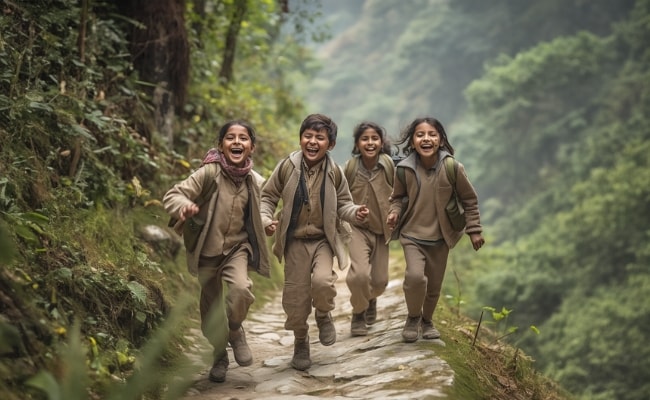
Play is spontaneous, it is imaginative, it is in the story that the child is making up in their heads, the building of something with sticks and stones, the shapes of things they see in the clouds, splashing in puddles, climbing trees and running without a care in the world. It is the time when a child leads the way, is in charge, makes rules and invites you to engage in worlds they create. A game, in contrast, has some structure and some rules, and sport also has rules and is somewhat institutionalised. In the life of a child, there must be space for all of this.
I recently watched children in Bangalore at our Bachpan Manao Sabha describe what a thriving childhood meant to them, while adults did the same task in a different room, unbeknownst to each other. While adults nostalgically talked of their free-range childhoods and barefoot freedom, as at the same time lamented how they do not allow that kind of space to play for their children, and some of them were preschool educators. The children came into the room all smiles and skipping, holding up their drawings, they talked with joy and simplicity about joys of childhood playing, doing things with people they liked, essentially their friends and family, going on field trips from school to explore outside the classroom and a little bit of independence to make choices for themselves.
I could not help reflecting that while we as adults can be nostalgic and know the importance of play, we only ever truly feel its need when we pause and reflect on it's absent. But for children, play was just being.
According to a survey of parents in 10 countries, which included India, 56% of parents felt that their children had fewer opportunities for play than they did when they were younger. Two-thirds of Indian teachers are stressed, anxious and emotionally withdrawn in a study conducted in 2022 by Azim Premji University; the recommendation to combat this was to double down on play. The Indian Academy of Paediatricians remind us through their periodic guidelines that children urgently need unstructured play as much as healthy food or sleep; it is non-negotiable. So, why aren't we listening? What's getting in the way of making play central to learning, growth, well-being and joy? Adults say, ‘We don't have time, there's too competition they need to prepare for the real world, there are no safe spaces.' But children simply say, ‘Just let us play.' They aren't looking for complex solutions, just the freedom we once had ourselves.
For all the barriers we put up in the form of time, space, lack of ideas or motivation, there is one good reason to make space and time for play. It is simply that it's good for you and it's good for our children.
India has a unique opportunity to show the world what it means to make play central to learning and growth at scale. With the idea of a learning continuum in the first 5 years of schooling (3-8 years), we have the opportunity to make it a play continuum. The National Education Policy, 2020, emphasises the importance of play-based learning, and the NCF-FS and Jaadui Pitara bring it to life, Adhardhila and Navchentna are ECC curriculum tha that have emphasised play. Most states in the country have their own frameworks and curricula created to suit their local and regional contexts.
With these frameworks and the tools we have, the opportunity before us today to innovate and create for this unique period of childhood, the first eight years or 3000 days. By making play rooted in the local context for every child, we can create the most aspirational and inclusive growth and learning environments for our youngest, in learning spaces, in communities, in our homes and more than anything else making space for play in our hearts and minds as adults.
This would mean also investing in the growth and well-being, and igniting the playfulness of the caring adult, the anganwadi karyakarta or a pre-school educator, so they become a play and care champion. The anganwadi or pre-school becomes a space for the community to come together in play and celebrate the growth and well-being of every child. What if every child were assessed through play, and they knew they could try again if they did not succeed? What better way to build a growth mindset?
This International Day of Play,June 11 let's each commit to rallying for play and doing one small but powerful act - sing a lullaby, play peek-a-boo, or tell a story with puppets, exchange riddles from a child, or read aloud from a picture book without words, jump in and out of puddles, go for a walk and find leaves of different shapes , chase a ball for the fun of it. Or simply stand up with a sign protecting spaces for play for every child. Take Bhoomi's advice.
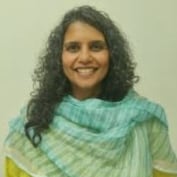
About The Author: Deepika Mogilishetty is the Chief, Policy & Partnerships for EkStep Foundation.
Published: June 11, 2025 08:44 IST
also read
Solar Is The Best Economic Investment, Says Ecologist Who Has Paid Zero Power Bill For Last Three Years
Written by Aastha Ahuja, Edited by Sonia BhaskarMonthly Power Bill Of Just Rs 130, Here's How A Couple In Kochi Did It
Written by Aastha Ahuja, Edited by Sonia BhaskarHimachal Pradesh's The Kalgidhar Society Saves Rs. 3.4 Crore Per Annum By Harnessing The Power Of Solar
Written by Aastha Ahuja, Edited by Sonia Bhaskar



NDTV in partnership with Luminous has launched an awareness campaign ‘Be A Bijli Donor’ to promote the idea of ‘save power for more power’. The idea is to conserve energy today in order to get more power tomorrow.
We inherently know that saving energy results in low energy bills, but we also need to understand that a unit of energy saved today makes it available for people still living in the dark or facing regular power cuts.
Saving power or conserving energy is about knowing the sources of energy, and areas of wastage and thereby eliminating these through technology and lifestyle changes. For instance, a 100 W (Watt) incandescent (ICL) bulb can be replaced with a 9 W LED bulb offering similar performance in terms of light output, but at far lower consumption of energy.
While a 100 W ICL bulb, used for four hours a day, consumes 146 units of energy per year, a 9 W LED bulb requires only 13.5 units per year. Clearly, switching to LED is a smart choice as it provides the same output while consuming 90 per cent less energy.
The focus of the campaign is to instill the idea of ‘save power for more power’ and in order to do so, the initiative will create awareness about energy efficient products and services, smart ways to reduce power consumption, alternate sources of energy like solar energy and the need to conserve energy. The idea is to address the rising need for energy conservation in India.
As part of the campaign, we will highlight the stories of individuals and organisations who are championing the cause of energy conservation by switching to renewable sources of energy, adopting innovations to reduce energy consumption while enjoying the same output.
The initiative will provide a platform for all stakeholders to share their ideas and work towards the common goal of, ‘Save power for more power’.