




- Home/
- Why Invest in Equity and Equity Mutual Funds?
Why Invest in Equity and Equity Mutual Funds?
| Updated: March 17, 2016 14:21 IST

Highlights
- Building wealth through equity requires tremendous patience and discipline. Remember, Rome was not built in a day! One might come across various rags to riches stories in the stock market and stocks giving multi-bagger returns over a period of time. Normally, we tend to get carried away by looking at historical returns and make the decision to invest in the stock.
Equity is one the key asset class which beats inflation hands down in the long run. Performance of Asset Classes over 35 years (Annualized Returns) - Inflation @ 7.57%
 Illustration disclaimer: The above example is only for illustration purposes & shall not be construed as indicative yields/returns of any of the Schemes of Canara Robeco Mutual Fund.
Assumptions and the source of this table given below:
Building wealth through equity requires tremendous patience and discipline. Remember, Rome was not built in a day! One might come across various rags to riches stories in the stock market and stocks giving multi-bagger returns over a period of time. Normally, we tend to get carried away by looking at historical returns and make the decision to invest in the stock. Investing in a single share or pool of few shares can be very risky as it is very difficult to identify the next big success story. To reduce the risk of investing in a single stock, one can look at investing in a portfolio of stocks.
Mutual Funds:
Mutual funds are run by a team of professionals called the Fund management team. Their expertise is to follow the performance of various companies & sectors closely and identify the future performers, so that a basket of stocks can be created.
A farmer in his farm land doesn't grow only one crop. For ex: a coffee estate owner would grow coffee, pepper, silver trees, Oranges, Jack fruit and maintain live stock all at once to diversify his risk from coffee prices.
Mutual funds become a viable alternative to investing in equity directly yet reducing the risk. Mutual Funds generally are made up of a combination of 40 to 60 stocks (the number of stocks in a fund can vary based on the investment objective or the fund management style) in one fund that helps investor diversify the risk.
Diversification could involve investing in multiple stocks across various sectors.
Isn't it better to bet on a team than on a single player? Performance of Large cap and Diversified Equity Funds:Source: Data based on CRISIL - AMFI Mutual Fund performance index
Illustration disclaimer: The above example is only for illustration purposes & shall not be construed as indicative yields/returns of any of the Schemes of Canara Robeco Mutual Fund.
In the long run, mutual funds have beaten inflation hands down and given consistent returns in the long run. Assumptions and Source for the above-mentioned table:
It is assumed that Interest earning from Fixed Deposits are taxed at 20%. The applicable tax rates for capital gains from Gold and Real Estate investment suffers capital gains tax of 20% after considering indexation (Cost of Inflation index/CII 1981-82 - 100 and 2014-15 - 1024).
Source of Fixed Deposit and Gold rates are from www.rbi.org.in and real estate data based on an article published in Live Mint. A rough rate of Gurgaon DLF City land in 1980 costedRs. 2 Lakhs and now the investment is turning to Rs.2 Crore approximately. Based on this data, we have arrived at the returns of real estate investment.
The 35 years tenure is from 1979 to 2014.
The Sensex returns are calculated for the period of 1979 to 2014. In all the given asset classes in the illustration, it is assumed that one time investment of Rs. 100,000/- invested in 1979 and current valuation as on 2014. Source of Sensex returns: BSEIndia.com
Source of gold returns: rbi.org.in
Mutual Funds are subject to market risks, read the scheme document carefully.
Disclaimer: All information in this article has been provided by Canara Robeco and NDTV Profit is not responsible for the accuracy and completeness of the same.
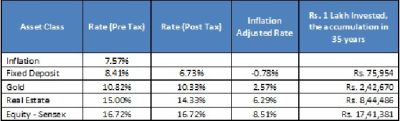
Assumptions and the source of this table given below:
Building wealth through equity requires tremendous patience and discipline. Remember, Rome was not built in a day! One might come across various rags to riches stories in the stock market and stocks giving multi-bagger returns over a period of time. Normally, we tend to get carried away by looking at historical returns and make the decision to invest in the stock. Investing in a single share or pool of few shares can be very risky as it is very difficult to identify the next big success story. To reduce the risk of investing in a single stock, one can look at investing in a portfolio of stocks.
Mutual Funds:
Mutual funds are run by a team of professionals called the Fund management team. Their expertise is to follow the performance of various companies & sectors closely and identify the future performers, so that a basket of stocks can be created.
A farmer in his farm land doesn't grow only one crop. For ex: a coffee estate owner would grow coffee, pepper, silver trees, Oranges, Jack fruit and maintain live stock all at once to diversify his risk from coffee prices.
Mutual funds become a viable alternative to investing in equity directly yet reducing the risk. Mutual Funds generally are made up of a combination of 40 to 60 stocks (the number of stocks in a fund can vary based on the investment objective or the fund management style) in one fund that helps investor diversify the risk.
Diversification could involve investing in multiple stocks across various sectors.
Isn't it better to bet on a team than on a single player? Performance of Large cap and Diversified Equity Funds:
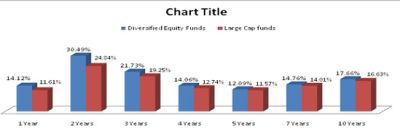
Illustration disclaimer: The above example is only for illustration purposes & shall not be construed as indicative yields/returns of any of the Schemes of Canara Robeco Mutual Fund.
In the long run, mutual funds have beaten inflation hands down and given consistent returns in the long run. Assumptions and Source for the above-mentioned table:
It is assumed that Interest earning from Fixed Deposits are taxed at 20%. The applicable tax rates for capital gains from Gold and Real Estate investment suffers capital gains tax of 20% after considering indexation (Cost of Inflation index/CII 1981-82 - 100 and 2014-15 - 1024).
Source of Fixed Deposit and Gold rates are from www.rbi.org.in and real estate data based on an article published in Live Mint. A rough rate of Gurgaon DLF City land in 1980 costedRs. 2 Lakhs and now the investment is turning to Rs.2 Crore approximately. Based on this data, we have arrived at the returns of real estate investment.
The 35 years tenure is from 1979 to 2014.
The Sensex returns are calculated for the period of 1979 to 2014. In all the given asset classes in the illustration, it is assumed that one time investment of Rs. 100,000/- invested in 1979 and current valuation as on 2014. Source of Sensex returns: BSEIndia.com
Source of gold returns: rbi.org.in
Mutual Funds are subject to market risks, read the scheme document carefully.
Disclaimer: All information in this article has been provided by Canara Robeco and NDTV Profit is not responsible for the accuracy and completeness of the same.
Published: February 29, 2016 12:43 IST
also read
Solar Is The Best Economic Investment, Says Ecologist Who Has Paid Zero Power Bill For Last Three Years
Written by Aastha Ahuja, Edited by Sonia BhaskarMonthly Power Bill Of Just Rs 130, Here's How A Couple In Kochi Did It
Written by Aastha Ahuja, Edited by Sonia BhaskarHimachal Pradesh's The Kalgidhar Society Saves Rs. 3.4 Crore Per Annum By Harnessing The Power Of Solar
Written by Aastha Ahuja, Edited by Sonia Bhaskar



NDTV in partnership with Luminous has launched an awareness campaign ‘Be A Bijli Donor’ to promote the idea of ‘save power for more power’. The idea is to conserve energy today in order to get more power tomorrow.
We inherently know that saving energy results in low energy bills, but we also need to understand that a unit of energy saved today makes it available for people still living in the dark or facing regular power cuts.
Saving power or conserving energy is about knowing the sources of energy, and areas of wastage and thereby eliminating these through technology and lifestyle changes. For instance, a 100 W (Watt) incandescent (ICL) bulb can be replaced with a 9 W LED bulb offering similar performance in terms of light output, but at far lower consumption of energy.
While a 100 W ICL bulb, used for four hours a day, consumes 146 units of energy per year, a 9 W LED bulb requires only 13.5 units per year. Clearly, switching to LED is a smart choice as it provides the same output while consuming 90 per cent less energy.
The focus of the campaign is to instill the idea of ‘save power for more power’ and in order to do so, the initiative will create awareness about energy efficient products and services, smart ways to reduce power consumption, alternate sources of energy like solar energy and the need to conserve energy. The idea is to address the rising need for energy conservation in India.
As part of the campaign, we will highlight the stories of individuals and organisations who are championing the cause of energy conservation by switching to renewable sources of energy, adopting innovations to reduce energy consumption while enjoying the same output.
The initiative will provide a platform for all stakeholders to share their ideas and work towards the common goal of, ‘Save power for more power’.
Comments