

'save our tiger' - 37 News Result(s)
 Reported by Nehal Kidwai, Edited by Chandrashekar Srinivasan | Sunday | July 14, 2019 , Bengaluru
Karnataka minister DK Shivakumar, who last week went to Mumbai to convince rebel lawmakers to return to the fold, expressed confidence today that his party colleagues would return to "save the government"
 Press Trust of India | Wednesday | December 07, 2016 , New Delhi
Over 40 tigers have died in various zoos across the country in 2015-16 while eight wild cats have died in the current financial year, the government has said.
 Agence France-Presse | Friday August 19, 2016
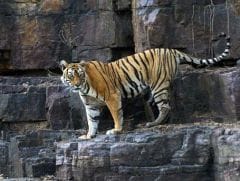
India's most famous tiger, photographed by thousands of tourists over the years at Ranthambore National Park, died on Thursday, days after the ageing animal stopped eating.
 Associated Press | Wednesday May 04, 2016
The world's count of wild tigers roaming forests from Russia to Vietnam has gone up for the first time in more than a century, with 3,890 counted by conservation groups and national governments in the latest global census.
 Blog by Swati Thiyagarajan | Thursday July 30, 2015
On Global Tiger Day, we are celebrating the increase in tiger numbers. We are feeling pleased that India today is home to almost 70% of the worlds tiger population. there are 2226 tigers in India, but these numbers have to compete with other numbers that usually take precedence.
 Blog by Prerna Singh Bindra | Sunday July 26, 2015
Saving the tiger calls for hard choices, clarity in priorities, a commitment both in word and deed. Saving the tiger means we recognise the writ of the tiger in its habitat.
 Govardhan Meena | Monday July 27, 2015
I have dedicated my life towards working for the Ranthambhore Tiger Reserve, it tigers and the people. I think winning the peoples support for the conservation of any forests and its animals is key.
 Blog by Swati Thiyagarajan | Saturday July 25, 2015
In 19 years of reporting on tigers, I have never seen the kind of mass mobilization of people for a tiger like the case of Ustad.
 Bittu Sehgal | Friday July 24, 2015
Tiger mothers can be as gentle when handling their tiny cubs, as they can be fierce in their defence.
 Amitabh Bachchan | Tuesday January 19, 2016
It is green all over, and a gentle breeze is building up from a most humid day. During the winter months the region shall experience zero temperatures and the day shall be pleasant and warm; almost desert like conditions!
 | Wednesday July 29, 2015
World Tiger Day contest is now closed. Here's the winner of - Design A Cover Pic Contest.
 Amitabh Bachchan | Tuesday July 21, 2015
What needs to be paid attention to is that it is being managed and operated by women - 90% of them!!
 Gargi Rawat | Tuesday July 21, 2015
Is tourism disturbing our big cats and should tourism be banned in the core areas of our tiger reserves? Well, that's what some activists say.
 Gargi Rawat | Tuesday July 21, 2015
At present, it is not illegal to manufacture, sell or possess a tiger trap; it is only an actionable offence if someone is found in possession of a trap in a protected area or a forest.
 Gargi Rawat | Tuesday July 21, 2015
India certainly cannot sustain 50,000 tigers anymore but at least we can reach our optimum numbers.
 Amitabh Bachchan | Tuesday July 21, 2015
The entire population of tigers in India is half of the entire population of tigers in the world and the importance of its protection therefore. How saving a tiger saves forests, environment, water and other animals that roam the jungles.
 Gargi Rawat | Tuesday July 21, 2015
India is now home to 70 per cent of the world's tigers, with new data putting their numbers at 2,226. That is a sharp rise of almost 60 per cent from 2006, when the first scientific and independent estimate delivered a shocking statistic of only 1,411 tigers left in India.
 Press Trust of India | Monday July 20, 2015
The government challenged claims by sections of wildlife experts that it had used a flawed methodology for its latest tiger census and instead asserted that their study was a "theoretical iteration" on old data whose precision is "questionable".
 Press Trust of India | Friday | January 23, 2015
The population of tigers has increased from 1411 to 2226 in the last two years
 NDTV Correspondent | Tuesday | July 24, 2012
Supreme Court has today ordered that tourism be banned in core areas of all tiger reserves in the country. It has said this ban should continue till it doesn't pass final orders in the matter filed by Bhopal-based environment protection NGO Prayatna. The NGO is demanding a ban on tourism in 'core areas' of tiger reserves while it can continue in the 'buffer areas' of...
 Amitabh Bachchan | Monday | July 16, 2012
I would like to consider myself as an aware citizen of my country, but I must confess that having spent time with two campaigns on the 'Save Our Tigers' over the last two years with NDTV have demonstrated how little I knew about tigers and their conservation.
- Gargi Rawat | Sunday | July 15, 2012
Gone are the days when India had a teeming tiger population of 50,000. According to the latest census, there are only 1706 tigers left in the country, but the big cats are known to be prolific breeders and every year dozens of cubs are reported from many of our parks.
- Gargi Rawat | Friday | July 20, 2012
Since the tiger is given the highest degree of protection under the law, one would think that the manufacture, sale, and possession of traps designed specifically to maim and kill them would be illegal. But shockingly, they are not.
- Gargi Rawat | Sunday | July 15, 2012
Is tourism disturbing our big cats and should tourism be banned in the core areas of our tiger reserves? Well, that's what some activists say, but there are others who believe that it's time the Indian government change its attitude towards tiger conservation and tiger tourism and that tigers cannot be loved in isolation.