




- Home/
- Top Stories/
- Davos 2025: India’s Scale And Growth Offer Unique Opportunities For Israel, Says Minister Nir Barkat
Davos 2025: India’s Scale And Growth Offer Unique Opportunities For Israel, Says Minister Nir Barkat
| Updated: January 23, 2025 11:21 IST
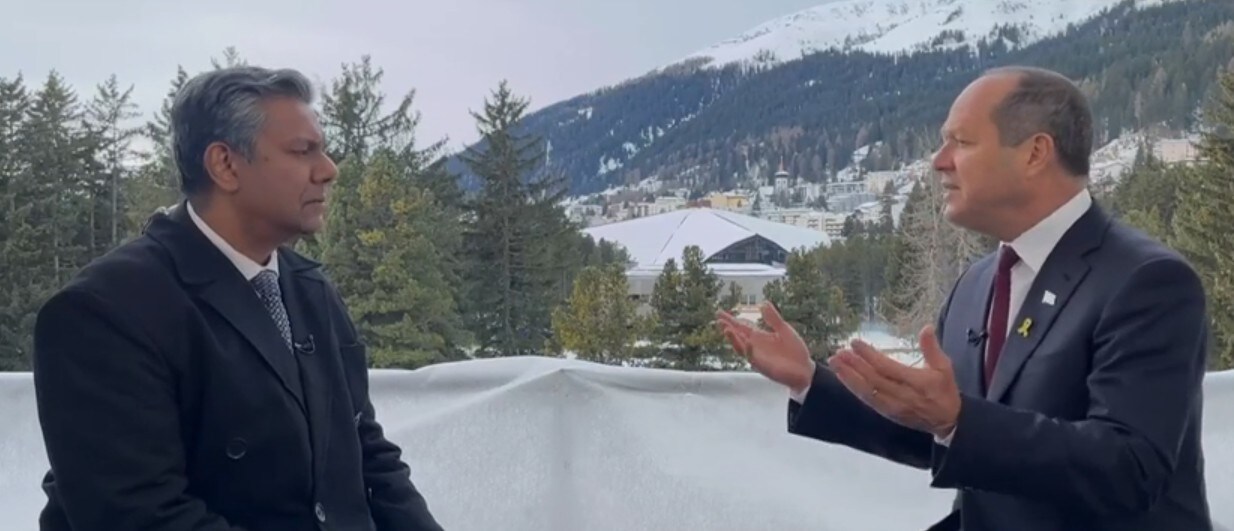
Israeli Finance Minister Nir Barkat announced plans to strengthen India-Israel trade ties at WEF Davos, including a high-powered Israeli trade mission to India on 11 February, hosted by Commerce Minister Piyush Goyal.(Photo source: NDTV/ YouTube)
Geopolitically, with the new US President Trump, the collaboration with India and the US has huge potential, Nir Barkat, Israeli Finance Minister, said.
Barkat emphasised the growing potential of India-Israel relations during a special interaction at the World Economic Forum in Davos. Speaking to NDTV Profit, he expressed optimism about collaboration across various sectors.
Highlighting India's vast market and Israel's technological expertise, Barkat said, "We are really good in technology, and India is really good in scope and size—it's a good match. Both countries are eager to expand collaboration."
"For me, India is the highest priority,” he stated.
Israel's relationship with India remains a bright spot in its foreign policy, as Barkat reiterated the importance of strong bilateral ties. "I need to thank PM Modi because he was the first to call Netanyahu and offer his support to Israel after the Oct. 7 attack. We will never forget that; we are very thankful," he said.
“As big as the crisis we have faced, the opportunities ahead are even greater,” he said.
Business Opportunities
"A few months back, I met my peer Piyush Goyal and other ministers, as there is high interest in increasing the collaboration between India and Israel," Barkat told NDTV Profit.
Barkat announced plans for a high-powered mission of Israeli CEOs, entrepreneurs, and trade officials to India on Feb. 11, hosted by Commerce Minister Piyush Goyal. Another Indian delegation will reciprocate the visit to Israel. "The focus areas include high-tech, health-tech, agro-tech, food-tech, aqua-tech, and security," he said.
"We have to work out a unique model to suit the scope and scale of India. That is why we are coming in February—to iron out the little details," he said, referencing India's 'Make in India' initiative.
"I am very optimistic that we would do a lot of things. Through the corridor, we are open for business; we want to make sure that the Saudis are on board, the Jordanians are on board, and we are planning our part—between the Port of Haifa and Mumbai—we are open for business, and we are eager to make it work," he further said.
On Hamas And Gaza
Barkat discussed shared security challenges and emphasised collaboration in counter-terrorism. "India is also challenged by terrorism. We have to unite against jihadist terrorism," he noted.
He criticised Hamas, describing them as a terrorist organisation committed to destroying Israel. "Their charter is to promote Sharia law and jihad globally. They embed terror infrastructure in homes, schools, and hospitals, using civilians as shields. Israel cannot allow another Oct. 7 to happen," he stated.
"Finally, now there is a deal where we can at least bring a few of them back," he said on the ceasefire and hostage release.
"Unfortunately, no. Hamas is not finished yet," he said. "Their charter and goal is to wipe Israel off the map. They are jihadist, and they want to return to power," he said about Hamas.
"They will not let anyone seek peace with Israel. As long as they are in power," he further said.
Regarding rebuilding Gaza, he insisted on conditions. "Whoever wants to rebuild Gaza must recognise Israel. If they choose peace and prosperity, like building a ‘Dubai,' we will support them. But if it's to prepare for more terror, Israel will not help.”
Broader Geopolitical Concerns
Barkat extended his critique to Hezbollah and Iran, calling Iran the “biggest funder of global terror.” He stressed the need to prevent Iran from acquiring nuclear power. "Therefore, we must take all the precautionary measures and be very proactive to make sure that they never have the nuclear capability," he warned. "If God forbid they do, there are people who would use it," he further said.
He also emphasised the importance of expanding the Abraham Accords to include Saudi Arabia and Indonesia. “It's a charter for the free world to combat terrorism,” he said.
Despite the regional instability, Barkat expressed hope. “We hope for the best but prepare for the worst.
On Syria, Barkat said that unfortunately, the ones that are leading Syria are again jihadist. "Hopefully, they change their mind and seek peace," he said.
"Israel has demonstrated that peace is possible if neighbours seek collaboration. We have had peace with Egypt for 40 years and with Jordan for 25 years," he said.
Israel-Gaza Ceasefire Begins After Hamas Releases Hostage NamesPublished: January 23, 2025 11:21 IST
also read
Vijay To Make History At Davos: First Tamil Nadu Chief Minister To Attend WEF Summit
Author: Altaf HussainSaudi Arabia Postpones Flagship FII Investor Summit To 2027 Amid Escalating Houthi Attacks
Author: Shafat Mir'Blasting Punjabi Music In Davos': Harsh Goenka Rues Our Lack Of Civic Sense Abroad
Author: Altaf Hussain, Edited by: NDTV Business Desk




Comments