


- Home/
- As More Indians Die Of Heart Diseases, A Critical Need For Heart Donations
As More Indians Die Of Heart Diseases, A Critical Need For Heart Donations
Edited by Priyanka Bhattacharya | Updated: February 10, 2017 21:47 IST

Studies show that by 2020, one-third of all deaths in India will be due to cardiovascular diseases.
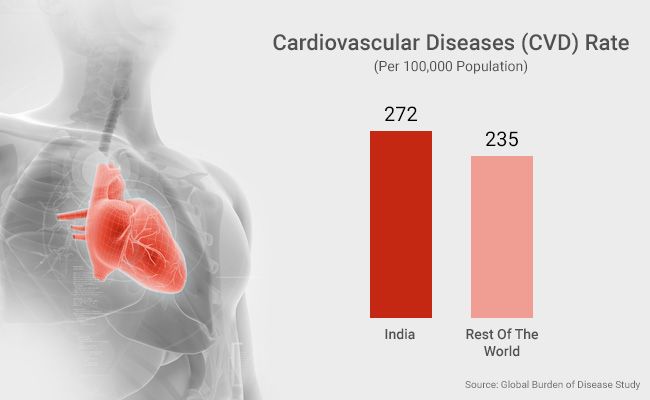
New Delhi: New Delhi: Cardiovascular diseases or CVDs cause the maximum number of deaths each year. According to the Global Burden of Disease Study, an estimated 17.5 million people died of CVDs globally in 2012. That is about 31% of all deaths and the numbers are just rising. While changing lifestyles, increasing stress, deteriorating food habits and smoking are among the biggest causes of CVDs, not all instances of heart disease need to lead to death.

Another often overlooked cause for CVD related deaths is the poor rate of organ donations, specifically, heart donations. In India alone, about 50,000 people with acute heart diseases are added to the heart transplant wait list every year, according to the country's apex organ donation body, NOTTO or the National Organ and Tissue Transplant Organisation.
A heart transplant is recommended to patients with end-stage heart failure or irreparable coronary artery disease. In this procedure, doctors replace the ailing heart with a healthy one harvested from a brain dead patient. However, myths and superstitions related to donation, as well as poor infrastructure have kept our organ transplant rates very low.
Within India too, different states have different attitudes towards organ donation, with the Southern states faring much better than their Northern counterparts.
Mukesh Goel, Senior Consultant, Cardiovascular Surgery at a private hospital told PTI, "In the South, there are well laid-out procedures and government is very active, besides people being aware about organ donation. In Delhi and other parts of north India, the coordination work is quite informal and hence not smooth and efficient, leading to delay."
"India's record when it comes to heart transplant is very dismal. One of the main factors is medical infrastructure and many times brain deaths in ICUs are not notified, thus losing precious time.
"Besides, there are logistical constraints, when the harvested heart doesn't reach in stipulated time through the green corridor," says Balram Airan, Professor of Cardiothoracic and Vascular Surgery at AIIMS, who was part of the history making medical team that performed the country's first heart transplant on August 3, 1994.
"Sometimes the harvested heart fails to reach the recipient in golden time due to lack of agency and traffic coordination. After harvesting, the heart must reach its recipient within 3-4 hours or it dies," adds Rajeev Maikhuri, Senior Organ Transplant Coordinator at AIIMS.
This system of transporting a harvested heart to a patient in record time has been perfected by Tamil Nadu, which has the distinction of being the first state in India to have created a 'Green Corridor.' Not surprisingly, the state is leading the way when it comes to organ donation.
"Tamil Nadu is leading the way with nearly 200 transplants, Delhi about 50-60, Kerala 20, a single transplant in Rajasthan and nothing from Lucknow to Kolkata," said Dr. Goel.
Kewal Krishan, Program Head, Heart Transplant and Ventricular Assist Devices at a private hospital chain in Delhi, added, "While the needle has moved slightly with increase in green corridors, more transplants etc, there continues to be a deeply entrenched stigma associated with organ donation. At present, there are 50-100 transplants happening in India every year. However, these are largely in south India. North India continues to struggle with donors,"
Studies show that by 2020, one-third of all deaths in India will be due to cardiovascular diseases. The most affected demographic will be those between the ages of 25 - 45. It is these dire predictions that make it even more critical for India to better its organ donation rates.
The government has made organ donation a priority by setting up the National Organ and Tissue Transplant Organisation (NOTTO) as the apex body for the coordination, procurement and distribution of organs and tissues.
Union Health Minister J P Nadda has stressed on the need for more trauma centre units and ICU facilities to be linked with hospitals having transplantation facilities as they are both potential retrieval centres.
However, these government initiatives need to be backed by the will of the people. Until more people get aware and come forward to pledge their heart, the demand and supply gap will never be filled, and more lives will continue to be lost to preventable deaths.
Another often overlooked cause for CVD related deaths is the poor rate of organ donations, specifically, heart donations. In India alone, about 50,000 people with acute heart diseases are added to the heart transplant wait list every year, according to the country's apex organ donation body, NOTTO or the National Organ and Tissue Transplant Organisation.
A heart transplant is recommended to patients with end-stage heart failure or irreparable coronary artery disease. In this procedure, doctors replace the ailing heart with a healthy one harvested from a brain dead patient. However, myths and superstitions related to donation, as well as poor infrastructure have kept our organ transplant rates very low.
Within India too, different states have different attitudes towards organ donation, with the Southern states faring much better than their Northern counterparts.
Mukesh Goel, Senior Consultant, Cardiovascular Surgery at a private hospital told PTI, "In the South, there are well laid-out procedures and government is very active, besides people being aware about organ donation. In Delhi and other parts of north India, the coordination work is quite informal and hence not smooth and efficient, leading to delay."
"India's record when it comes to heart transplant is very dismal. One of the main factors is medical infrastructure and many times brain deaths in ICUs are not notified, thus losing precious time.
"Besides, there are logistical constraints, when the harvested heart doesn't reach in stipulated time through the green corridor," says Balram Airan, Professor of Cardiothoracic and Vascular Surgery at AIIMS, who was part of the history making medical team that performed the country's first heart transplant on August 3, 1994.
"Sometimes the harvested heart fails to reach the recipient in golden time due to lack of agency and traffic coordination. After harvesting, the heart must reach its recipient within 3-4 hours or it dies," adds Rajeev Maikhuri, Senior Organ Transplant Coordinator at AIIMS.
This system of transporting a harvested heart to a patient in record time has been perfected by Tamil Nadu, which has the distinction of being the first state in India to have created a 'Green Corridor.' Not surprisingly, the state is leading the way when it comes to organ donation.
"Tamil Nadu is leading the way with nearly 200 transplants, Delhi about 50-60, Kerala 20, a single transplant in Rajasthan and nothing from Lucknow to Kolkata," said Dr. Goel.
Kewal Krishan, Program Head, Heart Transplant and Ventricular Assist Devices at a private hospital chain in Delhi, added, "While the needle has moved slightly with increase in green corridors, more transplants etc, there continues to be a deeply entrenched stigma associated with organ donation. At present, there are 50-100 transplants happening in India every year. However, these are largely in south India. North India continues to struggle with donors,"
Studies show that by 2020, one-third of all deaths in India will be due to cardiovascular diseases. The most affected demographic will be those between the ages of 25 - 45. It is these dire predictions that make it even more critical for India to better its organ donation rates.
The government has made organ donation a priority by setting up the National Organ and Tissue Transplant Organisation (NOTTO) as the apex body for the coordination, procurement and distribution of organs and tissues.
Union Health Minister J P Nadda has stressed on the need for more trauma centre units and ICU facilities to be linked with hospitals having transplantation facilities as they are both potential retrieval centres.
However, these government initiatives need to be backed by the will of the people. Until more people get aware and come forward to pledge their heart, the demand and supply gap will never be filled, and more lives will continue to be lost to preventable deaths.
Published: February 09, 2017 17:05 IST
................................ Advertisement ................................
Comments