

- Home/
- What Cities Owe Their Anganwadis
What Cities Owe Their Anganwadis
Written by Bhawna Jaimini | Updated: July 06, 2026 16:29 IST

New Delhi: 
Meeta, a 29-year-old anganwadi worker in Mumbai's M–East ward, had already spent 45 minutes waiting for a bus in the humid heat when her phone rang. Her landlord was calling to say the ten-by-ten room she rents for her Anganwadi Centre (AWC) in Natwar Parekh Compound wouldn't be available that day — the residents' association needed it back for their own work. In most professions, losing your workplace at the last minute means an unexpected day off. For Meeta, it meant logging into her reporting app as usual, then going door-to-door distributing food packets to every registered child. It took her months to find a space for the AWC; co-renting was the most stable option she found.
"For a few months, I even ran it from a 225-square-foot home with six people living in it. There were new challenges every day."
Around 900 kilometres away in Bhuj, Rashmi, a 37-year-old anganwadi worker with more than a decade of experience, stared at yet another notice to vacate — one month to find a new space. "People don't like renting their rooms for an anganwadi," she explained. "The rent the government gives is much lower than market rates." In ten years, Rashmi has moved six times; each relocation disrupts early childhood care and pushes vulnerable children to drop out entirely.
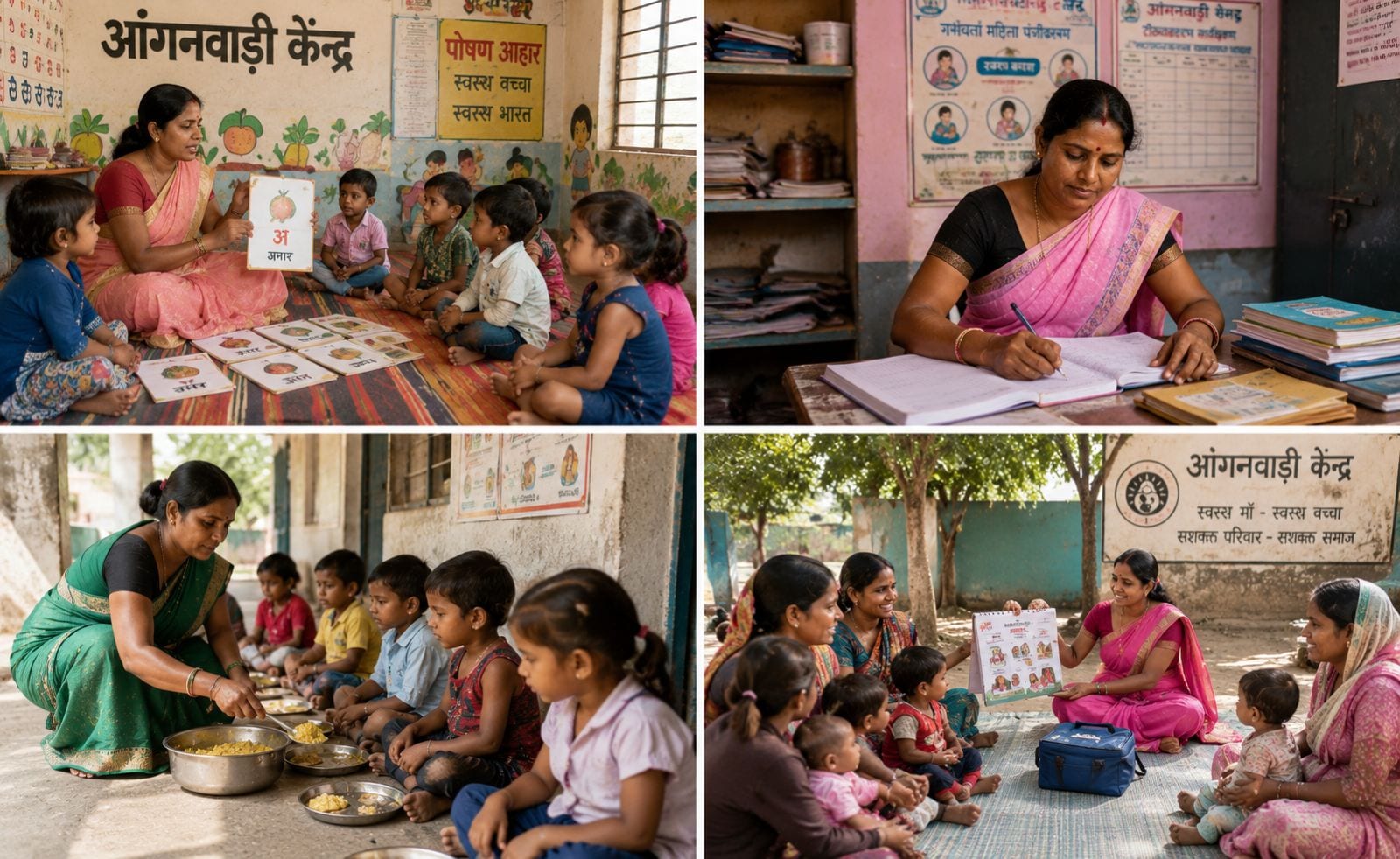
Anganwadis are not crumbling welfare bastions for the poor — they are the foundation of neighbourhood economies, women's mobility, and children's development. Workers like Meeta and Rashmi perform this care for millions across India. AWCs have grown into outposts of community life in both rural and urban areas: crisis centres during the pandemic, immunisation points for children, venues for menstrual health training for adolescent girls. Seeing them as infrastructures of care, not welfare points tucked into borrowed rooms, is the first step to reimagining Indian cities around care.
The Invisible Spaces Of Care
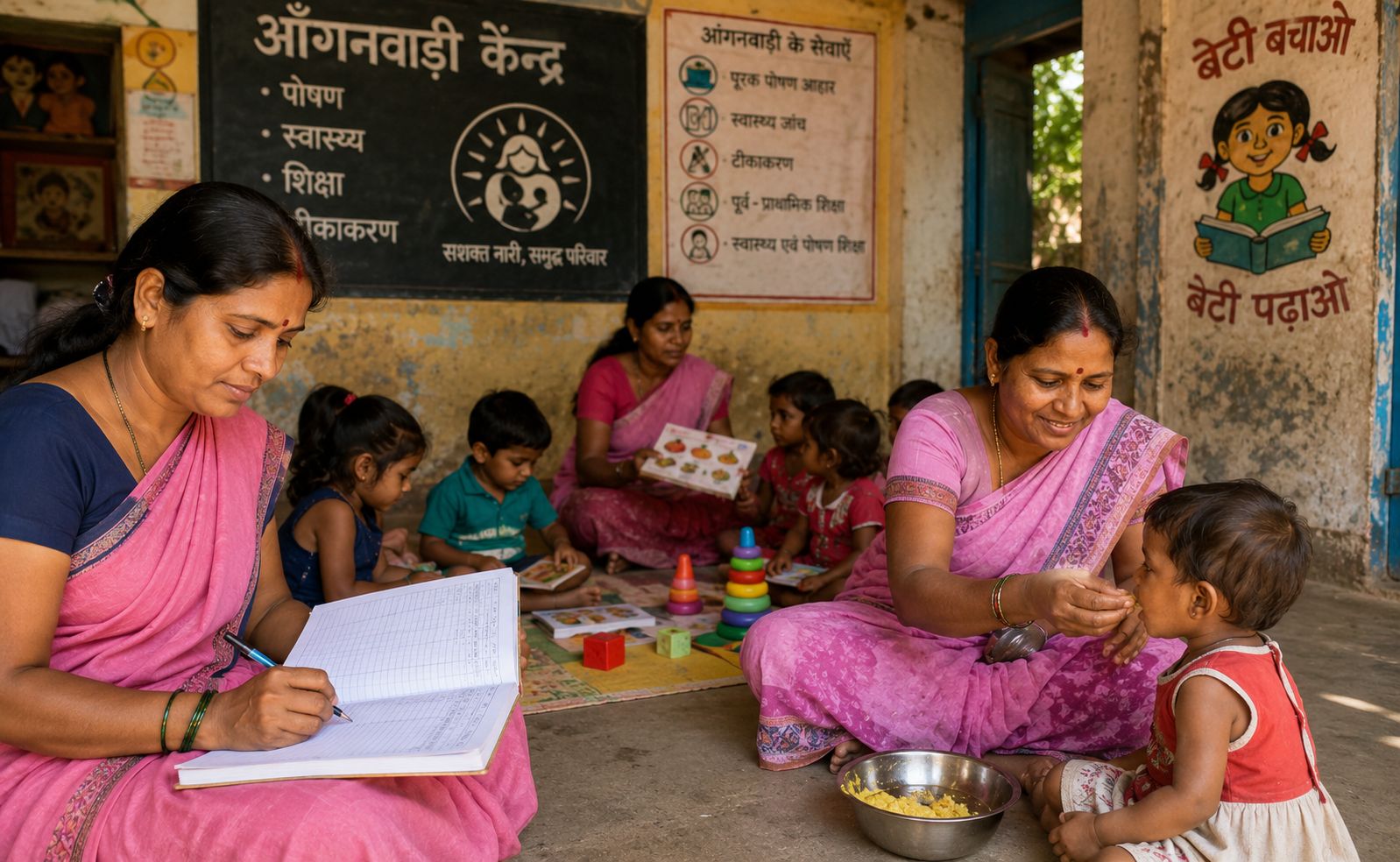
Anganwadis, loosely translated as "courtyard shelters," were set up in 1975 as part of the Integrated Child Development Services (ICDS) scheme to combat child hunger and malnutrition. Today, about 1.3 million AWCs provide services to over 100 million beneficiaries, including children under six, pregnant women and lactating mothers. At this scale, anganwadis form one of the densest, most intimate networks of public infrastructure in the country, woven into the everyday life of low-income communities.
Over the decades, anganwadis have expanded far beyond their initial nutrition mandate. Each AWC is meant to be staffed by an anganwadi worker who provides nutritional support and early childhood services, assisted by an anganwadi helper, an auxiliary nurse midwife who attends to pregnant and breastfeeding women and delivers babies, and an Accredited Social Health Activist (ASHA) who offers first aid, referrals for special needs, and reproductive health counselling. In practice, these roles often collapse onto the anganwadi worker herself. In Mumbai's Natwar Parekh Compound, none of the five AWCs has an ASHA deployed, so workers routinely counsel women on reproductive health themselves; in Bhuj too, workers report stepping into ASHA roles whenever needed.
For low-income mothers, the anganwadi is often the only childcare and nutrition support that makes paid and unpaid work possible. Pallavi, a young mother in Bhuj, was able to take up a receptionist job in a local doctor's clinic only after enrolling her daughter in the neighbourhood anganwadi.
"I drop her off on my way to work and pick her up on my way back," she says. "On days I get delayed, the anganwadi worker waits with her."
Despite this critical role, the spaces where the work happens are systematically neglected. Recent research visits to AWCs in Mumbai and Bhuj found centres squeezed into 8-by-10-foot rooms serving 40 to 50 children, some without toilets or drinking water, others without ventilation or natural light — all on borrowed or rented premises.
Even crammed into rented spaces, the anganwadi remains a multi-dimensional space, shape-shifting to meet the community's needs. Yet our planning paradigm rarely acknowledges care as infrastructure — master plans stay oblivious to the embodied work that supports, nurtures, and repairs communities so they can perform every other socio-economic function.
The derelict state of AWCs is not a result of absolute scarcity but of lack of intent. Cities like Mumbai and Bhuj have no shortage of ambition or funds for mega-projects: coastal roads and harbour links in Mumbai, or the redevelopment of bus and railway stations in Bhuj.
This refusal is rooted in a deeper devaluation of care and of the women who perform it. The ICDS programme is structured on a premise of "volunteerism" that takes women's labour for granted. Anganwadi workers have long been demanding recognition as workers entitled to minimum wages, not the honorarium they currently receive. When their labour is discounted, the spaces in which they work are also treated as informal, flexible, and ultimately expendable.
Ignoring anganwadi workers' infrastructural needs doesn't just fail the children, adolescents, and mothers who depend on them — it compromises the future of cities that are begging to be reimagined. Listening to the city's careworkers is the first step.
Anganwadis As Neighbourhood Care Commons
Feminist political theorist Joan Tronto defines care as everything we do to maintain, continue, and repair our world so we can live in it as well as possible. Reimagining Indian cities with care means dismantling the current idea of anganwadis as rooms allotted in housing schemes. We can start by asking:
- Is there a permanent, accessible, adequately sized building for every AWC, just as there are sites reserved for schools, parks or bus depots?
- Can every household reach a well designed and built anganwadi within a safe 5–10 minute walk, without having to cross highways or navigate hostile streets?
- Are anganwadi workers paid, trained and protected as public professionals, with stable tenures and a say in how their spaces are designed and used?
If cities adopted "universal access to dignified anganwadi infrastructure" as a non-negotiable standard — alongside water supply or road connectivity — care would slowly claim its physical and social space in cities. Well-designed anganwadis aren't just a demand from workers; they're an opportunity to build neighbourhood commons on a network of caregivers, parents and children that already exists. All it takes is converting rented, contested rooms into vibrant spaces that hold learning, play, health, and collective life together.
Rebuilding Cities From Rooms Of Care
Some states have already begun this transformation. In Tamil Nadu and Kerala, anganwadi workers are recognised as state employees with pensions and maternity leave — measures that have made the job more secure, respected, and sought after.
Kerala has also invested in the built form of anganwadis. Under its "Smart Anganwadi" scheme, the state has renovated dozens of centres and, in 2022, completed its first purpose-built smart anganwadi in Thiruvananthapuram, for around forty lakh rupees. The two-storey structure includes a study room, lounge, dining area, kitchen, storeroom, and indoor and outdoor play spaces. Kerala plans dedicated buildings for all 33,000-plus AWCs in the state, including the thousands still running from rented premises.
These aren't extravagant populist experiments. If Indian cities invested in care this way, anganwadis would stop being welfare collection points and become a visible, protected, celebrated grid of neighbourhood commons — each node a place where children learn, grow and play, women find support, and communities gather and organise.
Cars and concrete have become the defining features of Indian cities. Changing that begins with transforming the crowded rooms where early childhood is nurtured and cared for. Our cities would look very different if we made care an organising principle of urban life. All we have to do is rebuild one anganwadi at a time.
About the Author: Bhawna Jaimini is from the Centre for Urban Commons and is associated with Bachpan Manao
Published: July 06, 2026 16:09 IST
