




- Home/
- From Traditional Tribes To Thriving Entrepreneurs, How The Lives Of Women In Assam Changed
From Traditional Tribes To Thriving Entrepreneurs, How The Lives Of Women In Assam Changed
Team NDTV | Updated: December 25, 2023 18:44 IST
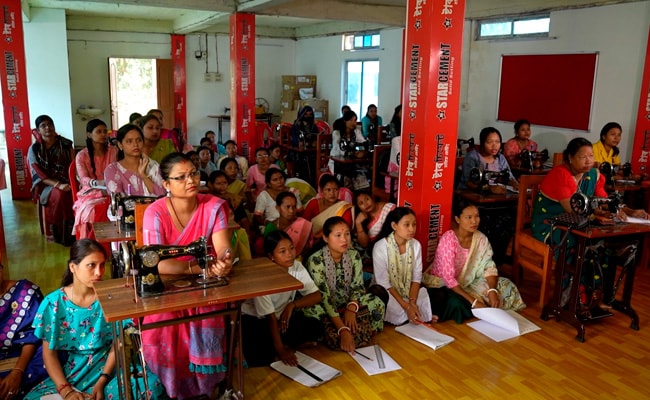
Located just an hour and a half's drive from Assam's Guwahati lies the special tailoring school at Chamata Pathar, near Sonapur, to attain self-dependence. This school is a unique venture of USHA International with Star Cement, a reputed cement manufacturing company from Northeast India that has pioneered and revolutionised the cement manufacturing sector in the region. Private organisations that share Usha's vision for women's empowerment, have demonstrated a commitment to fostering socio-economic change by partnering with Usha. In 2017, the Star Usha Tailoring School in collaboration with Usha International Limited was established with a noble vision: to empower rural women by enhancing their traditional skill sets. Under the umbrella of corporate social responsibility (CSR), Star Cement has acted as a pioneer in generating alternative source of livelihood in its operational areas. The initiative has witnessed remarkable success stories, one such tale being that of Sabita Phangcho.
Also Read: Empowering Women Through Skill And Tradition: The Usha Silai Initiative In Karauli
Hailing from the indigenous Karbi tribe of Assam, the 25-year-old Sabita Phangcho resides in Chamata Pathar village, where the Star Cement factory is located. The tribe carries a rich cultural heritage, and their language is Mikir. Sabita's father is a small-time farmer honed with various cultivation methods, her mother is a homemaker and her brother just opened a small shop in front of their house. Her family's modest background and her father's occupation painted a picture of limited opportunities. However, Sabita's enrollment in the Usha Silai School marked a turning point in her life. After she learned stitching and tailoring at Usha Star Silai School, she not only became the main breadwinner for her family but also a beacon of hope within her community.
Reflecting on her journey, Sabita Phangcho, a Trainee, Usha Silai School, said,
Once I had learnt sewing, the first thing I did was make my clothes. When people saw me wearing the dress I had stitched, they liked it very much and gradually, I startd getting orders.
It all began after Sabita visited Star Usha Silai School and came to know that comprehensive training is being provided at the centre, with Star Cement covering the entire cost of training and raw material, along with providing Usha sewing machines free of cost to the students. Therefore, she joined the course. With her passion for stitching, Sabita expanded her repertoire of sewing techniques and started turning simple material into exquisite garments that soon became the talk of the town. She also found a meaningful way to assist her parents financially by making clothes and selling them, thus contributing to her family income. On average, she earns Rs. 10, 000 per month and it goes up to about Rs. 15,000 during festival seasons.
Also Read: This Silai School Teacher Is Helping Women In Odisha Become Financially Independent
Sadhana Sharma, Assistant Regional Manager, Usha International Limited, elaborated on the collaborative efforts, saying,
We have been working with Star Cement for the last few years, focusing on a ‘training of the trainer' model. Star Cement and Usha have opened three centres including Assam, Meghalaya and West Bengal. We aim to confer 800 certificates in one financial year and the top-performing students will receive complimentary sewing machines from Star Cement.
The objective of Star Cement to start Silai School is to empower women and girls. In three centres, women and girls can learn stitching, and tailoring embroidery free of cost. The further support provided in the form of tailoring machines encourages women and girls to start their businesses. Emphasising on the initiative's success, Sukanya Goswami, Assistant General Manager, Star Cement said,
We did our collaboration in a very successful mode with more than 1,300 women getting an opportunity through this platform. They can learn tailoring, embroidery, cutting, and stitching free of cost. While Usha oversees course curriculum, certification, etc, Star Cement provides all logistical support like place and materials.
The lives of many women have changed after taking training at the Star Cement Silai School, honing their creativity and also helping them generate income and reduce financial stress. For Star Cement, this initiative has been a key area of work in terms of CSR activities, representing a profound commitment to fostering women's empowerment. Pradip Purohit, Chief Operating Officer, Star Cement said,
Coming together with Usha was a big step for us and the women. In our CSR activity, the women are the focus.
Speaking of skill development for women, he said,
Silai School is one thing that goes well with women, and Usha is the best brand for any sewing-related training. They provided us with the technical know-how and the certification. Their expertise and skillsets, combined with our resources help make a big difference in society.
By equipping women like Sabita Phangcho with essential skills and fostering entrepreneurial spirit, this collaboration is not only changing individual lives but also shaping a brighter, more inclusive future for the community at large.
Also Read: 37-Year-Old Anita Bal Is Stitching A Story Of Self-Sufficiency With Usha Silai School
Published: January 04, 2024 18:44 IST
also read
Solar Is The Best Economic Investment, Says Ecologist Who Has Paid Zero Power Bill For Last Three Years
Written by Aastha Ahuja, Edited by Sonia BhaskarMonthly Power Bill Of Just Rs 130, Here's How A Couple In Kochi Did It
Written by Aastha Ahuja, Edited by Sonia BhaskarHimachal Pradesh's The Kalgidhar Society Saves Rs. 3.4 Crore Per Annum By Harnessing The Power Of Solar
Written by Aastha Ahuja, Edited by Sonia Bhaskar



NDTV in partnership with Luminous has launched an awareness campaign ‘Be A Bijli Donor’ to promote the idea of ‘save power for more power’. The idea is to conserve energy today in order to get more power tomorrow.
We inherently know that saving energy results in low energy bills, but we also need to understand that a unit of energy saved today makes it available for people still living in the dark or facing regular power cuts.
Saving power or conserving energy is about knowing the sources of energy, and areas of wastage and thereby eliminating these through technology and lifestyle changes. For instance, a 100 W (Watt) incandescent (ICL) bulb can be replaced with a 9 W LED bulb offering similar performance in terms of light output, but at far lower consumption of energy.
While a 100 W ICL bulb, used for four hours a day, consumes 146 units of energy per year, a 9 W LED bulb requires only 13.5 units per year. Clearly, switching to LED is a smart choice as it provides the same output while consuming 90 per cent less energy.
The focus of the campaign is to instill the idea of ‘save power for more power’ and in order to do so, the initiative will create awareness about energy efficient products and services, smart ways to reduce power consumption, alternate sources of energy like solar energy and the need to conserve energy. The idea is to address the rising need for energy conservation in India.
As part of the campaign, we will highlight the stories of individuals and organisations who are championing the cause of energy conservation by switching to renewable sources of energy, adopting innovations to reduce energy consumption while enjoying the same output.
The initiative will provide a platform for all stakeholders to share their ideas and work towards the common goal of, ‘Save power for more power’.