




- Home/
- From Play To Nature: Neha Dhupia On What Shapes A Child's Early Years
From Play To Nature: Neha Dhupia On What Shapes A Child's Early Years
Written by Team NDTV | Updated: May 04, 2026 14:42 IST
New Delhi:
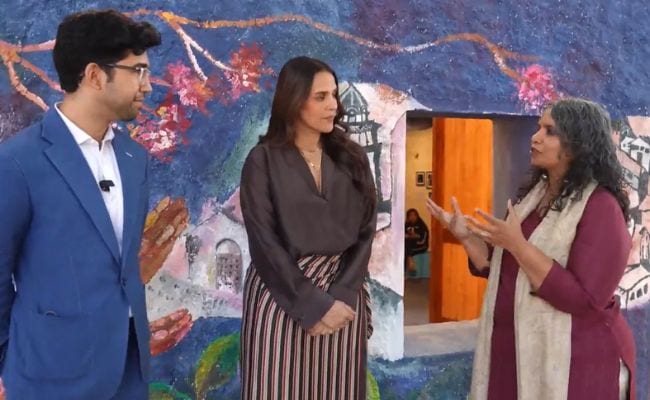
Bachpan is Gr8! These eight key areas nurture every aspect of a child's growth, igniting curiosity, forging strong bonds, and building lifelong health and skills. Actor Neha Dhupia shared one key area she focuses on as a parent among the eight growth areas. “A lot of times when they are doing their free play is when we get to learn so much more from them… sometimes they get more fascinated by a box than a simple toy,” she said. For her, these unstructured moments are where real learning happens. When children are simply allowed to be, she believes there is a “bottomless pit of creativity” that comes alive.
Social Bonding: Warm Relationships, Emotional Security
Another area that Neha strongly believes in is social bonding, saying, “I come from a nuclear family and for me, seeing my daughter and son with their grandparents - that is when they really learn.” She explains that children pick up values, confidence and understanding through these relationships. According to her, it comes down to the ‘A, B, C' of raising children: adaptability, bonding and confidence. She also shared that her children often pick up language from their grandparents, something she considers an ‘important input'. All-Round Skills & Education: Exposure To Language, Numbers, Patterns When it comes to building all-round skills, Neha believes it is not something that happens through structured learning alone but through everyday experiences. “There is learning in play and I also feel there should be play in learning,” she said.
For her, learning shows up in the smallest moments. She recalled how her mother encouraged her to let children be even if it meant dealing with a mess because that is how they truly learn. Over time, these small actions turn into habits, whether it is eating on their own or learning to clean up after themselves. Sharing a personal moment, she spoke about her 4-year-old son learning to tie his shoelaces. “You should have seen his face. He's like a little grown-up man,” she added.
Creativity Helps Build Focus And Innovation
Speaking about creativity, Neha said that children are naturally creative because they don't overanalyse things, they simply explore. “They do not need any lead. They just need materials or tools, and sometimes not even that. They can even get creative with sticks and stones. It is incredible how much our children can do and how creative they can get. I feel everything should be appreciated,” she said. According to her, appreciation plays a key role in nurturing this creativity. She added that if children are not encouraged or appreciated in their early years, it can end up ‘curbing' their creative instincts.
Stories: Reading, Read-Alouds, Storytelling & Conversations
Talking about the role of stories, Neha mentioned how children engage with them in their own unique ways. She shared that while her son can't yet read full sentences, he closely observes and interprets the pictures. “His interpretation of those pictures is really beautiful. Then he has our attention and we are just listening to him,” she added.
Being In Nature Encourages Discovery
Spending time in nature is another area many parents feel unsure about, often due to safety concerns. But Neha says she sees it very differently. “These are the fears that we face,” she said. Recalling her own childhood, she shared, “I grew up in an Army family where our houses had good garden spaces.” Those gardens, she said, often had frogs, lizards and other insects but her parents never made her feel afraid of them. For her, that early exposure made a difference.
Quiet Time: Stillness, Daydreaming, Mindfulness
Talking about the importance of quiet time, Neha said parents often tend to over-structure their children's routines. “I feel like as parents we shouldn't battle it,” she said. According to her, children don't always need a tightly planned timetable or constant activities. Instead, giving them time to pause, daydream and simply be can be just as important.
Published: April 30, 2026 14:11 IST
also read
Solar Is The Best Economic Investment, Says Ecologist Who Has Paid Zero Power Bill For Last Three Years
Written by Aastha Ahuja, Edited by Sonia BhaskarMonthly Power Bill Of Just Rs 130, Here's How A Couple In Kochi Did It
Written by Aastha Ahuja, Edited by Sonia BhaskarHimachal Pradesh's The Kalgidhar Society Saves Rs. 3.4 Crore Per Annum By Harnessing The Power Of Solar
Written by Aastha Ahuja, Edited by Sonia Bhaskar



NDTV in partnership with Luminous has launched an awareness campaign ‘Be A Bijli Donor’ to promote the idea of ‘save power for more power’. The idea is to conserve energy today in order to get more power tomorrow.
We inherently know that saving energy results in low energy bills, but we also need to understand that a unit of energy saved today makes it available for people still living in the dark or facing regular power cuts.
Saving power or conserving energy is about knowing the sources of energy, and areas of wastage and thereby eliminating these through technology and lifestyle changes. For instance, a 100 W (Watt) incandescent (ICL) bulb can be replaced with a 9 W LED bulb offering similar performance in terms of light output, but at far lower consumption of energy.
While a 100 W ICL bulb, used for four hours a day, consumes 146 units of energy per year, a 9 W LED bulb requires only 13.5 units per year. Clearly, switching to LED is a smart choice as it provides the same output while consuming 90 per cent less energy.
The focus of the campaign is to instill the idea of ‘save power for more power’ and in order to do so, the initiative will create awareness about energy efficient products and services, smart ways to reduce power consumption, alternate sources of energy like solar energy and the need to conserve energy. The idea is to address the rising need for energy conservation in India.
As part of the campaign, we will highlight the stories of individuals and organisations who are championing the cause of energy conservation by switching to renewable sources of energy, adopting innovations to reduce energy consumption while enjoying the same output.
The initiative will provide a platform for all stakeholders to share their ideas and work towards the common goal of, ‘Save power for more power’.