




- Home/
- From Waste To Wonder: The Sustainable Revolution Of Golden Feathers
From Waste To Wonder: The Sustainable Revolution Of Golden Feathers
Team NDTV | Updated: February 02, 2026 19:08 IST
New Delhi:
In the bustling landscape of Indian innovation, a remarkable transformation is taking place - one that turns a pungent environmental hazard into the world's lightest natural fiber. Golden Feathers, a Rajasthan-based social enterprise, is redefining the concept of "craft" by upcycling chicken waste into high-end sustainable fabric, while simultaneously pulling thousands of tribal women out of poverty.
The Visionary: Radhesh Agrahari
The story of Golden Feathers is inseparable from its founder, Radhesh Agrahari, a man now affectionately known as the "Chicken Man of the Textile World". Hailing from a traditional nine-member family in Fatehpur, Uttar Pradesh, Agrahari's journey was fueled by grit; he worked part-time jobs to fund his education and nearly a decade of research. His "eureka moment" occurred in 2010 while he was a postgraduate student at the Indian Institute of Craft and Design (IICD) in Jaipur. After returning late from a job in Agra, he found his classmates had already claimed "clean" waste materials like plastic and paper for a design project. Left with no choice, he looked toward food waste.
While at a local butchery, he realized that nearly 35% of a chicken—feathers, claws, and beaks—was discarded as waste. When he first brought a bag of this stinking waste into his classroom, the smell was so overpowering he was kicked out. Undeterred, Agrahari spent the next 13 years refining a process to prove that this "dirty" waste could become a luxury material.
How Golden Feathers Works
The operational model of Golden Feathers is a blend of scientific innovation and traditional handloom expertise. The process involves several key steps:
- Collection and Sanitation: Raw chicken feathers are collected from local slaughterhouses, preventing them from contaminating water bodies.
- Natural Processing: Using Agrahari's patented method, the feathers are cleaned and sanitised without harsh chemicals, ensuring the process remains eco-friendly.
- Spinning and Weaving: The sanitized down is carded and spun into yarn, then woven on traditional handlooms to create a variety of products, from fine fabrics to unique handmade paper.
Impact: Empowering the Tribal Artisans
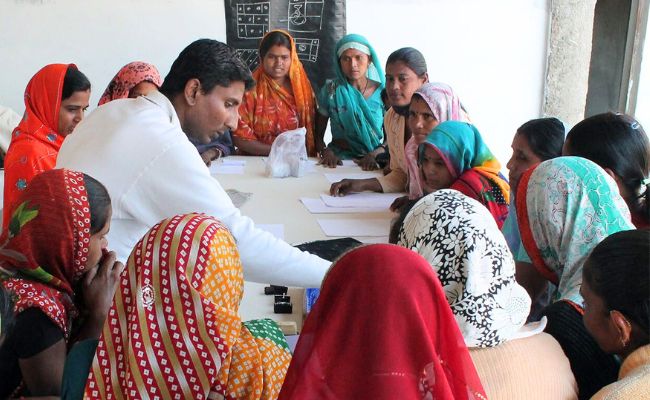
The most profound impact of Golden Feathers is social. To scale his vision, Agrahari sought a workforce capable of handling the material. However, he faced a steep challenge: in many Indian communities, touching chicken feathers was a social taboo. This led him deep into the tribal belts of Rajasthan—regions like Banswara, Baran, and Jhalawar—where poultry was already a part of daily life. Here, he met women who were earning as little as ₹80 a day through grueling labor like collecting tendu leaves. Golden Feathers offered them a new path: a dignified, home-based income. By training these women as skilled artisans, the program has revolutionized their economic status:
- Increased Earnings: Many women now earn between ₹200 and ₹400 daily, with some top artisans reaching monthly incomes of ₹10,000 to ₹12,000.
- Independence: Working from home allows these women to set their own hours, providing them with newfound independence and the ability to support their children's education.
- Environmental Stewardship: By upcycling thousands of kilograms of hazardous waste each month, the company prevents the spread of disease and contamination in their local environments.
Weaving a Future Golden Feathers is more than just a textile company; it is a 'quiet revolution' that addresses the dual crises of environmental waste and social inequality. With a vision to connect 20,000 women over the next five years through a "Paper Village" model, Agrahari and his team are proving that with imagination and empathy, even the most overlooked waste can be woven into a future of dignity and self-reliance.
Published: February 02, 2026 19:05 IST
also read
Solar Is The Best Economic Investment, Says Ecologist Who Has Paid Zero Power Bill For Last Three Years
Written by Aastha Ahuja, Edited by Sonia BhaskarMonthly Power Bill Of Just Rs 130, Here's How A Couple In Kochi Did It
Written by Aastha Ahuja, Edited by Sonia BhaskarHimachal Pradesh's The Kalgidhar Society Saves Rs. 3.4 Crore Per Annum By Harnessing The Power Of Solar
Written by Aastha Ahuja, Edited by Sonia Bhaskar



NDTV in partnership with Luminous has launched an awareness campaign ‘Be A Bijli Donor’ to promote the idea of ‘save power for more power’. The idea is to conserve energy today in order to get more power tomorrow.
We inherently know that saving energy results in low energy bills, but we also need to understand that a unit of energy saved today makes it available for people still living in the dark or facing regular power cuts.
Saving power or conserving energy is about knowing the sources of energy, and areas of wastage and thereby eliminating these through technology and lifestyle changes. For instance, a 100 W (Watt) incandescent (ICL) bulb can be replaced with a 9 W LED bulb offering similar performance in terms of light output, but at far lower consumption of energy.
While a 100 W ICL bulb, used for four hours a day, consumes 146 units of energy per year, a 9 W LED bulb requires only 13.5 units per year. Clearly, switching to LED is a smart choice as it provides the same output while consuming 90 per cent less energy.
The focus of the campaign is to instill the idea of ‘save power for more power’ and in order to do so, the initiative will create awareness about energy efficient products and services, smart ways to reduce power consumption, alternate sources of energy like solar energy and the need to conserve energy. The idea is to address the rising need for energy conservation in India.
As part of the campaign, we will highlight the stories of individuals and organisations who are championing the cause of energy conservation by switching to renewable sources of energy, adopting innovations to reduce energy consumption while enjoying the same output.
The initiative will provide a platform for all stakeholders to share their ideas and work towards the common goal of, ‘Save power for more power’.