




- Home/
- Frontier Needles Of Resilience: Usha Silai School Empowers Border Women
Frontier Needles Of Resilience: Usha Silai School Empowers Border Women
Team NDTV | Updated: February 12, 2026 12:42 IST
New Delhi:
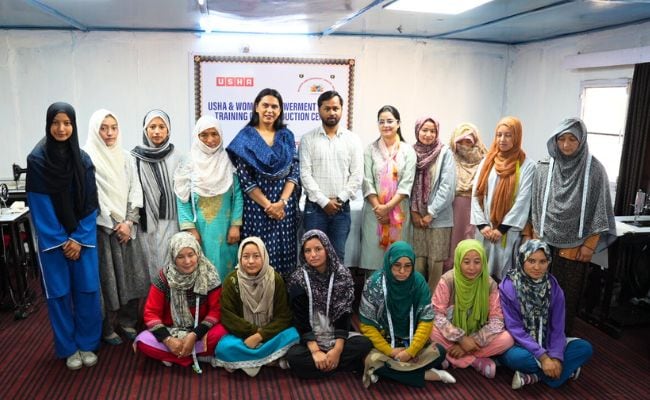
Thin mountain air bites at Turtuk's Karakoram edges, where Shakila Bano's fingers, once idle in tribal hardship, now guide Usha machines with precision. In 2018, Samaarambh Foundation, backed by NHPC and Usha International, launched a 7-day intensive for 30 Balti women—frocks, laptop bags, pillow covers emerging from frosty looms. "Never dreamed of this," Shakila beams, "Usha, Samaarambh, NHPC taught suits, covers—Inshallah, girls toil ahead."[script] Myank Khantwal notes their diligence, untapped sans resources; Uttam Lal hails skilling as family-core empowerment. These Training Cum Production Centres (TCPCs) sustain beyond training: women earn regularly, inspiring kin in Line of Control shadows. Sakina Bano envisions home suits, mentoring peers—self-reliance blooming where opportunities starved.
From resource voids to economic hubs, Usha's model fortifies remote sentinels, blending craft with community sinew.
Kargil's Empowerment Citadel
Snow-veiled Khumbathang in Kargil pulses differently since 2002's Women Empowerment Centre (WEC) under 8 Mountain Division. Chairperson Shikha Krishnan recalls: resilient Ladakhi women craved platforms beyond basic frocks. Partnering Usha, 15 completed 25-day professional tailoring—precision stitches forging not just garments, but purpose. "They travelled far daily," she says, "unsatisfied sans earnings; Usha's brand elevated them." WEC expands: beautician modules, soap-making, oils—home-viable sidelines to tailoring.
Women from villages bond, sharing resilience amid harsh weathers, birthing leadership. "Train professionally," Krishnan urges, "they'll become pros." Impact ripples: home earnings dignify families, preserve crafts, seed more schools. In border bastions, needles knit security—stronger homes, steadfast outposts.
Border Bamboo Symphony
Assam's Dakhinkuchi, hugging Bhutan, hums at the 14th Indo-Bhutan Friendship Fair—fabrics flowing sans protocols. Grameen Vikas Manch's TCPC, HDFC-funded under HRDP, births Birgwshri Fashion and Home Accessories Unit: 12 women master residential training—sewing, cutting, Bodo Aronnai-infused designs for bags, utilities. Jeevan Bhattaray lauds the fair's unity amid diverse communities. Sunita Baro, once tethered to cattle and silkworm whims, now blends Dokhona heritage with modern flair. "Struggles in bordering life eased," she shares, Fair visibility catapulting local produce cross-border. From hesitation to collective decisions—sourcing, marketing, quality—they're entrepreneurs, not laborers. TCPC symbolizes rhythm in bamboo groves: stability where wage whims ruled.
Threads Binding the Nation
Kushalta Ke Kadam chronicles these border bonds: Usha's 2018 Ladakh thrust with Samaarambh-NHPC; Army's 2002 WEC evolution; Assam's fair-fueled collectives. Shakila's joy, Shikha's vision, Sunita's leap echo Uttam Lal: skilled women transform families, regions. TCPCs ensure continuity—production hubs yielding steady incomes, expansions eyed. In unforgiving terrains—scarce resources, isolation—these alliances prove development defends as fiercely as borders. Women, once overlooked, now lead: mentoring, earning, preserving culture amid strategy. From Turtuk's tribes to Kargil's kin, Dakhinkuchi's dreamers, Usha forges belonging. As Krishnan vows, "Vision: trained professionals." Sunita adds cross-border commerce. High altitudes to forested fringes, machines silent at dusk hum promises: empowerment reaches outposts, fortifying India from within. One stitch safeguards sovereignty—self-reliant women, unbreakable frontiers.
Published: February 12, 2026 12:34 IST
also read
Solar Is The Best Economic Investment, Says Ecologist Who Has Paid Zero Power Bill For Last Three Years
Written by Aastha Ahuja, Edited by Sonia BhaskarMonthly Power Bill Of Just Rs 130, Here's How A Couple In Kochi Did It
Written by Aastha Ahuja, Edited by Sonia BhaskarHimachal Pradesh's The Kalgidhar Society Saves Rs. 3.4 Crore Per Annum By Harnessing The Power Of Solar
Written by Aastha Ahuja, Edited by Sonia Bhaskar



NDTV in partnership with Luminous has launched an awareness campaign ‘Be A Bijli Donor’ to promote the idea of ‘save power for more power’. The idea is to conserve energy today in order to get more power tomorrow.
We inherently know that saving energy results in low energy bills, but we also need to understand that a unit of energy saved today makes it available for people still living in the dark or facing regular power cuts.
Saving power or conserving energy is about knowing the sources of energy, and areas of wastage and thereby eliminating these through technology and lifestyle changes. For instance, a 100 W (Watt) incandescent (ICL) bulb can be replaced with a 9 W LED bulb offering similar performance in terms of light output, but at far lower consumption of energy.
While a 100 W ICL bulb, used for four hours a day, consumes 146 units of energy per year, a 9 W LED bulb requires only 13.5 units per year. Clearly, switching to LED is a smart choice as it provides the same output while consuming 90 per cent less energy.
The focus of the campaign is to instill the idea of ‘save power for more power’ and in order to do so, the initiative will create awareness about energy efficient products and services, smart ways to reduce power consumption, alternate sources of energy like solar energy and the need to conserve energy. The idea is to address the rising need for energy conservation in India.
As part of the campaign, we will highlight the stories of individuals and organisations who are championing the cause of energy conservation by switching to renewable sources of energy, adopting innovations to reduce energy consumption while enjoying the same output.
The initiative will provide a platform for all stakeholders to share their ideas and work towards the common goal of, ‘Save power for more power’.