




- Home/
- In Nilgiris, Usha Silai School Is Preserving Heritage And Empowering Women Through Toda Embroidery
In Nilgiris, Usha Silai School Is Preserving Heritage And Empowering Women Through Toda Embroidery
Team NDTV | Updated: November 30, 2023 11:07 IST
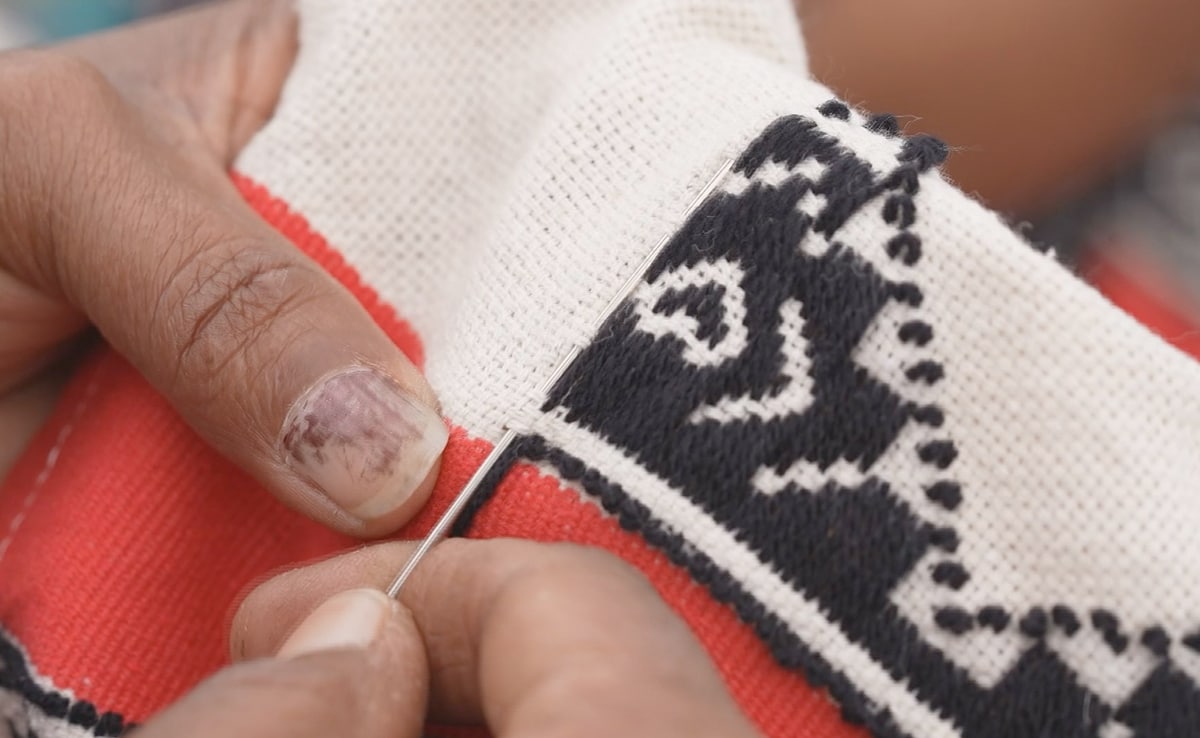
From Khneng embroidery in Meghalaya to Warli Art in Dadra and Nagar Haveli, the USHA Silai School programme isn't just upskilling women by teaching them how to stitch and sew, it is also incorporating local art and heritage into the sewing programme to keep alive old traditions that were in danger of dying out. One such art form is Toda embroidery.
The women of the Toda tribe practice an ancient form of embroidery which is deeply intertwined with their culture and heritage. This embroidery reflects their unique way of life, beliefs, and artistic expression. Toda embroidery is renowned for its exquisite beauty and intricate patterns.
Also Read: Reviving Meghalaya's Khneng Embroidery And Empowering Women, One Stitch At A Time
There are 12 Toda families in the small village of Mullimund in Ooty district. One of them is Kavitha's family. The Toda community is a pastoral community and their specific style of embroidery has been practised for around 3,500 years. It acquired the Geographical Indication (GI) tag in 2013. The embroidery is an essential part of Toda culture, passed down through generations, symbolising the tribe's social and cultural identity.
Kavitha shared that she learned Toda embroidery from our parents.
They taught us how to practise this art form. We used to practise this embroidery daily.
Toda embroidery involves a meticulous and time-consuming technique. With a plain fabric as the base, designs are created using a process known as stitching or binding. The patterns are primarily geometrical and linear, with rhombuses, squares, and rectangles being common shapes. The embroidery is characterised by its use of a distinctive stitch, known as the 'blanket stitch' which creates a raised effect and gives the designs a three-dimensional appearance.
It was in October 2012 that Usha International, in collaboration with Keystone Foundation, conducted a seven-day residential training, which Kavitha was a part of. The training helped Kavitha improve her sewing skills, and she got a machine and a certificate once she completed the programme. A decade later, Kavitha is now not only making products but is also helping women from the community earn a livelihood.
Also Read: With Usha Silai School's Support, Women From The Northeast Make It To The East India Fashion Week
Vinod Kumar, Coordinator, Keystone Foundation said,
Since 2012, we have been working with Usha to provide training to the Toda tribes in the Nilgiris district. 500 out of 1,500 members of this tribe are practising Toda embroidery.
Sharing the result of her training, Kavitha said,
After I was trained at the Usha Silai School, I trained nearly 10 women. Now they are practising Toda embroidery and other stitching work. Currently, around 20 women are practising Toda embroidery in our village.
The motifs and designs in Toda embroidery are inspired by nature, daily life, and the Toda tribe's beliefs and rituals. The designs often depict scenes from the tribe's environment, such as animals, flowers, hills, and their pastoral life. Additionally, sacred symbols, representing their religious beliefs and ceremonies, are prevalent in Toda embroidery. Each motif carries a unique meaning, making this craft a form of storytelling and cultural preservation for the Toda community.
Kavitha added,
We never copy the patterns and designs of others. All the designs are created by us, from our imagination.
Through the Usha Silai School, tribal women gain the necessary skills to create marketable products. They can monetise their Toda embroidery skills by making garments, accessories, and home decor items, giving themselves a sustainable source of income and economic independence. Learning these skills boosts the confidence and self-esteem of tribal women, making them self-reliant and financially capable. By becoming skilled artisans, they break traditional gender norms and take control of their lives and futures.
Sharing the workflow, from buying raw materials to selling the final product, Kavitha said,
We buy the cloth and other raw materials for the embroidery from a dedicated shop in Ooty. And we buy other materials like needles and threads from other shops. We make purses and cell phone covers, pouches, masks and coats. We sell these items in Ooty at a shop given to us by the government.
Vadivelan Perumal, Regional Manager - South, Usha Silai Schools said,
In the entire southern region we have around 7,000 Usha Silai Schools. In Tamil Nadu, we have 1,566 Usha Silai Schools. In the Nilgiris, we have trained 94 women, who belong to different tribal groups.
The Usha Silai School initiative is playing a vital role in empowering tribal women across India. By integrating traditional skills into the curriculum, Usha Silai Schools are not only preserving the rich cultural heritage of the country but are also providing economic opportunities and empowering women to improve their lives and the lives of their communities.
Also Read: USHA And Northern Railways Join Hands To Make Jaipur Women Financially Independent
Published: December 01, 2023 11:07 IST
also read
Solar Is The Best Economic Investment, Says Ecologist Who Has Paid Zero Power Bill For Last Three Years
Written by Aastha Ahuja, Edited by Sonia BhaskarMonthly Power Bill Of Just Rs 130, Here's How A Couple In Kochi Did It
Written by Aastha Ahuja, Edited by Sonia BhaskarHimachal Pradesh's The Kalgidhar Society Saves Rs. 3.4 Crore Per Annum By Harnessing The Power Of Solar
Written by Aastha Ahuja, Edited by Sonia Bhaskar



NDTV in partnership with Luminous has launched an awareness campaign ‘Be A Bijli Donor’ to promote the idea of ‘save power for more power’. The idea is to conserve energy today in order to get more power tomorrow.
We inherently know that saving energy results in low energy bills, but we also need to understand that a unit of energy saved today makes it available for people still living in the dark or facing regular power cuts.
Saving power or conserving energy is about knowing the sources of energy, and areas of wastage and thereby eliminating these through technology and lifestyle changes. For instance, a 100 W (Watt) incandescent (ICL) bulb can be replaced with a 9 W LED bulb offering similar performance in terms of light output, but at far lower consumption of energy.
While a 100 W ICL bulb, used for four hours a day, consumes 146 units of energy per year, a 9 W LED bulb requires only 13.5 units per year. Clearly, switching to LED is a smart choice as it provides the same output while consuming 90 per cent less energy.
The focus of the campaign is to instill the idea of ‘save power for more power’ and in order to do so, the initiative will create awareness about energy efficient products and services, smart ways to reduce power consumption, alternate sources of energy like solar energy and the need to conserve energy. The idea is to address the rising need for energy conservation in India.
As part of the campaign, we will highlight the stories of individuals and organisations who are championing the cause of energy conservation by switching to renewable sources of energy, adopting innovations to reduce energy consumption while enjoying the same output.
The initiative will provide a platform for all stakeholders to share their ideas and work towards the common goal of, ‘Save power for more power’.