




- Home/
- Meet Vilas, A Dabbawala Ensuring Access To Clothes For The Underprivileged
Meet Vilas, A Dabbawala Ensuring Access To Clothes For The Underprivileged
Team NDTV | Updated: June 02, 2023 10:27 IST
The focus on fast, disposable fashion has created a culture of consumerism, and a pressure to constantly buy new clothes. Repeating outfits is a strict no. Clothes are purchased cheaply and worn for a short period before being discarded. Sometimes, they are thrown away without even being worn. In a fast-paced world of rapidly evolving trends, recycling is often not the first choice when wardrobes are being cleared out. And at other times, sentiments kick in. People's emotional attachment to their old clothes also makes it difficult to part with them till they are literally falling apart. But, there are people who are trying to stop our old clothes from ending up in landfills, polluting our land and water, and air.
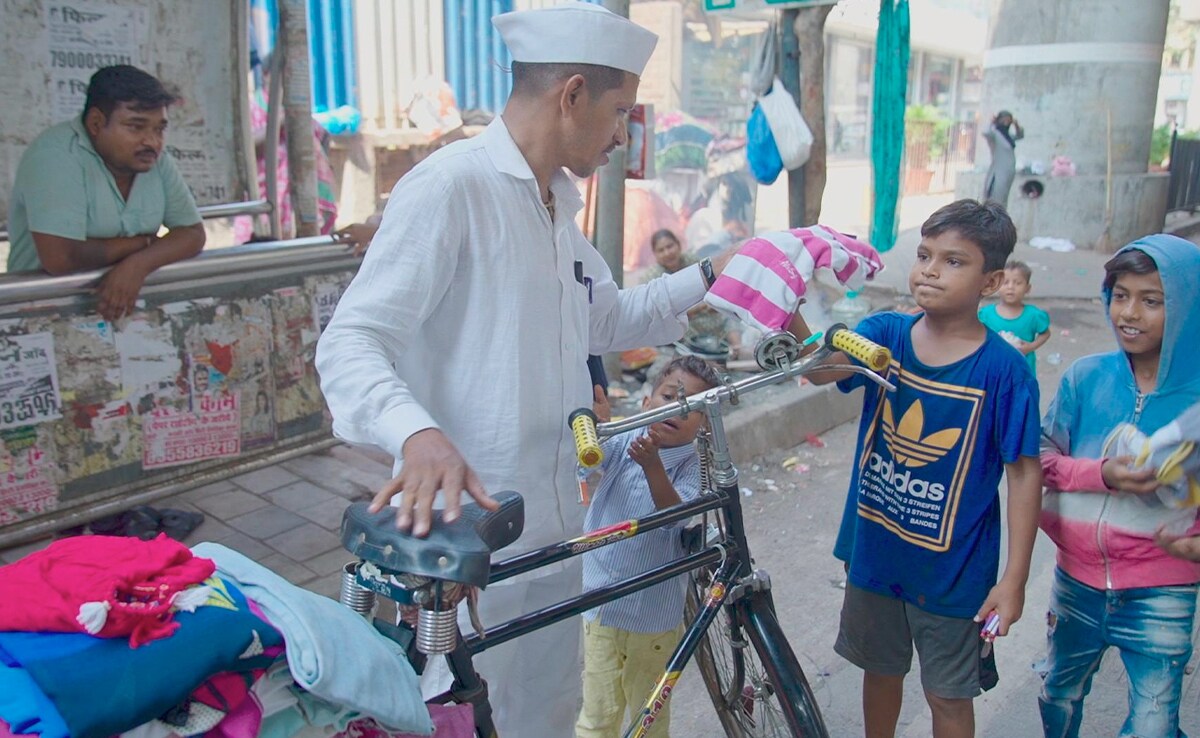
Meet Vilas Mahadu Shinde. 45-year-old Vilas who lives in a chawl in Versova is a dabbawala. He delivers hot meals from people's homes to their offices, schools, colleges, and institutions. Vilas realises the gap between the two worlds in the city where he lives and works in. One world has its cupboards full of colourful clothes, while the other world does not have a cupboard to fill.
It is 8 am, and Vilas is heading out to work. Over the next few hours, he will pick up lunchboxes and make sure that the people of Mumbai have hot meals to eat. But it isn't just food that Vilas is collecting. There is another valuable service that he is providing not just to his clients but to the environment.
Talking to NDTV, Vilas Mahadu Shinde, Dabbawala said,
I am 45-year-old and I have been delivering lunchboxes for 23 years. I meet all kinds of people while working and get to know about their needs. During Diwali, we collect clothes for poor people, and those from tribal communities. Soon, the people that I deliver lunchboxes to, found out about this. Once they found out, they started donating their waste clothes. The clothes are in good condition, but in many cases, the children wearing them have outgrown them.
Since the clothes are in good condition, people don't have the heart to throw them away, says Vilas. But, these old clothes are further given to people in need, requiring clothes.
The example we set then is still going strong. People give us old clothes along with their lunchboxes. These are good clothes that we give to needy people who require clothes.
Lata Chandak is one of the donors, who gives her and her family's old clothes to Vilas for the purpose of donation and distribution. Recalling how she connected with Vilas, Ms Chandak says,
When we first heard about him, I found out that he delivers clothes to poor people, to those who are in need, and to those who live on footpaths. We felt that they should be given clothes. So, I asked him if he would take our clothes. He said he would. Now, he even sends us photos of the people to whom he has given our clothes.
Back in the day, there was a culture of hand-me-down but that seems to have disappeared now, resulting in increased cloth waste. Sethu Kathet, another donor from Mumbai explains,
We have all used and worn the clothes that were first bought for our oldest sibling. His clothes have been passed down to the line to us. But now, nuclear families have just one child, and the clothes a child grows out of remain unused. Then there is fast fashion, where one wants trendy and new clothes for every occasion. This creates a huge amount of clutter. If we donate even a few of those clothes, it will also help keep our wardrobes clutter-free.
Vilas has been collecting clothes while delivering lunchboxes for six years now. Sharing his experience of hitting two birds with one stone, Vilas said,
The lunchboxes have to be delivered on time, and the clothes are collected at the same time. Once the clothes have been collected, I work only half days on Saturday and Sunday. I use those days to distribute the clothes amongst the people who really need them.
Vilas is trying to bridge the gap between haves and have-nots with the help of donors. One such donor is Smita Pengal, who has been associated with Vilas for five years now. Talking about donating old clothes, Ms Pengal said,
I wouldn't term them as old clothes, but it's like you know it's not the right fitting clothes right now. They're in good condition, and if he thinks that there are people who can fit it, then why not.
But who gets these clothes? Vilas says,
Those who sit by traffic signals on the roads have a lot of problems where clothes are concerned. People pass them by with no understanding of their problems or their needs. We are all human, we all have some problem, some kind of trouble in our lives.
Urging people to donate their old clothes or the clothes they have worn and outgrown for use by people in need, Vilas said,
They also have a desire to wear nice clothes. When they get these clothes they feel so good. Clothes that they have never seen before, or never expected would be given to them, we distribute those clothes amongst them during Diwali and other holidays.
The children are given children's clothes, adults are given clothes as per their size and sarees are given to women.
They feel good when they receive these clothes, they are happy. They tell us that we are doing a great job and that nobody has ever noticed them, but that we are doing good for them.
Vilas says that he spends most of his time doing this - collecting and distributing clothes. He adds,
I don't have to spend any money. I feel very good doing this. The world we live in is full of disparities. On the one hand, people wear the best clothes, and on the other people have nothing to do with clothes.
It is imperative for us to realise there are many ways to recycle our old clothes and play our role in the circular economy. Vilas is doing exactly that by providing to those in need from those who have a surplus, He has made it convenient for his clients to donate clothes from their very doorstep. He is making and involving others in making a conscious effort in reducing waste and minimising the environmental impact of textile waste.
Don't let your old clothes go to waste - clean your closet and donate them today! Log on to ndtv.com/clothes for a list of NGOs to donate your old clothes, and do your bit to make an impact.
Published: June 01, 2023 14:09 IST
also read
Solar Is The Best Economic Investment, Says Ecologist Who Has Paid Zero Power Bill For Last Three Years
Written by Aastha Ahuja, Edited by Sonia BhaskarMonthly Power Bill Of Just Rs 130, Here's How A Couple In Kochi Did It
Written by Aastha Ahuja, Edited by Sonia BhaskarHimachal Pradesh's The Kalgidhar Society Saves Rs. 3.4 Crore Per Annum By Harnessing The Power Of Solar
Written by Aastha Ahuja, Edited by Sonia Bhaskar



NDTV in partnership with Luminous has launched an awareness campaign ‘Be A Bijli Donor’ to promote the idea of ‘save power for more power’. The idea is to conserve energy today in order to get more power tomorrow.
We inherently know that saving energy results in low energy bills, but we also need to understand that a unit of energy saved today makes it available for people still living in the dark or facing regular power cuts.
Saving power or conserving energy is about knowing the sources of energy, and areas of wastage and thereby eliminating these through technology and lifestyle changes. For instance, a 100 W (Watt) incandescent (ICL) bulb can be replaced with a 9 W LED bulb offering similar performance in terms of light output, but at far lower consumption of energy.
While a 100 W ICL bulb, used for four hours a day, consumes 146 units of energy per year, a 9 W LED bulb requires only 13.5 units per year. Clearly, switching to LED is a smart choice as it provides the same output while consuming 90 per cent less energy.
The focus of the campaign is to instill the idea of ‘save power for more power’ and in order to do so, the initiative will create awareness about energy efficient products and services, smart ways to reduce power consumption, alternate sources of energy like solar energy and the need to conserve energy. The idea is to address the rising need for energy conservation in India.
As part of the campaign, we will highlight the stories of individuals and organisations who are championing the cause of energy conservation by switching to renewable sources of energy, adopting innovations to reduce energy consumption while enjoying the same output.
The initiative will provide a platform for all stakeholders to share their ideas and work towards the common goal of, ‘Save power for more power’.