




- Home/
- Threading Hope: Sakuben Ahir's Journey From Challenges To Empowerment
Threading Hope: Sakuben Ahir's Journey From Challenges To Empowerment
Team NDTV | Updated: January 24, 2025 13:36 IST
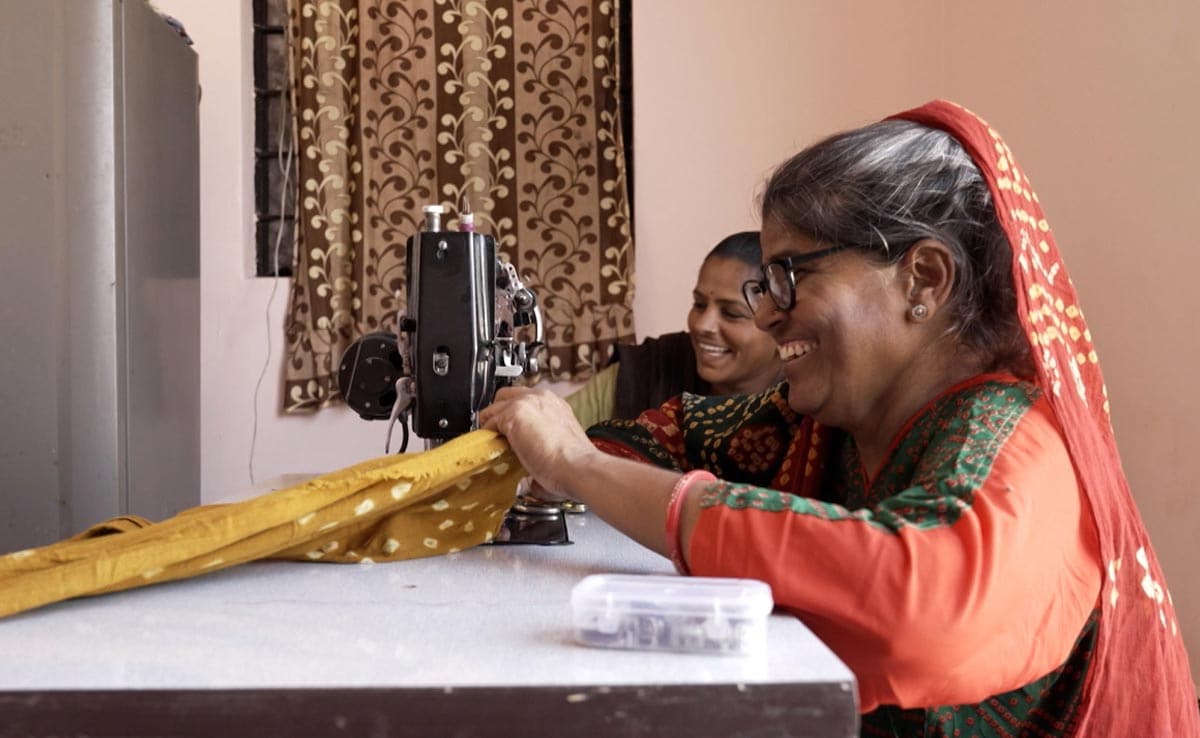
In Bhuj's Padhar Village lies the story of Sakuben Ahir who turned her challenges into opportunities
A life once confined is now unbound by a thread of hope. In the heart of Bhuj's Padhar Village lies a story of resilience and transformation—Sakuben Ahir, a remarkable woman who turned her challenges into opportunities. As a young girl, Sakuben dreamed as vast as the Kutch desert, but fate had other plans. A sudden ailment left her legs numb, altering her life forever. Reflecting on her struggles, Sakuben said,
I was 12 when my feet started turning numb. Despite multiple hospital visits and four surgeries in Udaipur, there was no improvement. My condition was so severe that I couldn't even walk to get myself water. But everything changed when I discovered sewing—it became my life. There were many hurdles. I didn't know what to do. But when I started learning to sew, it gave my life a new purpose. Before that, I was in such a bad state that I barely remember what I went through. I couldn't even walk to get myself a glass of water.
Also Read: Making Women Self-Reliant Through Usha-Common Service Centre Certification
From uncertainty and dependency, Sakuben's journey transformed when her mother encouraged her to learn embroidery. She gained confidence and skill through Usha Silai School, a programme designed to empower marginalised women. Sakuben said,
My mother asked me to learn embroidery. I started sewing and learned embroidery from her. Usha taught me how to sew.
The Usha Silai School's inclusive approach impacts individual lives and fosters societal progress. By empowering women from diverse and marginalised backgrounds, the programme enables them to gain confidence, achieve financial independence, and challenge stereotypes within their communities. Sakuben, who experienced complete immobility in her legs and restricted hand movement, received a customised sewing machine designed to suit her needs. After completing her training, she opened her own Silai School, teaching 20 students and earning Rs. 8,000-10,000 per month.
Geeta, a trainee at Sakuben's Silai School said,
Sakuben, a physically disabled woman near my house, is excellent at teaching sewing. I joined her classes and learned for six months. Now, I am self-sufficient and no longer need to ask my husband for money.
As her entrepreneurial spirit grew, Sakuben started taking orders for special occasions like Navratri and weddings in her village. Her expertise in stitching and design, combined with a deep understanding of cultural traditions, allows her to craft unique bridal outfits, preserving the vibrant heritage of her community. Through her dedication, Sakuben has not only transformed her own life but also uplifted others around her. Her skill in creating exquisite bridal outfits has earned her a respected space within the community.
Also Read: Usha Silai App - Teaching Women The Art Of Stitching And Sewing
Mary Rupa Tete, Vice President, Usha Social Services said,
The Usha Silai School programme is inclusive, supporting women from diverse backgrounds who have faced personal as well as economic challenges such as being single mothers, widows, rape survivors, HIV-positive, physically disabled, among many others. Over the last 13 years, the Usha Silai School programme have touched the lives of over 14 lakh women across India, with a sizable population of physically challenged women from Gujarat, HIV positive women from in and around Tripura and many tribal women from the Eastern, Central and Southern parts of India.
From feeling like a burden to becoming a pillar of strength, Sakuben's story is a reminder that change is possible when we believe in ourselves and support one another, and is a testament to the transformative power of the Usha Silai School programme.
Published: January 07, 2025 15:19 IST
also read
Solar Is The Best Economic Investment, Says Ecologist Who Has Paid Zero Power Bill For Last Three Years
Written by Aastha Ahuja, Edited by Sonia BhaskarMonthly Power Bill Of Just Rs 130, Here's How A Couple In Kochi Did It
Written by Aastha Ahuja, Edited by Sonia BhaskarHimachal Pradesh's The Kalgidhar Society Saves Rs. 3.4 Crore Per Annum By Harnessing The Power Of Solar
Written by Aastha Ahuja, Edited by Sonia Bhaskar



NDTV in partnership with Luminous has launched an awareness campaign ‘Be A Bijli Donor’ to promote the idea of ‘save power for more power’. The idea is to conserve energy today in order to get more power tomorrow.
We inherently know that saving energy results in low energy bills, but we also need to understand that a unit of energy saved today makes it available for people still living in the dark or facing regular power cuts.
Saving power or conserving energy is about knowing the sources of energy, and areas of wastage and thereby eliminating these through technology and lifestyle changes. For instance, a 100 W (Watt) incandescent (ICL) bulb can be replaced with a 9 W LED bulb offering similar performance in terms of light output, but at far lower consumption of energy.
While a 100 W ICL bulb, used for four hours a day, consumes 146 units of energy per year, a 9 W LED bulb requires only 13.5 units per year. Clearly, switching to LED is a smart choice as it provides the same output while consuming 90 per cent less energy.
The focus of the campaign is to instill the idea of ‘save power for more power’ and in order to do so, the initiative will create awareness about energy efficient products and services, smart ways to reduce power consumption, alternate sources of energy like solar energy and the need to conserve energy. The idea is to address the rising need for energy conservation in India.
As part of the campaign, we will highlight the stories of individuals and organisations who are championing the cause of energy conservation by switching to renewable sources of energy, adopting innovations to reduce energy consumption while enjoying the same output.
The initiative will provide a platform for all stakeholders to share their ideas and work towards the common goal of, ‘Save power for more power’.