




- Home/
- Usha And NEEPCO Are Empowering Women Through Skill Enhancement And Employment Prospects
Usha And NEEPCO Are Empowering Women Through Skill Enhancement And Employment Prospects
Team NDTV | Updated: January 03, 2024 16:28 IST
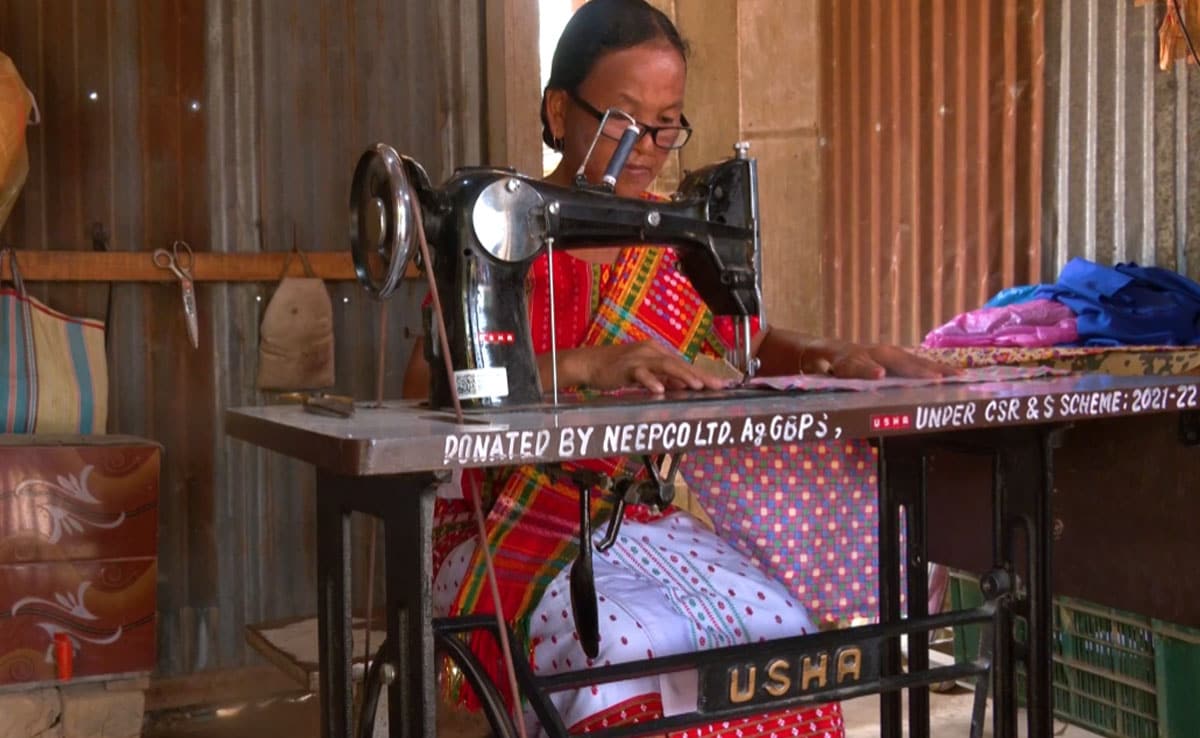
The Usha Silai School programme is a social project aimed at empowering women in rural regions by teaching them how to sew. Recognising the potential for socio-economic transformation through skill development, Usha has joined hands with various government bodies over the years to establish Usha Silai Schools in rural areas. The collaboration between Usha International and government bodies underscores a shared commitment to fostering grassroots development and promoting inclusive growth. By facilitating access to vocational training in remote regions, this collaboration not only equips individuals with sewing and entrepreneurial skills but also contributes to the larger goal of women's empowerment and community development.
Also Read: Meet Balamani, Usha Super Achiever Bringing Transformative Change In Telangana's Jadcherla
Kalpana Debbarma lives in Desharampara village of West Tripura. Before her marriage, Kalpana had a passion for clothing and used to sell ready-made garments. She was also interested in designing. At the age of 22, she married a tailor, and it was then that she expressed a desire to learn the art of sewing. Recalling the tale, Kalpana said,
When I got married, I was given a sewing machine. My husband already knew how to sew. He taught me some sewing and it became a source of income for us.
But, Kalpana's husband earned a mere Rs. 5,000 a month, which wasn't sufficient to run a household. Around that time, Usha along with North Eastern Electric Power Corporation (NEEPCO) was running a nine-day training programme to teach women how to sew. Usha and NEEPCO equipped Kalpana with a valuable skill that allowed her to pursue her hobby while also effectively managing her household.
Kalpana Debbarma explained,
At the training provided by Usha and NEEPCO, I learned to sew properly. We were taught how to design different things like dresses and kurta. After coming back from the training, I started making and selling different products. This improved our income and helped me provide my children with a good education.
Today, Kalpana and her husband share the finances and take care of the household expenses together.
Also Read: This Silai School Teacher Is Helping Women In Odisha Become Financially Independent
The success of the silai schools stems from the pivotal role played by the trainers. These trainers undergo rigorous training to acquire essential sewing and embroidery skills and knowledge. Their main role is to teach diverse sewing techniques and skills, encompassing stitching, embroidery, and tailoring, to the women within the community. In addition to practical skills, the trainers also educate the women on theoretical aspects of sewing, such as understanding the fabric and its qualities, measurement, pattern making, and garment construction. Their first and only priority is to ensure that their students gain a thorough understanding of the subject.
The Usha Silai School offers flexible and customised training curriculum to different government entities, as well as corporates and public sector undertakings (PSUs) under their corporate social responsibility (CSR).
Virendra Vegad, Trainer at the Usha Silai School explained, Despite them not being educated, we have to teach women how to calculate, multiply and divide during the cutting. We improvise to teach them. This will help them change their lives.
Also Read: 37-Year-Old Anita Bal Is Stitching A Story Of Self-Sufficiency With Usha Silai School
The North Eastern Electric Power Corporation Limited (NEEPCO), Usha's partner in this remarkable endeavor, is a state-owned enterprise engaged in the production and dissemination of electricity in the Northeastern region of India. By establishing a comprehensive partnership, NEEPCO and Usha have leveraged their strengths to foster sustainable energy and empower women through skill enhancement and valuable employment prospects.
Nanda Basumatary, Head of Power Station at NEEPCO, Tripura said,
We decided to partner with Usha because, with skill or knowledge of sewing, the local ladies in the area, who are underprivileged, are becoming self-reliant. In the future, they can impart their knowledge to their nearest neighbours or relatives. Accordingly, the economic growth in and around the village or locality would be developed.
Usha and NEEPCO firmly believe that empowering the women of rural India will not only enable them to support their households, but it will make them role models for other women in their community. And for the women, not only will they receive valuable training from Usha Silai School and NEEPCO, but they will also be provided a complete kit with which to start their business.
Kalpana and lakhs of other women like her can now take care of their household while also running a business due to Usha and a public sector enterprise like NEEPCO.
Also Read: Empowering Women Through Skill And Tradition: The Usha Silai Initiative In Karauli
Published: January 05, 2024 16:28 IST
also read
Solar Is The Best Economic Investment, Says Ecologist Who Has Paid Zero Power Bill For Last Three Years
Written by Aastha Ahuja, Edited by Sonia BhaskarMonthly Power Bill Of Just Rs 130, Here's How A Couple In Kochi Did It
Written by Aastha Ahuja, Edited by Sonia BhaskarHimachal Pradesh's The Kalgidhar Society Saves Rs. 3.4 Crore Per Annum By Harnessing The Power Of Solar
Written by Aastha Ahuja, Edited by Sonia Bhaskar



NDTV in partnership with Luminous has launched an awareness campaign ‘Be A Bijli Donor’ to promote the idea of ‘save power for more power’. The idea is to conserve energy today in order to get more power tomorrow.
We inherently know that saving energy results in low energy bills, but we also need to understand that a unit of energy saved today makes it available for people still living in the dark or facing regular power cuts.
Saving power or conserving energy is about knowing the sources of energy, and areas of wastage and thereby eliminating these through technology and lifestyle changes. For instance, a 100 W (Watt) incandescent (ICL) bulb can be replaced with a 9 W LED bulb offering similar performance in terms of light output, but at far lower consumption of energy.
While a 100 W ICL bulb, used for four hours a day, consumes 146 units of energy per year, a 9 W LED bulb requires only 13.5 units per year. Clearly, switching to LED is a smart choice as it provides the same output while consuming 90 per cent less energy.
The focus of the campaign is to instill the idea of ‘save power for more power’ and in order to do so, the initiative will create awareness about energy efficient products and services, smart ways to reduce power consumption, alternate sources of energy like solar energy and the need to conserve energy. The idea is to address the rising need for energy conservation in India.
As part of the campaign, we will highlight the stories of individuals and organisations who are championing the cause of energy conservation by switching to renewable sources of energy, adopting innovations to reduce energy consumption while enjoying the same output.
The initiative will provide a platform for all stakeholders to share their ideas and work towards the common goal of, ‘Save power for more power’.