




- Home/
- USHA-Bhansali Trust Foundation Gives New Hope To Women In Gujarat, Provides Them Silai Training
USHA-Bhansali Trust Foundation Gives New Hope To Women In Gujarat, Provides Them Silai Training
Team NDTV | Updated: December 27, 2022 14:06 IST
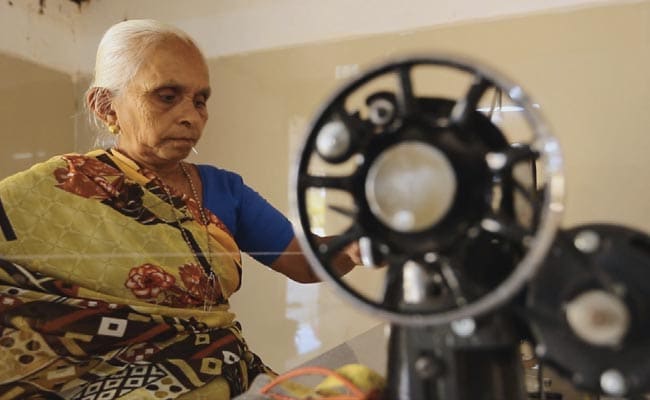
Nearly 100 miles from the hubbub of Ahmedabad lies the small town of Radhanpur. This is where USHA conducted its 15 day Silai Training Programme, in association with the Bhansali Trust Foundation. One of the many women working for the Bhansali Trust is Darji Hansaben Pravinbhai, who takes care of her own finances and lives by herself. Ms. Pravinbhai begins her day by making weak tea in the morning. Apart from the curiosity in her eyes, she has a deep interest in mathematics. She said,
I like mathematics more than work. I have appeared for an exam to learn sewing and stitching skills. I have learned a lot here, and I am able to find where I am making mistakes. The quality is an important aspect for me, so I can identify and resolve it. I don't get lazy now, I open the stitch and sew the cloth again. I learnt different kinds of garments for women, men and children. I used to stitch but was not able to take measurements. But now I can cut and stitch without fear. I learnt all aspects of garment construction here, 62-year-old Ms. Pravinbhai takes pride in being able to divide 30 into four parts for her stitching measurements.
Also Read: USHA-Shyam Metalics Provides Skill Development To Women In West Bengal And Odisha
The Bhansali Trust was established by a family of diamond merchants and is working across 16 states in medicine, mental health, rehabilitation, and more to provide employment and extend help to those in need. In Radhanpur alone, it has been helping people for 15 years. Over 800 women are running their households by stitching garments for the trust.
The women take pre-cut cloth home and join the cloth pieces to make bags and garments for children. These garments made by the women are further distributed among tribal children. The trust also runs 6,000 self-help groups for the rehabilitation of drug addicts with the support of a team comprising 60,000 people.
USHA programme coordinator, Vijay Goel said,
When Bhansali Trust approached us, they told us that they work with more than 700 women and have a separate production centre. And they want to ensure that the women who come to the production centre should receive quality training.
Bhansali Trust Programme Coordinator Nilam Gandhi informed me that the women who work at the trust are either widows or separated from their husbands.
We encourage them to enhance their skills. They sew, but they should be able to work with greater efficiency and skill. We shortlisted 40 of these women, who subsequently took the exam, and appeared in the viva. For the next stage, 15 women were selected, and they are currently engaged in practice.
Also Read: People With Disabilities Grace USHAs Mallakhamb Event In Villupuram, Tamil Nadu
Yet another resident of Radhanpur and part of the Bhansali Trust Foundation is 36-year-old USHA Silai School trainee Nandaben Manilal. Ms. Manilal worked as a school teacher before she lost her husband to COVID-19. She is taking care of her 7-year-old son and two daughters from the money she makes from stitching.
Ms. Manilal has a beautiful message for single mothers keeping their families afloat,
I may earn less than the average income, but I can run the house with that income.
Speaking of her work, Ms. Manilal said,
The work we were doing earlier and the work we have been doing in these 15 days of training, are very different. Now we do it with finesse. And now, whatever work we are asked to do, we are able to do it. We don't turn them away by saying we don't know how to do it. We say that we do know how to do the work.
Another USHA Silai School trainee, Urmila Ben said,
One of my children is a little mentally slow. I learned to sew because I had no other option. Now I can work at home and also take care of my child at the same time.
Ms. Ben's story might have also taken a different turn, but for her determination to stitch her life together piece by piece. She is happy to have the convenience of finishing her work from the comfort of her home. Ms. Ben separated from her husband. She has dedicated her life to the education of her sons, who remain her constant ray of hope.
A majority of these women trained at the USHA Silai school have had disheartening journeys, and continue to struggle in their lives. They have no one with whom to share the burden of their responsibilities. But they are conscious of their problems and have gracefully held the reins of their future.
Ms. Pravinbhai, Ms. Manilal, Ms. Ben and more such women go home knowing that they will have some difficulty or the other to overcome, but they keep going. The collaboration of USHA and The Bhansali Trust has not just enabled employment and upskilling but also long-lasting relationships. All these ladies are emotionally available for each other as friends and family, sharing the small joys of everyday life.
Also Read: USHA Silai School Teachers Head 'Satoliya' Teams For Sport Event In Heerapura, Rajasthan
Published: December 27, 2022 14:06 IST
also read
Solar Is The Best Economic Investment, Says Ecologist Who Has Paid Zero Power Bill For Last Three Years
Written by Aastha Ahuja, Edited by Sonia BhaskarMonthly Power Bill Of Just Rs 130, Here's How A Couple In Kochi Did It
Written by Aastha Ahuja, Edited by Sonia BhaskarHimachal Pradesh's The Kalgidhar Society Saves Rs. 3.4 Crore Per Annum By Harnessing The Power Of Solar
Written by Aastha Ahuja, Edited by Sonia Bhaskar



NDTV in partnership with Luminous has launched an awareness campaign ‘Be A Bijli Donor’ to promote the idea of ‘save power for more power’. The idea is to conserve energy today in order to get more power tomorrow.
We inherently know that saving energy results in low energy bills, but we also need to understand that a unit of energy saved today makes it available for people still living in the dark or facing regular power cuts.
Saving power or conserving energy is about knowing the sources of energy, and areas of wastage and thereby eliminating these through technology and lifestyle changes. For instance, a 100 W (Watt) incandescent (ICL) bulb can be replaced with a 9 W LED bulb offering similar performance in terms of light output, but at far lower consumption of energy.
While a 100 W ICL bulb, used for four hours a day, consumes 146 units of energy per year, a 9 W LED bulb requires only 13.5 units per year. Clearly, switching to LED is a smart choice as it provides the same output while consuming 90 per cent less energy.
The focus of the campaign is to instill the idea of ‘save power for more power’ and in order to do so, the initiative will create awareness about energy efficient products and services, smart ways to reduce power consumption, alternate sources of energy like solar energy and the need to conserve energy. The idea is to address the rising need for energy conservation in India.
As part of the campaign, we will highlight the stories of individuals and organisations who are championing the cause of energy conservation by switching to renewable sources of energy, adopting innovations to reduce energy consumption while enjoying the same output.
The initiative will provide a platform for all stakeholders to share their ideas and work towards the common goal of, ‘Save power for more power’.