




- Home/
- Usha Silai School Promotes Lost Traditional Sports 'Kathi Samu' And 'Karra Samu'
Usha Silai School Promotes Lost Traditional Sports 'Kathi Samu' And 'Karra Samu'
Team NDTV | Updated: January 27, 2024 13:48 IST
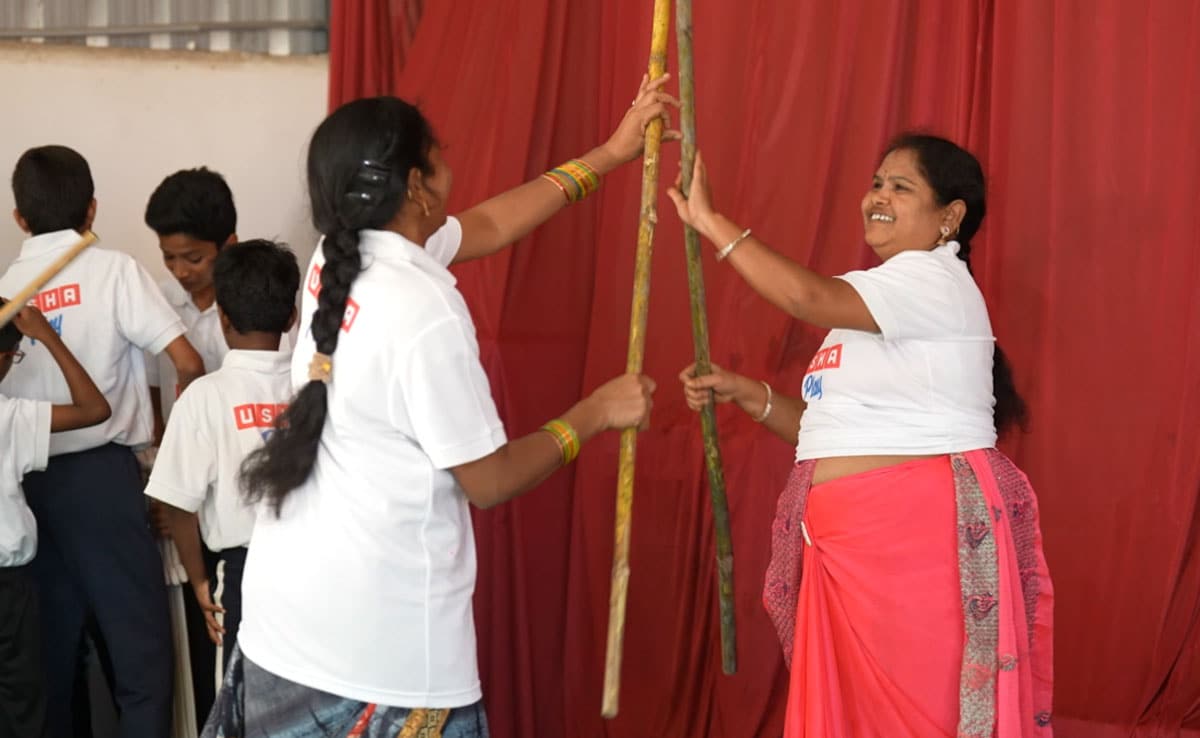
Our travels across the landscape of India's traditional sports, now seeing a revival thanks to Usha, bring us to Telangana and the fascinating world of Karra Samu and Kathi Samu. Karra Samu, or stick fighting, is a traditional martial art from Andhra Pradesh that spread across Telugu regions. It is deeply rooted in the rich history of the area. Dating back centuries, this form of combat came about as a form of self-defence - to prevent thefts which were then common in villages and to ward off robbers who may waylay you during your travels. Replace the stick with a sword or Kathi, and you have Kathi Samu, an ancient skill mastered they say by the royal armies of the region.
Also Read: In Tamil Nadu's Kanyakumari, Adimurai, A Martial Art Form Is Making A Comeback
It is the Karra and the Kathi, or the stick and the sword that set Karra Samu and Kathi Samu apart from other martial arts. Used for both offense and defence, these are incredibly dynamic and visually captivating martial art forms. Karra Samu and Katti Samu are a required attraction during community gatherings and sometimes, marriage processions. The waving of the stick during Karra Samu is done to the beats of an instrument called Tasha. Most demonstrations begin with the showing of individual talent, and then other performers join in for a group fight - their sticks twirling and waving to block and paralyse the other. Not only is Karra Samu good for physical strength, agility and mental focus, but it can also still be a powerful tool for self-defence.
Raj Kumar, Deputy Manager at Usha International Limited said the organisation is working for women's empowerment, in terms of promoting good health and hygiene and economic development. He added,
As part of this program, we are encouraging and promoting Karra Samu and Kathi Samu. It's a traditional sport for the tribal community, and residents of forest areas. Self-protection is required for tribal women.
Also Read: In Haryana, 'Usha Gatka Championship' Is Reviving The Lost Form Of Self-Defence
Leading the charge for the revival of this precious ancient form of sport, which still has use and relevance today, are the teachers of the Usha Silai School.
It is their ardent belief that by introducing these traditional sports to children, they are keeping their cultural identity alive. It is a way for them to connect with their roots and understand the importance of preserving traditions.
The event organised by the USHA Silai School teachers is not just about the sport. It's about celebrating the spirit of their communities, fostering unity, and inspiring the younger generation to stay connected with their roots.
Lauding the revival of traditional sports, Pooja Rathod, one of the trainers at the Usha Silai School said,
Today, women need this sport for their safety and health. Many women often live in fear but this sport is giving them courage and bringing them awareness.
Urvete Tanubai, another trainer shared the health benefits and said,
It's very beneficial because it is exercise and it strengthens the shoulders. It is good if learned properly.
Practitioners say that Karra Samu is not just about combat; it's a way of life. It teaches respect, discipline, and self-control. It instills a sense of camaraderie and creates a strong bond among the Karra Samu community.
For the people of Adilabad in Telangana - Karra Samu is also a time to celebrate, happening as it does during vibrant festivals and religious celebrations. With these long-forgotten martial art forms coming back into the spotlight, showcasing the rich heritage and talent of the region, it truly is time to celebrate.
Also Read: Turai Kar, Kashmir's Traditional Game Is Making A Comeback With Usha And MOOL Sustainability
Published: January 27, 2024 13:27 IST
also read
Solar Is The Best Economic Investment, Says Ecologist Who Has Paid Zero Power Bill For Last Three Years
Written by Aastha Ahuja, Edited by Sonia BhaskarMonthly Power Bill Of Just Rs 130, Here's How A Couple In Kochi Did It
Written by Aastha Ahuja, Edited by Sonia BhaskarHimachal Pradesh's The Kalgidhar Society Saves Rs. 3.4 Crore Per Annum By Harnessing The Power Of Solar
Written by Aastha Ahuja, Edited by Sonia Bhaskar



NDTV in partnership with Luminous has launched an awareness campaign ‘Be A Bijli Donor’ to promote the idea of ‘save power for more power’. The idea is to conserve energy today in order to get more power tomorrow.
We inherently know that saving energy results in low energy bills, but we also need to understand that a unit of energy saved today makes it available for people still living in the dark or facing regular power cuts.
Saving power or conserving energy is about knowing the sources of energy, and areas of wastage and thereby eliminating these through technology and lifestyle changes. For instance, a 100 W (Watt) incandescent (ICL) bulb can be replaced with a 9 W LED bulb offering similar performance in terms of light output, but at far lower consumption of energy.
While a 100 W ICL bulb, used for four hours a day, consumes 146 units of energy per year, a 9 W LED bulb requires only 13.5 units per year. Clearly, switching to LED is a smart choice as it provides the same output while consuming 90 per cent less energy.
The focus of the campaign is to instill the idea of ‘save power for more power’ and in order to do so, the initiative will create awareness about energy efficient products and services, smart ways to reduce power consumption, alternate sources of energy like solar energy and the need to conserve energy. The idea is to address the rising need for energy conservation in India.
As part of the campaign, we will highlight the stories of individuals and organisations who are championing the cause of energy conservation by switching to renewable sources of energy, adopting innovations to reduce energy consumption while enjoying the same output.
The initiative will provide a platform for all stakeholders to share their ideas and work towards the common goal of, ‘Save power for more power’.