- Home/
- From Waste To Wonder: The Sustainable Revolution Of Golden Feathers
From Waste To Wonder: The Sustainable Revolution Of Golden Feathers
Team NDTV | Updated: February 02, 2026 19:08 IST
New Delhi:
In the bustling landscape of Indian innovation, a remarkable transformation is taking place - one that turns a pungent environmental hazard into the world's lightest natural fiber. Golden Feathers, a Rajasthan-based social enterprise, is redefining the concept of "craft" by upcycling chicken waste into high-end sustainable fabric, while simultaneously pulling thousands of tribal women out of poverty.
The Visionary: Radhesh Agrahari
The story of Golden Feathers is inseparable from its founder, Radhesh Agrahari, a man now affectionately known as the "Chicken Man of the Textile World". Hailing from a traditional nine-member family in Fatehpur, Uttar Pradesh, Agrahari's journey was fueled by grit; he worked part-time jobs to fund his education and nearly a decade of research. His "eureka moment" occurred in 2010 while he was a postgraduate student at the Indian Institute of Craft and Design (IICD) in Jaipur. After returning late from a job in Agra, he found his classmates had already claimed "clean" waste materials like plastic and paper for a design project. Left with no choice, he looked toward food waste.
While at a local butchery, he realized that nearly 35% of a chicken—feathers, claws, and beaks—was discarded as waste. When he first brought a bag of this stinking waste into his classroom, the smell was so overpowering he was kicked out. Undeterred, Agrahari spent the next 13 years refining a process to prove that this "dirty" waste could become a luxury material.
How Golden Feathers Works
The operational model of Golden Feathers is a blend of scientific innovation and traditional handloom expertise. The process involves several key steps:
- Collection and Sanitation: Raw chicken feathers are collected from local slaughterhouses, preventing them from contaminating water bodies.
- Natural Processing: Using Agrahari's patented method, the feathers are cleaned and sanitised without harsh chemicals, ensuring the process remains eco-friendly.
- Spinning and Weaving: The sanitized down is carded and spun into yarn, then woven on traditional handlooms to create a variety of products, from fine fabrics to unique handmade paper.
Impact: Empowering the Tribal Artisans
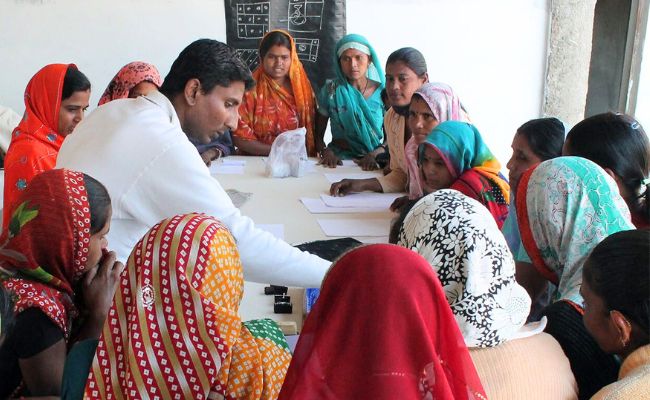
The most profound impact of Golden Feathers is social. To scale his vision, Agrahari sought a workforce capable of handling the material. However, he faced a steep challenge: in many Indian communities, touching chicken feathers was a social taboo. This led him deep into the tribal belts of Rajasthan—regions like Banswara, Baran, and Jhalawar—where poultry was already a part of daily life. Here, he met women who were earning as little as ₹80 a day through grueling labor like collecting tendu leaves. Golden Feathers offered them a new path: a dignified, home-based income. By training these women as skilled artisans, the program has revolutionized their economic status:
- Increased Earnings: Many women now earn between ₹200 and ₹400 daily, with some top artisans reaching monthly incomes of ₹10,000 to ₹12,000.
- Independence: Working from home allows these women to set their own hours, providing them with newfound independence and the ability to support their children's education.
- Environmental Stewardship: By upcycling thousands of kilograms of hazardous waste each month, the company prevents the spread of disease and contamination in their local environments.
Weaving a Future Golden Feathers is more than just a textile company; it is a 'quiet revolution' that addresses the dual crises of environmental waste and social inequality. With a vision to connect 20,000 women over the next five years through a "Paper Village" model, Agrahari and his team are proving that with imagination and empathy, even the most overlooked waste can be woven into a future of dignity and self-reliance.
Published: February 02, 2026 19:05 IST
also read
Important To Implement Environmental Rules To Sustain Gains Of Lockdown: Union Environment Minister Prakash Javadekar
PTIMumbai Based Green Champion Is Striving To Make The City The Cycling Capital By 2030
Reported by Ambika Singh KahmaDr Naresh Trehan On The Learnings From The Coronavirus Pandemic And How Technology Can Help Save The Environment
Written by Aastha Ahuja, Edited by Sonia Bhaskar
 Written by Sneha Mordani | Wednesday November 25, 2026
One person dies every 2nd day in Delhi due to Lung Cancer reveals data from an RTI query. Top Delhi Chest Surgeon says the number of a gross underestimate.
- Written by Debosmita Ghosh | Wednesday November 25, 2026
6,581 lung cancer cases were reported at AIIMS, Ram Manohar Lohia (RML) Hospital and the Delhi State Cancer Institute (DSCI) between January 1, 2020, and July 31, 2026. Safdarjung Hospital did not provide its total number of cases but reported 393 lung cancer deaths.
- Written by Shreya Goswami | Wednesday November 25, 2026
Air pollution may increase the risk of Alzheimer's disease and dementia by disrupting the brain's immune cells, a new study finds. With Indian cities facing high PM2.5 levels, researchers' findings raise fresh concerns about the long-term neurological effects of polluted air.
- Written by Amit Chaturvedi | Wednesday November 25, 2026
The sources of pollution identified by the study include vehicular traffic, construction, and commercial sources. It also said that stubble burning contributes to seasonal deterioration in the air quality in Delhi and areas around it.
- Wednesday November 25, 2026 , New Delhi
Air quality in Delhi remained in the poor category, with four monitoring stations recording 'very poor' readings.
................................ Advertisement ................................

Opinion | Delhi Has Every Pollution Control Policy - Except One That Works
Monday November 09, 2026Every November, Delhi performs the same ritual. We check the AQI before stepping outdoors, children are kept indoors, masks reappear, schools consider shutting, construction is restricted, and emergency meetings are convened. Politicians blame the weather, neighbouring states, farmers, or firecrackers. And then, as the season changes, the urgency d...
दीवाली की चौखट पर दिल्ली में सांसों का संकट: 30 साल की स्टडी ने हरियाली को लेकर क्या बताया?
Thursday November 05, 2026अध्ययन में हरियाली की मात्रा के साथ उसके फैलाव और आपसी जुड़ाव को भी महत्वपूर्ण पाया गया. जिन इलाकों में हरियाली ज्यादा बिखरी हुई थी, वहां सतही तापमान अधिक रहा. इसके विपरीत, बड़े और आपस में जुड़े हरित क्षेत्रों में तापमान कम पाया गया.
Opinion: Why Delhi's Smog Can't Be Fixed From SpaceDavid Fickling, Bloomberg
Monday October 19, 2026The clearest sign that Delhi is on a path to cleaner air would be a decline in the amount of paddy grown nearby, and therefore the acreage liable to be burned each year.
Don't Normalise Air Purifiers As Delhi Chokes | The Reason Why
Thursday December 11, 2025More than 90 cities in the world's top 100 polluting list are in India. With every passing year, the AQI is rising, reaching 'hazardous' levels.
Blog | Well Done, Delhi. You've Turned Lung Sacrifice Into A Badge Of HonourSaikat Kumar Bose
Monday November 10, 2025Till some years back, Delhiites would ask angry questions to those in power about the capitals annual tryst with toxic air. This has changed. Those in the driving seat dont see the need to answer now.