- Home/
- Partnering For Sustainable Progress: Usha Silai Schools Fuel India's Inclusive Development
Partnering For Sustainable Progress: Usha Silai Schools Fuel India's Inclusive Development
| Updated: February 03, 2026 11:41 IST
New Delhi:
True sustainable development thrives on collaboration. In this story, we dive into how Usha International Ltd. teams up with government bodies to turn national policies into grassroots realities, empowering marginalized communities—especially women and transgender individuals—through skill-building and livelihoods. Empowering the Excluded in West Bengal The story kicks off with the National Institute of Rural Development and Panchayati Raj (NIRDPR), under India's Ministry of Rural Development, partnering with the Centre on Integrated Rural Development for Asia and the Pacific (CIRDAP), PLEQSUS India Foundation, and Usha.
Their Action Lab for Inclusive Livelihoods targets transgender communities in West Bengal, often trapped in multidimensional poverty. Usha Silai Schools deliver hands-on stitching training, providing machines and advanced apparel skills.
Dr. Sandhya Gopakumaran, NIRDPR's Director of Training and Development, explains,
"This aligns with our vision of reaching the unreached for Viksit Bharat 2047, improving rural quality of life through skills."
Dr. P. Chandra Shekara of CIRDAP adds that Usha stabilised the model—training 15 transpersons, with five excelling and eyeing high-end markets. Avinava Dutta, an NIRDPR expert, highlights the ripple effect,
"Usha Silai promotes self-employment, turning trainees into entrepreneurs who employ their own community."
Sudeb Suvana of PLEQSUS dreams big,
"We aim to link these entrepreneurs into a trans-led company, proving they can earn respectfully without begging."
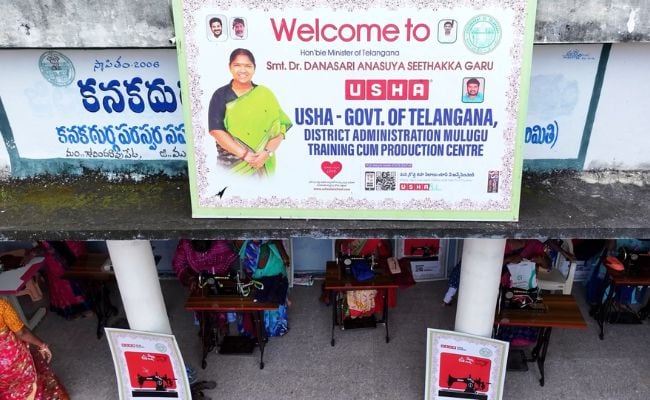
Transforming Lives in Telangana's Mulugu District The journey shifts to Mulugu, Telangana, where District Collector Sri T.S. Divakara, IAS, partnered with Usha to launch training centers for remote tribal women. "Tailoring creates a circular economy," he says, noting quick responsiveness from Usha's team. They've trained 80 women, who now stitch school uniforms, earning steadily and planning bulk apparel orders. Usha Entrepreneurs share triumphs: One woman earned Rs 5,000–6,000 monthly, funding her children's education without relying on her husband. T. Rajkumar, Usha's Program Coordinator, mobilized 30 from the poorest families, securing government work orders worth Rs 1 lakh. Prashanthi beams,
"In 14 days, I learned stitching types—Usha changed our lives."
Reviving Heritage in Meghalaya In Meghalaya, a six-year alliance with the Meghalaya State Rural Livelihoods Society (MSRLS) has set up 17 Training Cum Production Centres, skilling over 250 women. Ram Krishna, MSRLS CEO, praises,
"Usha's centers give women new livelihood options."
Shanlang Lyngdoh notes graduates launching their own units. Highlights include the Saras Aajivika Fair's fashion shows, where women showcase self-stitched designs, blending modern skills with Khneng embroidery—a fading art revived in two villages. Peter Passah, ADC Shillong, says,
"This empowers women to train others, stretching the craft nationwide."
Conrad Sangma emphasises localising livelihoods in this matrilineal society. A Blueprint for Nation-Building These stories—from West Bengal's inclusion drive to Mulugu's economic boost and Meghalaya's cultural revival—showcase Usha Silai Schools as more than trainers: they're knowledge partners fostering self-reliance, market linkages, and dignity. As Dr. Gopakumaran puts it, "Skills and livelihoods offer employability and entrepreneurship in high-demand fields like apparel." Through these synergies, India edges toward equitable growth, proving partnerships scale impact. Usha's 14-year legacy empowers thousands, ensuring no one is left behind in the march to Viksit Bharat.
Published: February 03, 2026 11:41 IST
also read
Important To Implement Environmental Rules To Sustain Gains Of Lockdown: Union Environment Minister Prakash Javadekar
PTIMumbai Based Green Champion Is Striving To Make The City The Cycling Capital By 2030
Reported by Ambika Singh KahmaDr Naresh Trehan On The Learnings From The Coronavirus Pandemic And How Technology Can Help Save The Environment
Written by Aastha Ahuja, Edited by Sonia Bhaskar
 Written by Sneha Mordani | Wednesday November 25, 2026
One person dies every 2nd day in Delhi due to Lung Cancer reveals data from an RTI query. Top Delhi Chest Surgeon says the number of a gross underestimate.
- Written by Debosmita Ghosh | Wednesday November 25, 2026
6,581 lung cancer cases were reported at AIIMS, Ram Manohar Lohia (RML) Hospital and the Delhi State Cancer Institute (DSCI) between January 1, 2020, and July 31, 2026. Safdarjung Hospital did not provide its total number of cases but reported 393 lung cancer deaths.
- Written by Shreya Goswami | Wednesday November 25, 2026
Air pollution may increase the risk of Alzheimer's disease and dementia by disrupting the brain's immune cells, a new study finds. With Indian cities facing high PM2.5 levels, researchers' findings raise fresh concerns about the long-term neurological effects of polluted air.
- Written by Amit Chaturvedi | Wednesday November 25, 2026
The sources of pollution identified by the study include vehicular traffic, construction, and commercial sources. It also said that stubble burning contributes to seasonal deterioration in the air quality in Delhi and areas around it.
- Wednesday November 25, 2026 , New Delhi
Air quality in Delhi remained in the poor category, with four monitoring stations recording 'very poor' readings.


................................ Advertisement ................................


Opinion | Delhi Has Every Pollution Control Policy - Except One That Works
Monday November 09, 2026Every November, Delhi performs the same ritual. We check the AQI before stepping outdoors, children are kept indoors, masks reappear, schools consider shutting, construction is restricted, and emergency meetings are convened. Politicians blame the weather, neighbouring states, farmers, or firecrackers. And then, as the season changes, the urgency d...
दीवाली की चौखट पर दिल्ली में सांसों का संकट: 30 साल की स्टडी ने हरियाली को लेकर क्या बताया?
Thursday November 05, 2026अध्ययन में हरियाली की मात्रा के साथ उसके फैलाव और आपसी जुड़ाव को भी महत्वपूर्ण पाया गया. जिन इलाकों में हरियाली ज्यादा बिखरी हुई थी, वहां सतही तापमान अधिक रहा. इसके विपरीत, बड़े और आपस में जुड़े हरित क्षेत्रों में तापमान कम पाया गया.
Opinion: Why Delhi's Smog Can't Be Fixed From SpaceDavid Fickling, Bloomberg
Monday October 19, 2026The clearest sign that Delhi is on a path to cleaner air would be a decline in the amount of paddy grown nearby, and therefore the acreage liable to be burned each year.
Don't Normalise Air Purifiers As Delhi Chokes | The Reason Why
Thursday December 11, 2025More than 90 cities in the world's top 100 polluting list are in India. With every passing year, the AQI is rising, reaching 'hazardous' levels.
Blog | Well Done, Delhi. You've Turned Lung Sacrifice Into A Badge Of HonourSaikat Kumar Bose
Monday November 10, 2025Till some years back, Delhiites would ask angry questions to those in power about the capitals annual tryst with toxic air. This has changed. Those in the driving seat dont see the need to answer now.