




- Home/
- Trump Wants Venezuela's Oil. What It Means For Climate
Trump Wants Venezuela's Oil. What It Means For Climate
Edited by NDTV News Desk | Updated: January 08, 2026 19:22 IST
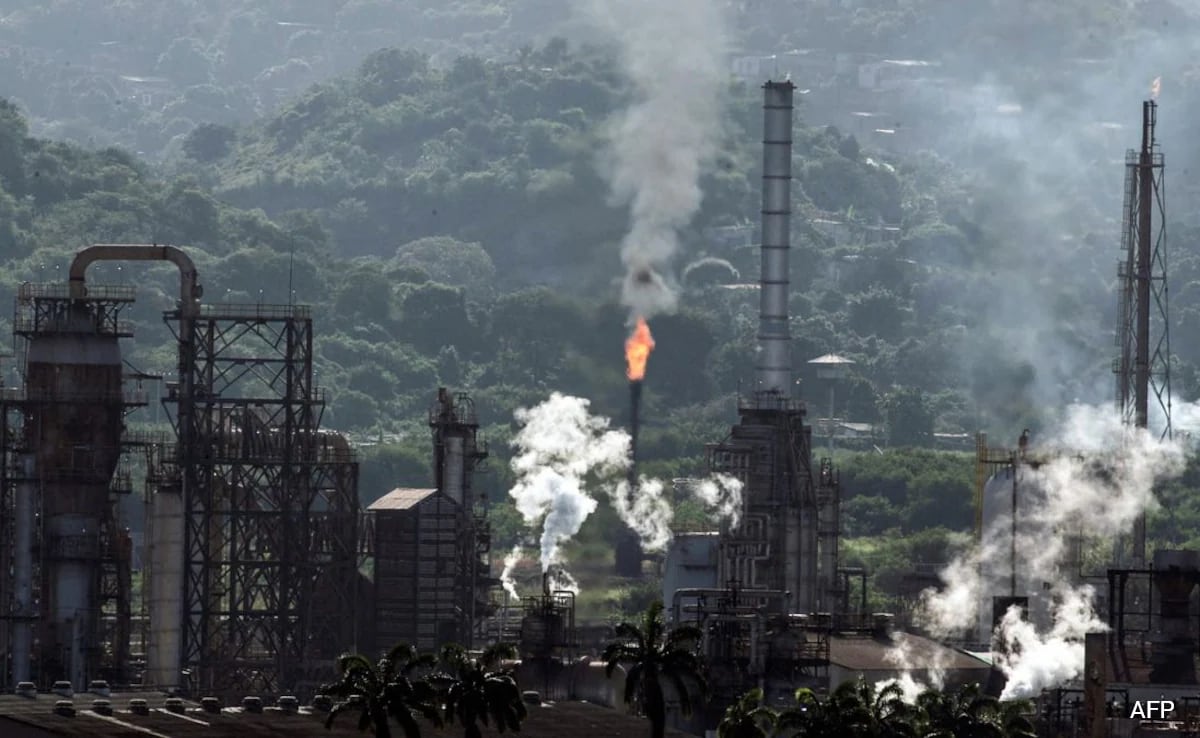
US companies could make Venezuelan oil less dirty but not clean.
Days after invading Venezuela and capturing its President, Nicolas Maduro, the US is now eyeing the country's vast oil reserves. US President Donald Trump has also underlined that he is all for the direct involvement of American companies in the South American country, something he claims will also help the people of Venezuela.
Analysts disagree. They say that technology and stricter emission controls may help, but the economic and climate feasibility of exploiting Venezuelan oil may remain a thorn in the flesh.
Venezuela sits in a paradox that worries climate scientists. The country has the largest oil reserves. Home to over 300 billion barrels of crude, its oil production has declined sharply in recent years, from around 2 million barrels a day in 2016 to less than 1 million barrels today.
This is largely due to US sanctions, years of underinvestment, and crumbling infrastructure. Many of Venezuela's oil pipelines, tanks and refineries are extremely old and poorly maintained. Because of this, oil leaks and spills frequently, polluting rivers, lakes and nearby land.
Guy Prince, head of energy supply research at independent think tank Carbon Tracker, said, "Venezuela's oil is considered 'dirty' not because of ideology, but because of physics and infrastructure," according to CNN.
“The most significant climate impact of a Venezuelan intervention wouldn't be releasing vast new carbon, it would be indirect: distracting from the clean energy transition, reinforcing a 20th-century resource-conflict mindset, and creating instability that slows coordinated climate action,” he added.
According to the International Energy Agency, "The methane intensity of oil and gas operations in Venezuela is six times the global average."
Most of Venezuela's oil comes from the Orinoco Belt, which has very thick and dirty oil as compared to the regular one. It requires more energy and processing to extract and refine, which leads to more pollution and carbon emissions.
Experts have also warned about the climate and environmental consequences of expanding Venezuelan oil production.
Kevin Book, managing director at ClearView Energy Partners, told NPR, “It's not just a geologic problem or an engineering problem, but a math problem.” He added, “The go-go days of shale tended to be a 'drill first and figure out the math later' time in the oil industry's history. And it didn't go that well for many of the companies that produced first and asked questions later.”
Patrick King, head of emissions research at Rystad Energy, said American oil majors have experience in cutting emissions in some of their global oil operations.
According to energy consultancy Rystad Energy, just maintaining the current low level of production would require more than $53 billion over the next 15 years. This money would go into fixing old wells, pipelines and equipment.
As per the American Fuel & Petrochemical Manufacturers trade group, 70 per cent of US refining capacity is optimised for heavy crude, while the vast majority of US production is light crude.
If EVs and other clean technologies keep expanding, global oil demand could plateau or even fall over time.
“There are limits” on how much US oil majors could reduce emissions, King said.
Diego Rivera Rivota, Senior research associate, Columbia University's Center on Global Energy Policy said, “Most likely carbon emissions would very significantly increase.”
Even with better management, extracting Venezuela's heavy oil still requires large amounts of energy and costly flare-reduction programmes. US companies could make Venezuelan oil less dirty but not clean.
Meanwhile, with an interim government in charge of Venezuela, Trump has made his intentions clear - fall in line or meet Maduro's fate.
US Energy Secretary Chris Wright said on Wednesday, "We're just going to get that crude moving again and sell it. We're going to market the crude coming out of Venezuela – first, this backed-up stored oil and then indefinitely going forward, we will sell the production that comes out of Venezuela."
(Except for the headline, this story has not been edited by NDTV staff and is published from a syndicated feed.)
Published: January 08, 2026 17:52 IST

