




- Home/
- Final Chapter Of A23a? Colossal Antarctic Iceberg Nears Its End, Might Disappear Within Weeks
Final Chapter Of A23a? Colossal Antarctic Iceberg Nears Its End, Might Disappear Within Weeks
Edited by Srishti Singh Sisodia | Updated: March 08, 2026 14:52 IST
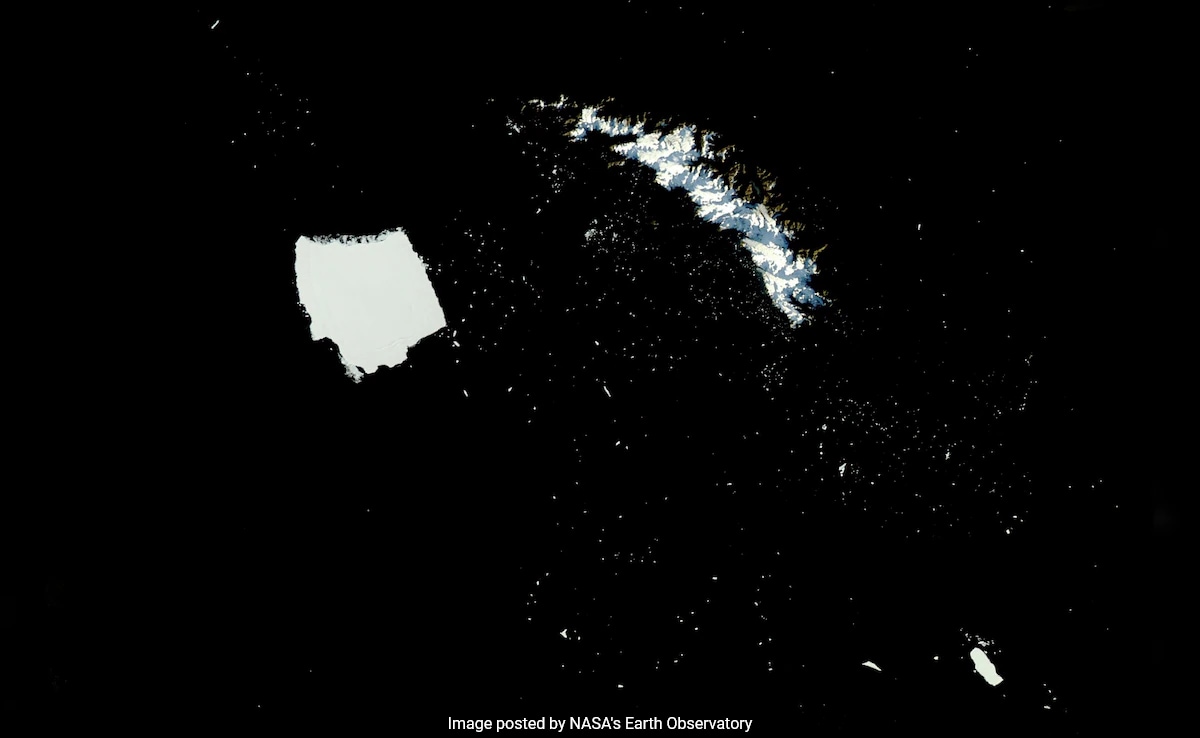
In 2025, A23a weighed a little under a trillion tonnes.
Highlights
- A23a iceberg began drifting after breaking free from Weddell Sea in 2020
- It originated from Antarctica's Filchner-Ronne Ice Shelf in 1986, size 4,000 sq km
- The iceberg shrank dramatically after entering warmer South Atlantic waters
A23a, one of the world's oldest and once the largest iceberg, is nearing the end of its 40-year journey across the Southern Ocean. This colossal iceberg has captivated scientists with its extraordinary longevity and unpredictable path. This "megaberg" broke off from Antarctica's Filchner-Ronne Ice Shelf in 1986, covering an area of approximately 4,000 square kilometres, more than twice the size of Greater London. Soon after breaking away, it ran aground in the Weddell Sea, where it remained stuck on the seafloor for more than three decades.
In 2020, A23a finally broke free and began drifting north, propelled by ocean currents and winds. During its journey, it moved along the route known as "Iceberg Alley" and at one stage became trapped in a rotating ocean vortex called a Taylor column, which caused it to spin in place.
Also read | World's Largest Acidic Geyser In Yellowstone Erupts After 6 Years. Here's What It Means
After entering warmer waters in the South Atlantic, the iceberg began to deteriorate rapidly. Satellite observations show it shrinking dramatically. According to a recent report by the BBC, A23a has "melted", "fractured" and "disintegrated" over the past year.
"Its journey is really pretty impressive, just for sheer longevity," Dr Christopher Shuman, a retired scientist formerly with the University of Maryland, Baltimore County, in the US, said as quoted.
By January 2026, it had shrunk to around 506 square kilometres, with several large fragments breaking off. The report mentioned that the iceberg was still massive after 39 years, last year. In 2025 January, A23a was about 3,600 sq km. But on March 5, it was reduced to 180 sq km.
Also read | Europe's Sun-Observation Satellite Goes Dark, Loses Contact With Ground Control: Here's What We Know
"To watch it be so stable for so long, and then just disintegrate over one year, has been fascinating," Dr Catherine Walker of the Woods Hole Oceanographic Institution in the US said, as quoted.
Researchers note that A23a's unusually long life makes it scientifically valuable. Icebergs of this size rarely survive so long once they leave Antarctic waters. As it melts, it releases nutrients into surrounding waters- sometimes boosting marine productivity- though the freshwater also contributes slightly to global sea-level rise.
Scientists now believe A23a will completely disintegrate within weeks, marking the end of one of the longest-tracked iceberg journeys on record. As quoted, Prof Adrian Luckman of Swansea University said that recent satellite images suggest further hydrofracturing of the iceberg is a "tantalising evidence of sudden disintegration".
He further stated that once A23a gets to roughly 70 sq km, scientists will stop tracking it. "All traces will probably have disappeared in a matter of weeks now, at most," Luckman said.
Published: March 08, 2026 14:52 IST

