




- Home/
- Mars Experienced Catastrophic Flooding 3.5 Billion Years Ago, Reshaping Planet's Surface
Mars Experienced Catastrophic Flooding 3.5 Billion Years Ago, Reshaping Planet's Surface
Edited by Srishti Singh Sisodia | Updated: May 17, 2026 12:54 IST
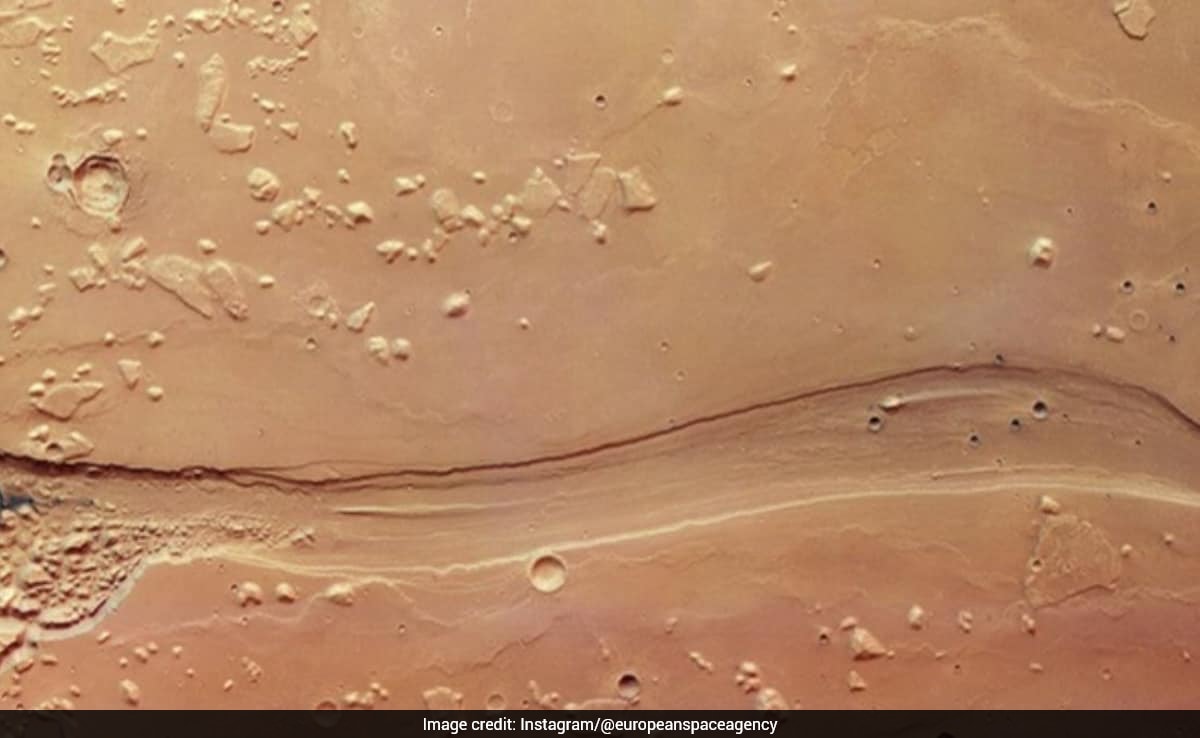
The source of so much water remains a puzzle.
Highlights
- Scientists revealed Mars was shaped by floods about 3.5 billion years ago
- Mars Express HRSC images show valleys, craters, and sediment from ancient floods
- Shalbatana Vallis is a 1300 km-long valley carved by groundwater on early Mars
Scientists have shared photos of the Mars surface, revealing that the Red Planet was rocked by "catastrophic floods" that carved valleys, filled craters and moved enough sediment to bury entire Great Lakes in just days or weeks. All of this apparently happened about 3.5 billion years ago, when Mars was not the dry, dusty world we know today.
The new images, taken by Mars Express's High Resolution Stereo Camera (HRSC), highlight how dramatically different Mars' climate and geology were during its early history, and how water was a dominant force in shaping the planet.
"Groundwater burst to the surface, carved a valley 10 km wide and 500 m deep, and then vanished. What remains is Shalbatana Vallis, a 1 300 km-long channel near the Martian equator, roughly the length of Italy," European Space Agency (ESA) wrote as the caption of the post.
"Look closely and you'll spot impact craters at different stages of erosion, patches of volcanic ash carried by Martian winds, "wrinkle ridges" formed as lava cooled and contracted, and chaotic terrain: a jumbled maze of rock blocks that collapsed when underground ice melted."
Also read | Video: Indian Astrophotographer Captures Stunning Triangulum Galaxy From Uttarakhand Village
See the post here:
"The region sits at a crossroads between Mars's heavily cratered southern highlands and its smoother northern lowlands. Just beyond the frame lies Chryse Planitia, one of the lowest points on the entire planet, where many of Mars's great outflow channels converge and where some scientists believe an ancient ocean may once have existed," the post added.
While discussing Shalbatana Vallis, ESA wrote that it is one of many such valleys found in this region. NASA reported that this part of Mars divides the planet's heavily cratered southern highlands (to the left) from the smoother northern lowlands (right).
Social Media Reaction
"It still strikes me as amazing that Mars might have had an ocean. Incredible. I wonder what else is hiden beneath the surface," one user noted.
"I guess I'm going to watch The Martian... tonight swing those pics," another user mentioned.
"Fascinating.. esp patches of volcanic ash. Any plans to retrieve ash samples? It would reveal so much," a third user wondered.
Published: May 17, 2026 12:54 IST

