




- Home/
- Preserving The Traditional Rabari Embroidery And Giving Scraps Of Clothes A Conscience Is Pabiben From Gujarat
Preserving The Traditional Rabari Embroidery And Giving Scraps Of Clothes A Conscience Is Pabiben From Gujarat
Team NDTV | Updated: July 12, 2023 17:39 IST
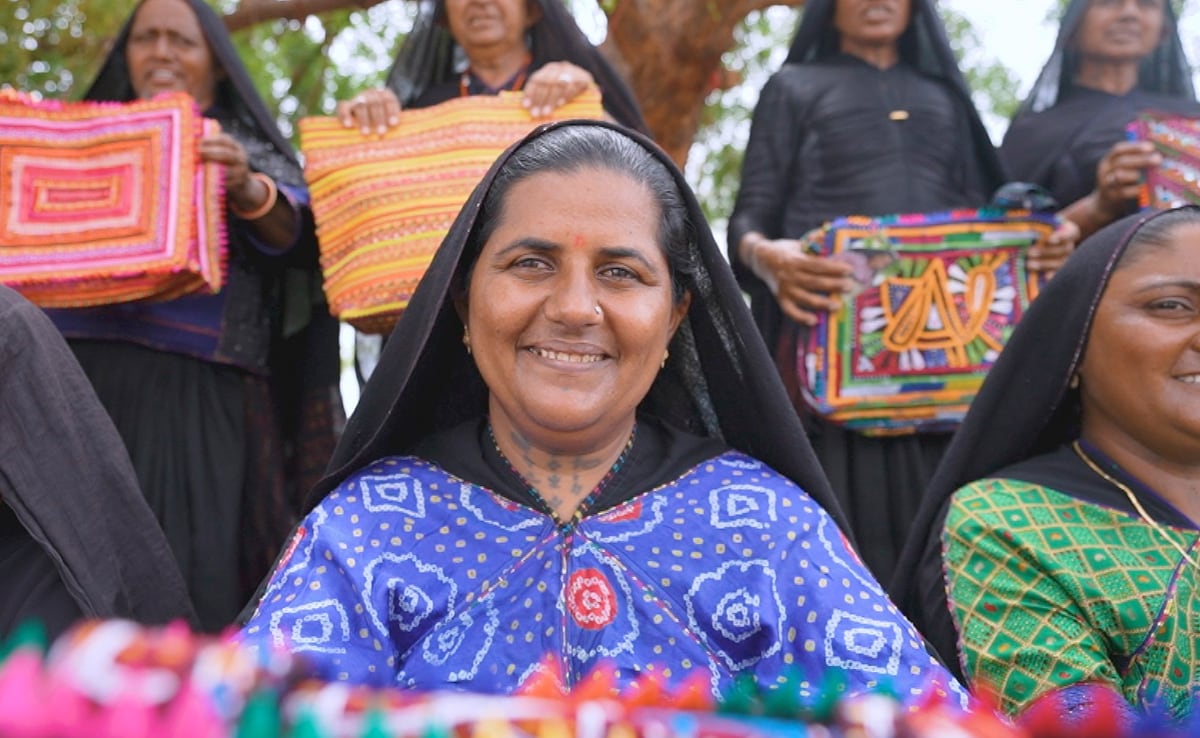
Nestled in the westernmost part of India, the mesmerising land of Kutch is known for its majestic salt flats and intricate handicrafts. Kutchi embroidery is renowned for its intricate patterns, vibrant colors, and skilled craftsmanship. The embroidery has been passed down through generations, preserving its cultural significance and connecting communities through creativity and artistry.
The embroidery of Kutch has a rich history dating back several centuries. Its roots can be traced back to the nomadic and pastoral communities that inhabited the Kutch region. Women from these communities began using embroidery as a means of artistic expression and a way to decorate their clothing and household items.
Also Read: How The Waghri Community, Indias Invisible Recyclers Help Keep Old Clothes Away From Landfills
One such woman is Pabiben Rabari, an artisan determined to bring attention to the unique craftsmanship of her community. She said,
I too have learnt from my mother and my grandmother. In our community, every girl knows embroidery. There would be embroidery happening in my house too, so I watched and learned at home.
Pabiben Rabari is an extraordinary craftswoman from the Rabari community in Gujarat who has emerged as a pioneer in the world of sustainable fashion through her innovative use of upcycled clothing. With her creativity and dedication, she is bringing positive change to the fashion industry while empowering women and preserving traditional craftsmanship.
The Rabari community is a nomadic pastoral community. While the community is known for its distinctive arts - mirrored mud sculptures among them, it is embroidery that the Rabari women are best known for. Everything can be embroidered - from clothing and bags to wall hangings, pillows and purses. And every piece of Rabari embroidery carries some sort of significance.
Also Read: Sweet Root, Preserving Childhood By Upcycling Baby Clothes To Memory Quilts
Mythological and historic events can be depicted in embroidery, as can significant riots and events for the community. Every pattern is hand sewn and the Rabaris draw inspiration from their surroundings, experiences, and heritage.
Talking about her work, Pabiben said,
We were pastoralists and took our cattle to graze in the jungle. Whatever we saw there is what we put into our art here.
Creatures like peacocks, which roam in the jungle are all represented via embroidery and applique. The pieces are colorful just like the Rabari community.
All these are from the imagination, and I haven't learnt this from anywhere. Whatever I have seen in life is what I have put into my craft.
Helping people like Pabiben market their products and take them to a larger market is Kaarigar Clinic, founded by Nilesh Priyadarshi. Talking about having ‘tradition' at its core, Nilesh Priyadarshi, CEO of Kaarigar Clinic said,
We give importance to the traditional knowledge and the skill of artists who work with us. We don't guide them as to which colour or design to use. We leave it all to them. They use their traditions and knowledge. The only permanent solution we can give them is what new products can be created and what shape they could take. So, I feel, we aren't letting go of tradition. Rather we are encouraging innovation within tradition. They innovate within the bounds of tradition and advance their craft. This way there is a balance between both tradition and the market.
With the increasing concern for environmental sustainability, repurposing and recycling materials has gained prominence. Rabari embroidery has evolved with the times by embracing this sustainable ethos. The use of recycled clothes as a canvas for Rabari embroidery not only reduces waste but also creates a harmonious blend of tradition and eco-consciousness.
Pabiben said,
People think of clothes as a Western concept. But we stitch together small pieces of old clothes, and create designs on them - peacocks, scorpions, elephants, and so on. No one can make out that these designs can be created using scraps of old clothes. Even today, when the white clothes worn by the men become old and dirty, they are washed to make godadis, or baby quilts. No one can say that it is an old godadi, everyone says it is a new godadi.
Further talking about the Gujarati habit of reusing and upcycling a piece of cloth till the end of its life cycle, Nilesh said,
In Gujarat, we have a tradition that no old clothing is thrown away. Old clothes are used for mopping the floor or used in other different ways. This tradition runs in the blood of the artisans that nothing is to be wasted. They use methods and tools to cut clothes in a manner that generates minimum waste. In case there is any waste or leftover cloth, it is used in making accessories, wall hangings, applique work, or patchwork, or then if they are making a bag, they will use it to make a belt for it. So, it's the artisan who innovates to ensure that the waste is fully utilised.
Also Read: 'Share At Door Step', A Social Enterprise Is Here To Take Away Your Discarded Clothes And Items
Kaarigar Clinic has helped Pabiben in her journey to becoming an entrepreneur. With her grit and determination, Pabiben has also given a means of livelihood to around 300 women. While some women come to Pabiben's house and work under the shade of a neem tree, some take the work home.
Pabiben said,
Every woman has some talent, some skill in them. Once they recognise the skill inside them, the way forward also materialises. When the women of our village, and of nearby villages, complete five pieces of clothing, they deposit the clothes and take away fresh pieces. And with the women of other villages, I go there to give them raw materials and collect finished pieces.
Pabiben's exceptional craftsmanship caught the attention of the international art community. Her work has been exhibited in prestigious galleries, museums, and fashion shows around the world.
Perhaps amongst her best-known creations is the Pabi Bag - made in the style of a new art form created by Pabiben called Hari Jari.
Also Read: Sewaj Neesim Foundation Gives A New Identity, Purpose, Pride To Old Military Uniforms
Recognition from within and outside India has not only popularised Rabari embroidery but also opened doors for economic opportunities for the entire community. Pabiben has also received numerous awards and accolades that help her artistic brilliance and efforts at preserving her culture. She now runs her own website pabiben.com, and is the first woman in her community to have her own brand.
Talking about Pabiben's growth that led her to become an entrepreneur, Nilesh said,
There was a time when Pabiben's family too did cattle grazing. Her family members would also go to the jungles of Chhattisgarh. She had the talent and she joined us. Together we created the website Pabiben.com and introduced many other women to this line of work. Slowly we started a system of work. We developed the design and branding and gradually Pabiben became a brand name. In many countries today, Pabiben is the global face of a handicraft. This has been a memorable experience for us.
A revolution started by Pabiben in Bhadroi village has given local artisans and their communities a new identity. Beating all odds, she has built a brand for herself while providing financial independence to hundreds of women, preserving traditional handicrafts while being the champion of environmental sustainability.
While signing off, Pabiben said,
Don't think that you cannot do a business or job because it is small. No work is small. Whatever work you do is big. Start any kind of work.
Also Read: Twirl.Store, A Social Initiative Is Reducing Fabric Waste And Empowering Women
Published: July 12, 2023 17:39 IST
also read
Solar Is The Best Economic Investment, Says Ecologist Who Has Paid Zero Power Bill For Last Three Years
Written by Aastha Ahuja, Edited by Sonia BhaskarMonthly Power Bill Of Just Rs 130, Here's How A Couple In Kochi Did It
Written by Aastha Ahuja, Edited by Sonia BhaskarHimachal Pradesh's The Kalgidhar Society Saves Rs. 3.4 Crore Per Annum By Harnessing The Power Of Solar
Written by Aastha Ahuja, Edited by Sonia Bhaskar



NDTV in partnership with Luminous has launched an awareness campaign ‘Be A Bijli Donor’ to promote the idea of ‘save power for more power’. The idea is to conserve energy today in order to get more power tomorrow.
We inherently know that saving energy results in low energy bills, but we also need to understand that a unit of energy saved today makes it available for people still living in the dark or facing regular power cuts.
Saving power or conserving energy is about knowing the sources of energy, and areas of wastage and thereby eliminating these through technology and lifestyle changes. For instance, a 100 W (Watt) incandescent (ICL) bulb can be replaced with a 9 W LED bulb offering similar performance in terms of light output, but at far lower consumption of energy.
While a 100 W ICL bulb, used for four hours a day, consumes 146 units of energy per year, a 9 W LED bulb requires only 13.5 units per year. Clearly, switching to LED is a smart choice as it provides the same output while consuming 90 per cent less energy.
The focus of the campaign is to instill the idea of ‘save power for more power’ and in order to do so, the initiative will create awareness about energy efficient products and services, smart ways to reduce power consumption, alternate sources of energy like solar energy and the need to conserve energy. The idea is to address the rising need for energy conservation in India.
As part of the campaign, we will highlight the stories of individuals and organisations who are championing the cause of energy conservation by switching to renewable sources of energy, adopting innovations to reduce energy consumption while enjoying the same output.
The initiative will provide a platform for all stakeholders to share their ideas and work towards the common goal of, ‘Save power for more power’.