


- Home/
- Cops Add 'National Security' Charge Over Maoist Slogans At Delhi Protest
Cops Add 'National Security' Charge Over Maoist Slogans At Delhi Protest
Press Trust of India | Updated: November 25, 2025 11:41 IST
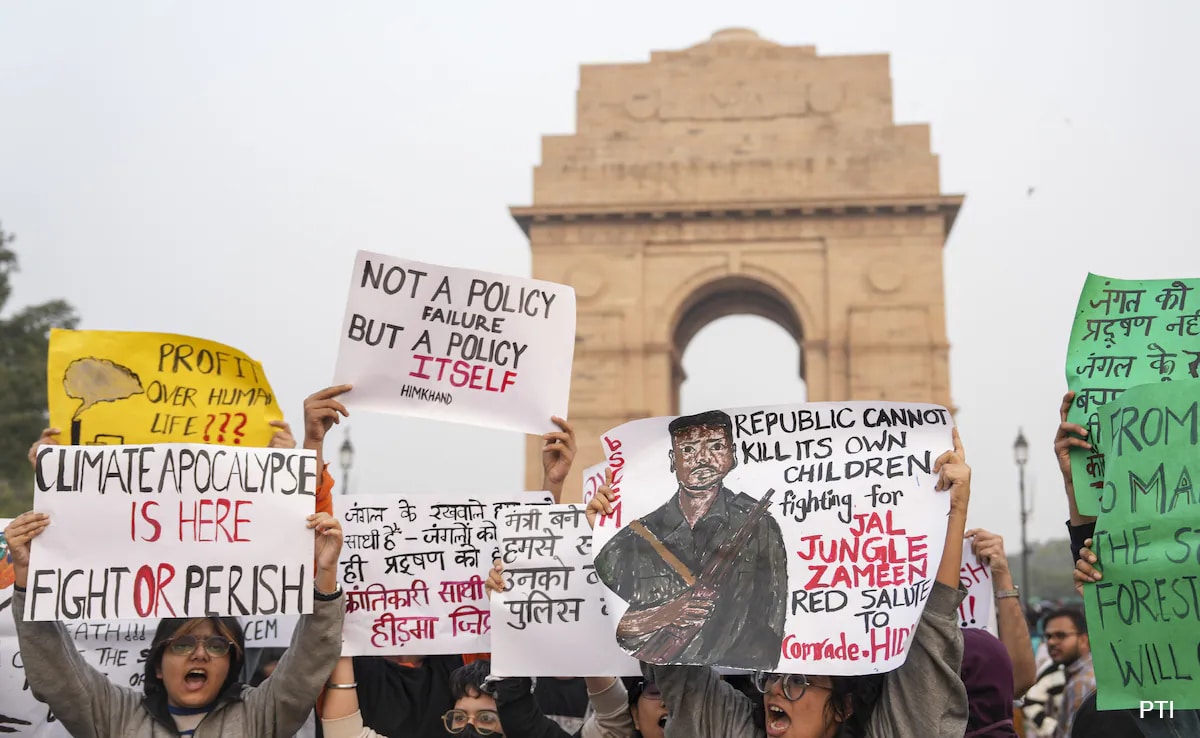
The FIR said the protesters raised alleged Maoist slogans.
New Delhi:
The Delhi Police has invoked charges under 'imputations and assertions prejudicial to national integration' in one of the FIRs registered against a group of protesters who allegedly raised pro-Maoist slogans and used pepper spray on police personnel during an anti-pollution demonstration at the India Gate on Sunday, an official said on Tuesday.
On Monday, the Delhi Police told a court here that the group of protesters arrested for allegedly using pepper spray on cops raised slogans hailing slain Maoist leader Madvi Hidma.
The police have registered two different FIRs -- one at the Kartavya Path police station against six protesters and the other at the Sansad Marg police station against 17 people.
The new section has been added to the Kartavya Path FIR. After the accused were produced before two magisterial courts, 22 were sent to judicial custody.
The newly-added Section 197 of the Bharatiya Nyaya Sanhita (BNS) pertains to imputations and assertions prejudicial to national integration, which includes charges for disseminating false information that endangers India's sovereignty, unity, or security.
The FIR said the protesters raised alleged Maoist slogans, including "Hidma amar rahe", "Kitne Hidma maroge, har ghar se Hidma nikalega" and "Hidma lal salaam", prompting the addition of Section 197 for assertions deemed prejudicial to national integration.
Top Maoist commander Madvi Hidma, who masterminded several attacks over the past two decades, was killed in an encounter on November 18, a breakthrough the Chhattisgarh Police described as the "last nail in the coffin" of the insurgency.
Security forces gunned down Hidma, his wife Raje, and four other Naxalites in the action in Andhra Pradesh's Alluri Sitaramaraju district.
According to the Kartavya Path FIR, police had prior information that protesters under the banner of the Delhi Coordination Committee for Clean Air were planning to assemble at the India Gate.
They were also informed that activists from student groups, including AISA and the JNU Students' Union (JNUSU), were likely to join the protest.
“When we reached the spot, we found a group of men and women carrying pamphlets and banners. They were informed that protests are not allowed at the India Gate and that the Jantar Mantar is the designated site for demonstrations," a senior police officer said.
Despite repeated warnings, several protesters climbed over barricades and entered the C-Hexagon, blocking traffic for over an hour.
As police attempted to disperse them, some protesters allegedly assaulted them. “During the scuffle, a student attacked police, and some used a bottle containing pepper spray on our officers,” police said.
Several policemen were injured and taken to the RML Hospital.
Another confrontation reportedly broke out at the Parliament Street police station when the detainees were brought there, officials said.
The Kartavya Path FIR now includes sections 74, 79, 115(2), 132, 197, 221 and 223 of the BSS, while the FIR lodged at the Parliament Street police station includes charges under BNS sections 223A, 132, 221, 121A and 126(2).
(Except for the headline, this story has not been edited by NDTV staff and is published from a syndicated feed.)
Published: November 25, 2025 10:23 IST
also read
Delhi Air "Silent Epidemic": Ex-AIIMS Chief On Why People Are Falling Sick
Reported by Sneha Mordani, Edited by Prapti UpadhayayClasses In Hybrid Mode, Restrictions On Cars: What Changes Under GRAP-III
NDTV News DeskStricter Pollution Curbs Under GRAP-III Imposed In Delhi-NCR Ahead Of Diwali
Reported by Reet Kaur Sahni
 Reported by Sneha Mordani, Edited by Prapti Upadhayay | Friday November 06, 2026 , New Delhi
Dr Guleria said there is growing evidence, from India and abroad, that living for long in polluted air raises the risk of lung cancer. He said poor air exposes the lungs to mutations, and both lab studies and clinical data suggest the risk rises among non-smokers as well.
- Written by Ambika Singh Kahma | Friday November 06, 2026
Lung cancer cases are rising among women, younger people, and non-smokers, highlighting risks beyond tobacco such as air pollution.
- Written by Vishesh Nagar | Friday November 06, 2026
From Delhi's AQI of 275 to Bengaluru's 60, here's how air quality compares across six Indian cities.
- Friday November 06, 2026 , New Delhi
The Commission for Air Quality Management (CAQM) on Friday invoked Stage-III of the Graded Response Action Plan (GRAP) across Delhi and the entire National Capital Region, amid an increase in pollution levels in the National Capital Region (NCR).
- NDTV News Desk | Friday November 06, 2026 , Delhi
While GRAP-III is typically invoked when the air quality turns "severe" and the AQI hits 400, the pollution board invoked it early as a precautionary measure.
................................ Advertisement ................................
दीवाली की चौखट पर दिल्ली में सांसों का संकट: 30 साल की स्टडी ने हरियाली को लेकर क्या बताया?
Thursday November 05, 2026अध्ययन में हरियाली की मात्रा के साथ उसके फैलाव और आपसी जुड़ाव को भी महत्वपूर्ण पाया गया. जिन इलाकों में हरियाली ज्यादा बिखरी हुई थी, वहां सतही तापमान अधिक रहा. इसके विपरीत, बड़े और आपस में जुड़े हरित क्षेत्रों में तापमान कम पाया गया.
Opinion: Why Delhi's Smog Can't Be Fixed From SpaceDavid Fickling, Bloomberg
Monday October 19, 2026The clearest sign that Delhi is on a path to cleaner air would be a decline in the amount of paddy grown nearby, and therefore the acreage liable to be burned each year.
Don't Normalise Air Purifiers As Delhi Chokes | The Reason Why
Thursday December 11, 2025More than 90 cities in the world's top 100 polluting list are in India. With every passing year, the AQI is rising, reaching 'hazardous' levels.
Blog | Well Done, Delhi. You've Turned Lung Sacrifice Into A Badge Of HonourSaikat Kumar Bose
Monday November 10, 2025Till some years back, Delhiites would ask angry questions to those in power about the capitals annual tryst with toxic air. This has changed. Those in the driving seat dont see the need to answer now.
Opinion | Why Indians Have Just Given Up On Air Pollution CrisisTanushree Ganguly
Friday December 20, 2024While some may argue that people in Delhi are now more aware of air pollution than they were a decade back, my rebuttal would be that awareness does not mean that people are concerned.




