


- Home/
- AIIMS Delhi Doctors Conduct Remote Ultrasound Scans On Volunteers In Antarctica
AIIMS Delhi Doctors Conduct Remote Ultrasound Scans On Volunteers In Antarctica
Press Trust of India | Updated: February 04, 2026 10:51 IST
Highlights
- AIIMS Delhi remotely conducted ultrasound scans on volunteers in Antarctica using telerobotic technology
- The system was co-developed by IIT Delhi and AIIMS, enabling expert radiological care across extreme locations
- The project involved AIIMS, IIT Delhi, NCPOR, IHFC, and RGSSH, highlighting strong institutional collaboration
New Delhi:
Recently, a team at AIIMS Delhi performed ultrasound scans on a group of volunteers. This medical procedure would seem usual; however, it was anything but — the subjects were not physically present at AIIMS. They were in Antarctica. The real-time scans were performed remotely using a telerobotic ultrasound system on volunteers of the Indian Antarctica station, Maitri. This technology demonstration was led by Dr Chandrashekhara SH, professor in the Department of Radiodiagnosis, IRCH, and was conducted on the AIIMS Research Day 2026 on Friday.
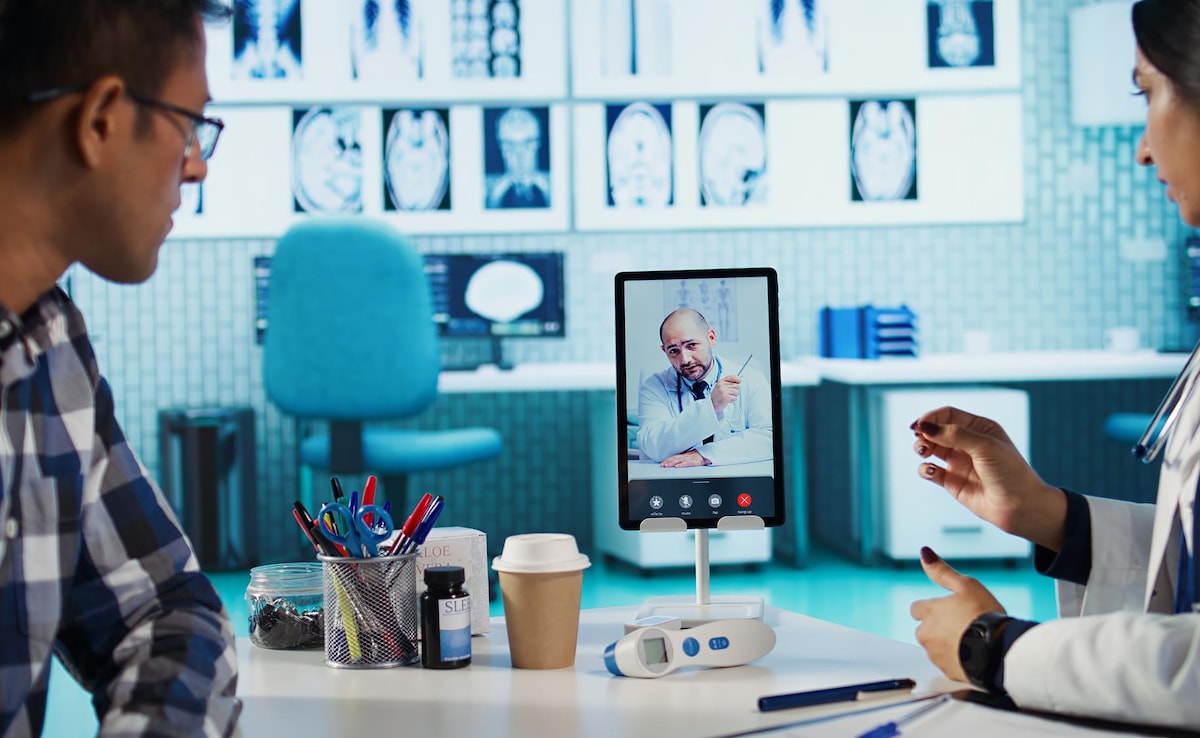
Using the advanced telerobotic ultrasound system, the clinician remotely controlled a robotic arm holding an ultrasound probe, demonstrating the feasibility of expert radiological care across extreme geographical and climatic barriers, AIIMS said in a statement.
The system uses a robotic arm controlled remotely to position the ultrasound probe, while images are streamed back to the clinician in Delhi, it said.
The system was co-developed by IIT and AIIMS Delhi in 2022.
This demonstration was the combined project of AIIMS, IIT Delhi, I-Hub Foundation for Cobotics (IHFC), National Centre for Polar and Ocean Research (NCPOR) and Rajiv Gandhi Superspeciality hospital (RGSSH).
Dr Subir Kumar Saha, IIT professor and IHFC project director, was instrumental in developing and refining the robotic system, ensuring precision control, robustness and reliable remote operation, all of which are essential for deployment in extreme and isolated environments.
Dedicated efforts of young researchers, Udayan Banerjee and Siddharth Gupta, in system installation, technical setup and extensive groundwork were crucial in translating this concept into operational reality, the statement said.
Recognising its potential beyond hospitals, Dr Vikas Dogra from RGHS, long associated with the Indian Antarctic Programme, envisioned deploying this technology at Indian Antarctic stations. Drawing upon his first-hand experience of medical challenges in Antarctica, the idea of deploying telerobotic ultrasound at Indian Antarctic stations was conceived, the statement said.
A project of this national importance required strong institutional vision and logistical stewardship, which came from the National Centre for Polar and Ocean Research (NCPOR), it stated.
Healthcare delivery in Antarctica presents extraordinary challenges, the statement said.
Members of the Indian Antarctic Expeditions work in extreme cold, complete geographical isolation, and with very limited medical infrastructure, it said.
When sudden medical emergencies arise, such as trauma, acute abdominal pain, chest symptoms, or suspected internal injuries, critical decisions regarding on-site management versus medical evacuation must be made swiftly and accurately.
In such settings, diagnostic uncertainty can cost precious time and lives.
It is in this context that telerobotic ultrasound emerges as a truly transformative solution, it said.
(Except for the headline, this story has not been edited by NDTV staff and is published from a syndicated feed.)
Published: February 03, 2026 23:38 IST
also read
 Karin Modig, The Conversation | Tuesday February 03, 2026
A new study published in Science has challenged this view, suggesting the genetic contribution might be considerably higher.
- Asian News International | Monday February 02, 2026 , New Delhi
Several parts of the national capital woke up to dense fog on Monday morning, with the Air Quality Index (AQI) remaining in the moderate to poor categories according to the Central Pollution Control Board (CPCB) data.
- Reported by Shreya Ghosh | Sunday February 01, 2026 , New Delhi
India's fight against toxic air just took a hit. The 2026-27 Budget allocated only Rs 1,091 crore to pollution control - down from Rs 1,300 crore last year.
- Sunday February 01, 2026
Several parts of Delhi and the wider National Capital Region (NCR) witnessed light rain during the intervening night of Saturday and Sunday. The India Meteorological Department (IMD) has forecast a drop in the maximum temperature for today.
- Press Trust of India | Saturday January 31, 2026
The air quality in Delhi has shown slight deterioration this January compared to last year, with the average Air Quality Index (AQI) till January 30 standing at 307, compared to 306 during the same period in 2025, according to an analysis

................................ Advertisement ................................

Blog | Well Done, Delhi. You've Turned Lung Sacrifice Into A Badge Of HonourSaikat Kumar Bose
Monday November 10, 2025Till some years back, Delhiites would ask angry questions to those in power about the capitals annual tryst with toxic air. This has changed. Those in the driving seat dont see the need to answer now.
Opinion | Why Indians Have Just Given Up On Air Pollution CrisisTanushree Ganguly
Friday December 20, 2024While some may argue that people in Delhi are now more aware of air pollution than they were a decade back, my rebuttal would be that awareness does not mean that people are concerned.
Opinion | You Must Outrage Over Filthy Air More Than Once A YearJyoti Pande Lavakare
Tuesday December 10, 2024Delhi welcomed us with monsoon rains and mangos. We were home. Fast forward a couple of years, in the winter of 2012, I found myself in denial about something other parents, mostly expats, were calling toxic air.
Opinion | Delhi's Air Pollution Situation Is Like A Bad MarriageNishtha Gautam
Friday November 22, 2024On a good day, such as today, the AQI reading in Delhi is 407. We are jubilant at the sickly sunshine trickling through the slightly dissipated smog. At least its not 1600.
दिवाली... पराली... सियासी जुगाली!Ashwini kumar
Monday November 18, 2024दिल्ली-एनसीआर में प्रदूषण का समाधान तो आज तक मिला नहीं. हर साल चिंतित होकर हम-आप सांसों की तकलीफ के साथ-साथ दिल और ब्लड प्रेशर के मरीज भी क्यों बनें?


