


- Home/
- Toxic Airborne Pollutants From Bombing In Iran Pose Serious Health Risks
Toxic Airborne Pollutants From Bombing In Iran Pose Serious Health Risks
The Conversation | Updated: March 17, 2026 14:02 IST
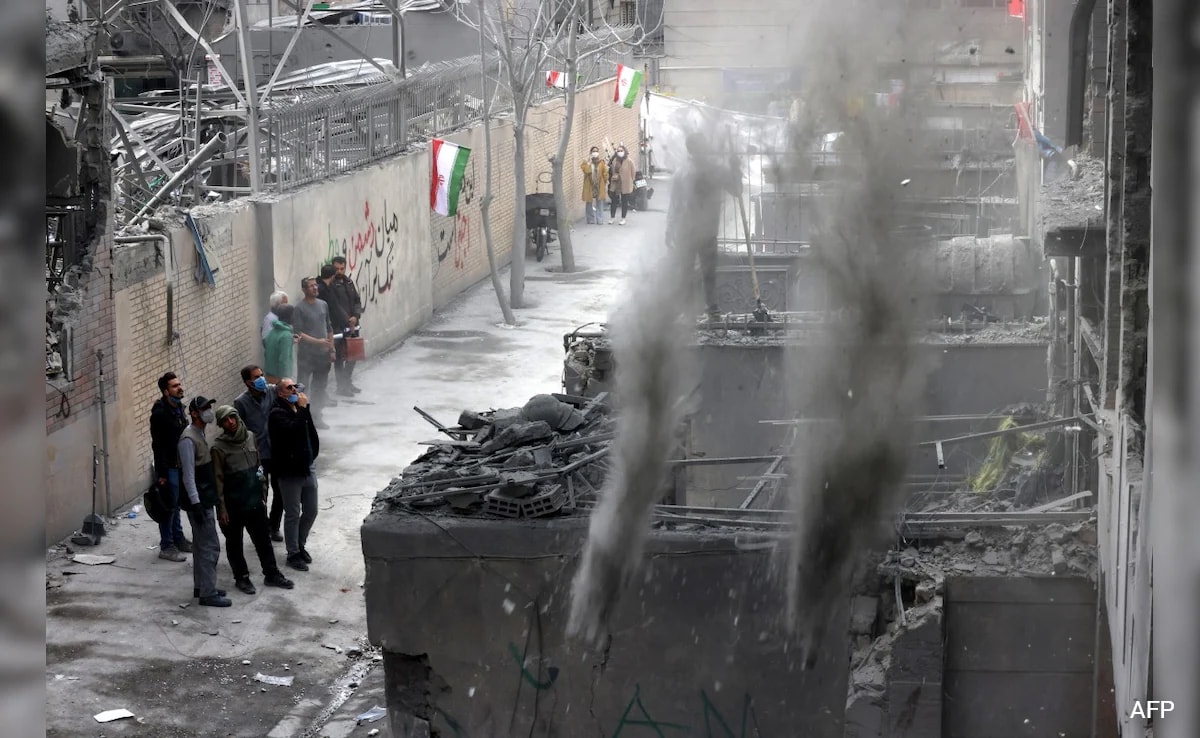
Tehran has another challenge when it comes to pollution because of its terrain
Highlights
- Military strikes in Tehran and Beirut release toxic debris into the air affecting millions of residents
- Damage to missile stockpiles and oil facilities emits harmful pollutants like heavy metals and soot
- Toxic black rain from burning oil depots worsens air quality and poses respiratory health risks
The waves of US and Israeli bomb strikes in Tehranand Beirut, and Iran's missile and drone attacks on neighboring countries in response, are damaging more than buildings – they are sending toxic debris into the air in cities that are home to millions of people.
Military strikes have hit Iran's missile stockpiles, nuclear facilities and oil refineries. When a strike set fire to an oil depot, it sent toxic black clouds billowing over Tehran and created oily rain that settled on buildings, cars and people. Residents described having headaches and difficulty breathing.
As a chemical and environmental engineer who studies the behavior and effects of airborne particles, I have been following the damage reports to understand the health risks residents are facing as toxic materials get into the air. The risks come from many sources, from heavy metals in the munitions themselves to the materials sent airborne by what they blow apart.

The invisible enemy during war: Air pollution
A disaster's effects on air quality and public health depend in large part on what is being destroyed.
The terrorist attacks on New York City's World Trade Center on September 11, 2001, were localised, but they ejected massive bursts of pollutants into the air. These included gases such as volatile organic compounds and particulates – often called aerosols – containing a myriad of substances, such as dust, polycyclic aromatic hydrocarbons, metals, asbestos and polychlorinated biphenyls.
These pollutants can harm the lungs, making breathing difficult, and worsen cardiovascular problems, contributing to heart attacks, among other health damage. Tiny particles smaller than 2.5 micrometers, called PM2.5, are especially harmful because they can travel deep into the human respiratory system. But larger particles can also bring major airborne health risks.
When buildings are heavily damaged or collapse, the rubble often contains crushed concrete, gypsum and carcinogenic fibrous materials, such as asbestos. Even after the initial dust settles, wind and other disturbances, including efforts to find survivors or clear the rubble, can send those materials back into the air, putting more people at risk.
Many rescue and recovery workers who responded to the World Trade Center collapse in 2001 developed chronic respiratory problems. That's also a risk for people searching for survivors in bombed buildings after military strikes and later when cleaning up the debris.
Fires create additional hazards as vehicles, buildings and the chemicals and other materials in them burn. The January 2025 fires in Los Angeles sent a stew of dangerous particles and gases into the lower atmosphere. Studies have shown how lead particles that fell to the ground were kicked back up into the air again where people could inhale them, along with other contaminants.
Munitions and oil facilities
Military attacks degrade air quality in other ways. The Gaza Strip, Iraq, Kuwait, Ukraine and most recently Iran and surrounding countries have all faced extensive damage from munitions, which contain toxic materials. Bombs and artillery often contain explosives and heavy metals, such as lead and mercury, which also contaminate soil, water and the environment.
When oil storage facilities and pipelines are damaged, they emit an especially harmful cocktail of pollutants. This chemical blend includes airborne soot particles, which darken the sky and contribute to the “black rain” observed in Iran.

During the Gulf War in 1991, downwind countries experienced similar polluted rain as Kuwait's oil fields burned. The U.S. Department of Defense found that the smoke plumes contained sulfur dioxide and nitrogen oxides, among other gases and soot.
The severe consequences of environmental pollution during wars prompted the U.S. National Academies of Science, Engineering, and Medicine to publish a series of reports on Gulf War military veterans' health, starting in the early 2000s. They documented illnesses soldiers suffered after being exposed to chemicals and heavy metals, including from oil well fires. They also examined scientific evidence on potential associations between pollution in war and reproductive and developmental effects in the veterans' children.
Getting pollution out of the air
Nature, including rain and wind, can help reduce the pollution levels in the air.
Rain helps pull particles out of the air, depositing them back on the ground and surfaces. The raindrops form around particles and also collect more particles as they fall. However, rain has occurred only sporadically since the military attacks began in Iran.
And rain also contributes to runoff into streams, and pollutants can damage crops and contaminate waterways, soil and vegetation.
Wind can help blow pollutants out of an area, though at the expense of downwind sites.

Tehran has another challenge when it comes to pollution because of its terrain. The city is surrounded by mountains and prone to the effects of low-altitude temperature inversions in the wintertime, which concentrates pollutants even more by holding them closer to the ground. These attacks have been slightly outside the coldest periods for Tehran, allowing for deeper mixing of air, but the inversion still has an effect.
Can people in war zones protect their health?
People in war zones, where they are already under stress, can reduce their health risks by staying indoors in the days after military attacks, if possible. Keeping windows and doors closed can help reduce the amount of polluted ambient air that comes inside.
Indoor air quality is just as important as the air outside. For example, infants crawling on floors can be exposed to deposited particles with toxic materials that are tracked in or blow in under sills and doors, similar to wildfire smoke exposure.
As buildings continue to smolder and clearing debris sends harmful particles back into the air, the pollutants can also contaminate agriculture and waterways. People can try to avoid crops, water and seafood that were likely to have been affected by toxic airborne pollutants. However, getting information about risks gets harder in a time of war, and scarcity can leave people with few choices.
Armin Sorooshian, Professor of Chemical and Environmental Engineering, University of Arizona
This article is republished from The Conversation under a Creative Commons license. Read the original article.
(Except for the headline, this story has not been edited by NDTV staff and is published from a syndicated feed.)
Published: March 17, 2026 13:00 IST
 Reported by Reet Kaur Sahni | Friday August 07, 2026
As per the ministry, prior Environmental Clearance becomes mandatory for data centres depending on their physical footprint under Schedule 8 of the EIA Notification, 2006.
- Written by Sambhav Kumar | Thursday August 06, 2026
Keerthy Suresh's 41-hour no-sleep stretch highlights the intense demands many professionals face, but experts warn that prolonged sleep deprivation should never become routine.
- Written by Sambhav Kumar | Wednesday August 05, 2026
Preliminary evidence suggests the blood filtration treatment could reduce some microplastic particles, though findings are limited and require more study.
- Monday August 03, 2026 , New Delhi
Study reveals black crust from pollution weakens Humayuns Tomb sandstone
- Written by Debosmita Ghosh | Saturday August 01, 2026
Lung cancer is often diagnosed at an advanced stage because its early symptoms are easy to overlook. A persistent cough is among the most commonly ignored warning signs.



................................ Advertisement ................................

Blog | Well Done, Delhi. You've Turned Lung Sacrifice Into A Badge Of HonourSaikat Kumar Bose
Monday November 10, 2025Till some years back, Delhiites would ask angry questions to those in power about the capitals annual tryst with toxic air. This has changed. Those in the driving seat dont see the need to answer now.
Opinion | Why Indians Have Just Given Up On Air Pollution CrisisTanushree Ganguly
Friday December 20, 2024While some may argue that people in Delhi are now more aware of air pollution than they were a decade back, my rebuttal would be that awareness does not mean that people are concerned.
Opinion | You Must Outrage Over Filthy Air More Than Once A YearJyoti Pande Lavakare
Tuesday December 10, 2024Delhi welcomed us with monsoon rains and mangos. We were home. Fast forward a couple of years, in the winter of 2012, I found myself in denial about something other parents, mostly expats, were calling toxic air.
Opinion | Delhi's Air Pollution Situation Is Like A Bad MarriageNishtha Gautam
Friday November 22, 2024On a good day, such as today, the AQI reading in Delhi is 407. We are jubilant at the sickly sunshine trickling through the slightly dissipated smog. At least its not 1600.
दिवाली... पराली... सियासी जुगाली!Ashwini kumar
Monday November 18, 2024दिल्ली-एनसीआर में प्रदूषण का समाधान तो आज तक मिला नहीं. हर साल चिंतित होकर हम-आप सांसों की तकलीफ के साथ-साथ दिल और ब्लड प्रेशर के मरीज भी क्यों बनें?


