


- Home/
- 'Washington Needs Delhi As A Friend': US-India Forum Head On Trade Deal
'Washington Needs Delhi As A Friend': US-India Forum Head On Trade Deal
Reported by Aditya Raj Kaul | Updated: February 03, 2026 21:33 IST
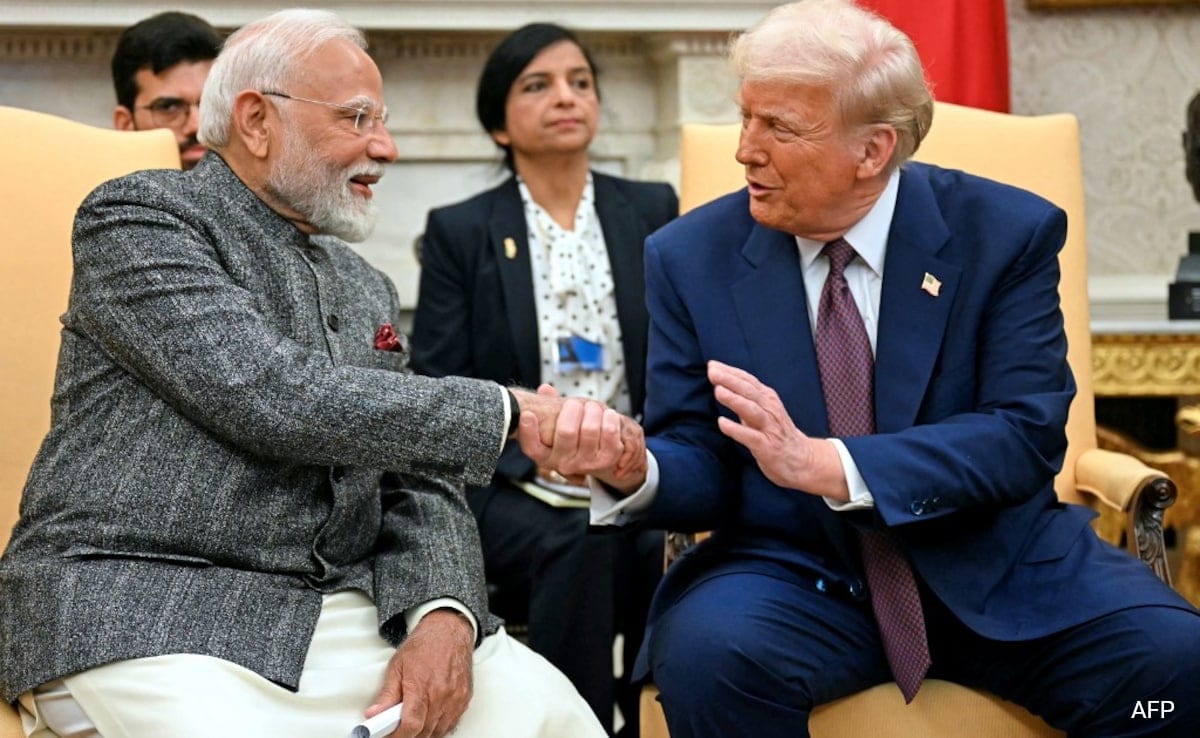
US and India have sealed a trade deal that slashes US tariffs on Indian goods from 50% to 18%
In a significant breakthrough after months of tense negotiations and public sparring, Washington and New Delhi have sealed a trade deal that slashes US tariffs on Indian goods from 50 per cent to 18 per cent. While the fine print is still awaited, industry leaders are already calling it a turning point not just for trade, but for geopolitics.
Speaking exclusively to NDTV's Senior Executive Editor Aditya Raj Kaul, Mukesh Aghi, President and CEO of the US India Strategic Partnership Forum (USISPF), described the agreement as far more than a tariff adjustment.
"It's a win-win for the people of the US and India. You have to ignore the domestic noise created by politicians on both sides. Overall, this is a partnership that goes beyond trade and will have a geopolitical impact."
India's Tariff Edge Over China and Asia
Aghi emphasised that the 18 per cent tariff rate places India in a uniquely advantageous position compared to other Asian manufacturing hubs.
China currently faces 24 per cent tariffs, Vietnam and Bangladesh 20 per cent, and Pakistan 19 per cent. "It sends a message that for President Trump, India is very important," Aghi said.
For American companies pursuing a "China-plus-one" strategy, the math now favours India.
"All the components coming from China into the US are subject to a 34 per cent tariff. Now we are coming down to 18. That has a very different impact."
The reduced tariffs are expected to boost India's labour-intensive exports and strengthen US supply chains that are increasingly diversifying away from China.
Russian Oil: Adjustment, Not Compromise
One of the most sensitive aspects of the negotiations reportedly involved US concerns over India's continued purchase of Russian oil. Aghi acknowledged that energy sourcing did factor into the talks but rejected the notion that India had compromised its strategic autonomy.
"When you make partnerships, you have to adjust to other people's needs without sacrificing national interest. India is a proud nation and will decide what's good for India."
He pointed out that India had already begun reducing Russian oil purchases following sanctions on two Russian companies and suggested that imports would gradually shift toward the US and other suppliers like Venezuela.
"It may not stop overnight, but you will see a reduction coming through."
Business Sentiment Remains Strong
Despite months of trade uncertainty, Aghi revealed that global corporate sentiment toward India has remained overwhelmingly positive.
"I have talked to over 100 global CEOs in the last six months. Not a single one told me they were reducing investment in India."
He highlighted the rise of over 2,000 Global Capability Centers in India, 60 per cent of them American, engaged in high-end R&D and innovation. In the past two years alone, these centres have generated over 300,000 intellectual property filings.
This, he said, underscores why India continues to be seen as indispensable in global supply chains.
A Broader FTA Wave Toward India
The US deal comes amid a flurry of trade agreements India has recently signed with the UK, New Zealand, Oman, and the European Union after nearly two decades of negotiations.
According to Aghi, this is no coincidence.
"When tariffs are rising from the US side, countries are asking where else they can pursue market access. India, with 1.4 billion people and a $4 trillion economy growing at 7-8 per cent, becomes critical."
He cited Apple as a case study: five years ago, Apple had negligible domestic sales in India. Today, it records over $9 billion in domestic revenue, and exports from India have surged, with iPhone production increasingly based in the country.
"This is the story of making India for India and making India for the world."
The $500 Billion Ambition
Trump has spoken of a potential $500 billion trade target between the two nations. Aghi believes this is realistic over a five- to seven-year horizon.
India imports over $120 billion worth of energy annually and is a major defence buyer. Redirecting a portion of this toward the US is, in his view, a natural evolution of a deepening partnership.
"That number looks very big today, but over the long term it is achievable."
Geopolitics Driving Convergence
Aghi repeatedly stressed that the trade deal cannot be viewed in isolation from the geopolitical context. With China becoming "more aggressive and assertive", both Washington and New Delhi are seeing greater strategic alignment, particularly in the Indo-Pacific.
"India has a friend in the US, and the US needs India as a friend."
He noted that despite earlier rhetorical tensions, the personal rapport between Trump and Prime Minister Narendra Modi remained intact, helping smooth the path to the agreement.
The Real Challenge: Ease of Doing Business
If there is one area Aghi believes India must continue to improve, it is the ease of doing business.
"Make things easier, make things smoother. That's still a fundamental issue companies face."
He acknowledged recent progress in infrastructure, customs reforms, and supply chain facilitation but said sustained focus here would be critical to converting tariff advantages into real economic gains.
A Deal for an Uncertain World
In closing, Aghi reflected on the broader global disorder marked by weakening international norms and rising "might is right" geopolitics.
"This tells India you have to become self-sufficient and stronger economically and militarily. We are moving into a very uncertain world."
Against that backdrop, the US-India trade deal, he suggested, offers a rare moment of optimism.
"It's about people, technology, geopolitics – much bigger than trade," Aghi said. "Let's celebrate the 18 per cent and keep working to bring it down further."
Published: February 03, 2026 21:21 IST
also read
 Karin Modig, The Conversation | Tuesday February 03, 2026
A new study published in Science has challenged this view, suggesting the genetic contribution might be considerably higher.
- Asian News International | Monday February 02, 2026 , New Delhi
Several parts of the national capital woke up to dense fog on Monday morning, with the Air Quality Index (AQI) remaining in the moderate to poor categories according to the Central Pollution Control Board (CPCB) data.
- Reported by Shreya Ghosh | Sunday February 01, 2026 , New Delhi
India's fight against toxic air just took a hit. The 2026-27 Budget allocated only Rs 1,091 crore to pollution control - down from Rs 1,300 crore last year.
- Sunday February 01, 2026
Several parts of Delhi and the wider National Capital Region (NCR) witnessed light rain during the intervening night of Saturday and Sunday. The India Meteorological Department (IMD) has forecast a drop in the maximum temperature for today.
- Press Trust of India | Saturday January 31, 2026
The air quality in Delhi has shown slight deterioration this January compared to last year, with the average Air Quality Index (AQI) till January 30 standing at 307, compared to 306 during the same period in 2025, according to an analysis





................................ Advertisement ................................


Blog | Well Done, Delhi. You've Turned Lung Sacrifice Into A Badge Of HonourSaikat Kumar Bose
Monday November 10, 2025Till some years back, Delhiites would ask angry questions to those in power about the capitals annual tryst with toxic air. This has changed. Those in the driving seat dont see the need to answer now.
Opinion | Why Indians Have Just Given Up On Air Pollution CrisisTanushree Ganguly
Friday December 20, 2024While some may argue that people in Delhi are now more aware of air pollution than they were a decade back, my rebuttal would be that awareness does not mean that people are concerned.
Opinion | You Must Outrage Over Filthy Air More Than Once A YearJyoti Pande Lavakare
Tuesday December 10, 2024Delhi welcomed us with monsoon rains and mangos. We were home. Fast forward a couple of years, in the winter of 2012, I found myself in denial about something other parents, mostly expats, were calling toxic air.
Opinion | Delhi's Air Pollution Situation Is Like A Bad MarriageNishtha Gautam
Friday November 22, 2024On a good day, such as today, the AQI reading in Delhi is 407. We are jubilant at the sickly sunshine trickling through the slightly dissipated smog. At least its not 1600.
दिवाली... पराली... सियासी जुगाली!Ashwini kumar
Monday November 18, 2024दिल्ली-एनसीआर में प्रदूषण का समाधान तो आज तक मिला नहीं. हर साल चिंतित होकर हम-आप सांसों की तकलीफ के साथ-साथ दिल और ब्लड प्रेशर के मरीज भी क्यों बनें?


