




- Home/
- It's A Race Against Time For Rohit Bal's Team Of Kashmiri Women Stitching Clothes For The Lakme Fashion Week
It's A Race Against Time For Rohit Bal's Team Of Kashmiri Women Stitching Clothes For The Lakme Fashion Week
Delhi:
Kashmir's striking beauty fails to hide its grave reality. Among various issues that the state is grappling with, literacy rate, especially among women is a cause of concern. And then there is the issue of unemployment. Centre for Monitoring Indian Economy Report 2017, noted that Jammu and Kashmir had the highest unemployment rate in India, just above 12 per cent - higher than the national average at the time of 4.7 per cent. The prolonged violence in the state has prevented girls and women from stepping out of their homes for decades.
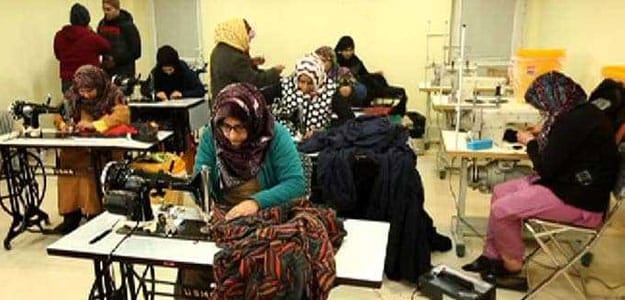
The Usha Silai School initiative forayed into Kashmir in 2012 to set up a training centre to tap into the state's talent pool and give some of its women an avenue to become self-reliant. What began as a small initiative to train women to stitch clothes, took a larger than life dimension for these women, when the trainees at the Silai school became a part of the Silai Label movement in 2018.
USHA's very own fashion label 'Silai' gives a big push to the humble dreams of many women from rural areas who have been trained at USHA Silai Schools. For the creation of the label, women from the Silai schools were given an opportunity to enhance their skills and 32 women were selected to be mentored by professional fashion designers.
Also Read: Silai School Opens Up An Opportunity For Women In Kashmir To Be Part Of The Lakme Fashion Week
As part of the Silai label, few women from the Jammu and Kashmir production unit will be selected after a rigorous assessment process. These select few will then work with ace designer Rohit Bal to stitch the clothes he will showcase at the Lakme Fashion Week.
The journey has not been an easy one, yet the women brought themselves one step closer to having their clothes shown at the Lakme Fashion Week, with the ace fashion designer Rohit Bal and his team working to train the women and guiding them every step of the way. The shortlisted women were made to travel to Delhi for the first time, for the assessment of the samples made by them.
The assessment was done by Rohit Bal himself and the women did not disappoint him. He was impressed with what the women achieved during their training to replicate some of the samples sent by him. In the ace designer's words, the team did an exceptional job to meet his expectations and whatever scope for improvement remained; he had no doubts that these women had the capability to match the quality standards he aspires for.
Post the Delhi visit, the journey of their dreams was well and truly underway. The hard work resumed once they returned to Kashmir for the next stage – the final production and the ladies had a lot of ground to cover.
That's when Chilai Kalan approached, the 40 day period, when winter is at its harshest in Kashmir. People in the valley face extreme hardships during these 40 days as the region is gripped by intense cold with high chances of snowfall and rain and the minimum temperature dropping to as low as minus 4.4 degree Celsius.
Also Read: Silai School Opens Up An Opportunity For Women In Kashmir To Be Part Of The Lakme Fashion Week
It was in the middle of this adverse weather conditions that the production for Rohit Bal's line began at the Usha Silai School in Srinagar. The harsh weather in the valley was adding up to the existing challenges of a stiff timeline of delivering the products. With time already running out, an addition to the existing work load emerged; a requirement of 10 more samples was made.
Given the unavoidable circumstances, the team decided to shift the production from Srinagar to Gurugram (Gurgaon) near Delhi. Shifting the production centre proved to be a good decision, the work picked up pace and it helped the production get to the final stage faster.
Just a couple of days remained before the final garments are sent to Rohit Bal's studio, and their creators move closer to the dream of taking center stage at the Lakme Fashion Week 2019.
Published: April 10, 2019 15:38 IST
also read
In Karnataka's Chikkballapur, Nutritional Rehabilitation Centres Are Pulling Children Out Of Malnutrition
Reported by Maya Sharma, Written by Aastha Ahuja#Reimagine Telethon: How Can We Protect The Vulnerable Children Affected By COVID-19? Experts, Social Workers & Celebrities Discuss
Written by Anisha BhatiaHow Odisha Government Is Taking The School To Children's Home, Ensuring Learning During COVID-19 Pandemic
Reported by Saurabh Gupta, Written by Aastha Ahuja
Comments