




- Home/
- Minaben- The Woman Who Embraced Her Struggles And Flourished As An USHA Master Trainer
Minaben- The Woman Who Embraced Her Struggles And Flourished As An USHA Master Trainer
Team NDTV | Updated: December 08, 2022 16:14 IST
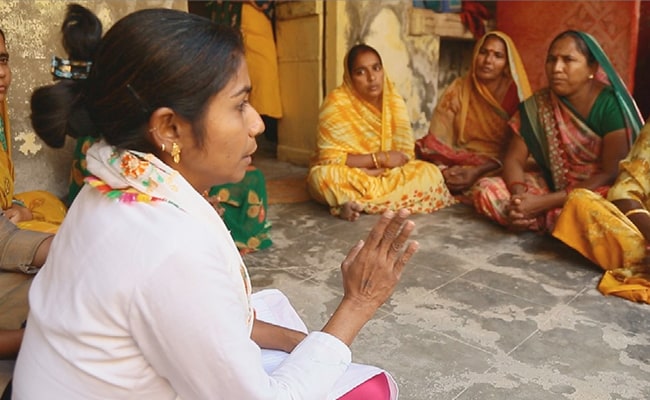
Disability - The very word is quick to suggest a person's inability to do things. Sometimes people can be disabled by their struggles, and sometimes their physical disability can become a persistent struggle. Every time we call someone 'disabled', we unknowingly limit their personality to their condition. Ms. Minaben, a resident of Dholka, Gujarat, has been battling and continues to battle the social prejudice surrounding disability for 42 years, but she chooses to smile through her sorrows.
In the past 7 years, she has transitioned from an USHA Silai School learner to a Master Trainer and is now working as a Local Resource Person. She said,
I am comfortable with stitching, and I also teach stitching. There are women who are unable to step outside of their homes, but they are keen to learn. I go and meet them. This is my field work, where I listen to the problems that women are facing. There are women who love to learn stitching but are not allowed to step outside of their homes. So, I go to their homes and talk about ways in which work can happen. I have trained 200 women and girls. This batch also had 18 to 20-year-old young girls.
Ms. Minaben and several other women in the villages will soon be a major driving force behind the USHA Silai Schools of the future. USHA created the Local Resource Person (LRP) model to establish a connection between the NGO partners, the beneficiaries, the Master trainers and the community at large. The LRPs help with the dissemination of information and data to keep their 10 lakh learners connected.
USHA Program Coordinator, Vijay Goel, said,
The Local Resource Person model helps us connect with all types of women. They work as a substitute. We pick an LRP from every 10 women that we train as we observe their skills during the course of the training program. We see who can communicate well, has gained confidence, and is enthusiastic to do the work. We identify LRPs and train them to build capacity. We teach them how to visit others and the things that they need to observe, how to work on new things, if income needs to be increased, then what are the sources one can think of, and much more.
Ms. Minaben's limbs were paralysed at the age of 3 due to polio. She spent the majority of her childhood dependent on her family. Even marriage didn't fare well for her. Once she had given her husband what he wanted, a son, she was disposed of. But now she runs a production centre and earns her livelihood making aprons for operation theatres, eye towels, and several other articles for hospitals in Gujarat. Ms. Minaben has struggled a great deal and will continue to struggle, but she has embraced her struggle.
Also Read: Anti Devi's Journey From Despair To Becoming A Local Resource Person
Speaking of her work profile, Ms Minaben said,
Earlier, I used to think that life was too long, and I wondered when it would come to an end. But now I feel that life is short, and I want to live. I want to work and be a part of this collective of women with my sisters. I feel very proud. I want to work all hours of the day and night and do something different. The problem I have faced should not happen to anyone else, and this is what I aim for. I teach women to sew, and if they are not educated, I offer them tuition classes as well. I have created a work from home model for women who are unable to leave their homes.
USHA's production centre has not only given Ms. Minaben a means of livelihood but has also changed her life in other ways. It helped her make friends with whom she could share the weight of her thoughts, her problems, and her joys.
When we asked Ms. Minaben if she was happy, she said,
I really like what BPA and USHA have done for women. I am thankful for it because if it had not come, I would not have known anything. I learned to stitch and now impart the knowledge to other women. Going ahead, I dream of setting up a big production centre. Many women will get employment opportunities and will also learn something new. USHA has done something new each time.
The centre is mainly run by specially-abled women trained by Ms. Minaben. She has never charged a single penny from these women for the training. She believes that she owes this service to every specially-abled woman in society. Every field visit to help other women gives her hope to keep going the next day.
Also Read: Annapurna Devi Makes 1000 Flags For ‘Har Ghar Tiranga' Programme
Published: December 08, 2022 16:08 IST
also read
In Karnataka's Chikkballapur, Nutritional Rehabilitation Centres Are Pulling Children Out Of Malnutrition
Reported by Maya Sharma, Written by Aastha Ahuja#Reimagine Telethon: How Can We Protect The Vulnerable Children Affected By COVID-19? Experts, Social Workers & Celebrities Discuss
Written by Anisha BhatiaHow Odisha Government Is Taking The School To Children's Home, Ensuring Learning During COVID-19 Pandemic
Reported by Saurabh Gupta, Written by Aastha Ahuja