




- Home/
- Partnering For Sustainable Progress: Usha Silai Schools Fuel India's Inclusive Development
Partnering For Sustainable Progress: Usha Silai Schools Fuel India's Inclusive Development
| Updated: February 03, 2026 11:41 IST
New Delhi:
True sustainable development thrives on collaboration. In this story, we dive into how Usha International Ltd. teams up with government bodies to turn national policies into grassroots realities, empowering marginalized communities—especially women and transgender individuals—through skill-building and livelihoods. Empowering the Excluded in West Bengal The story kicks off with the National Institute of Rural Development and Panchayati Raj (NIRDPR), under India's Ministry of Rural Development, partnering with the Centre on Integrated Rural Development for Asia and the Pacific (CIRDAP), PLEQSUS India Foundation, and Usha.
Their Action Lab for Inclusive Livelihoods targets transgender communities in West Bengal, often trapped in multidimensional poverty. Usha Silai Schools deliver hands-on stitching training, providing machines and advanced apparel skills.
Dr. Sandhya Gopakumaran, NIRDPR's Director of Training and Development, explains,
"This aligns with our vision of reaching the unreached for Viksit Bharat 2047, improving rural quality of life through skills."
Dr. P. Chandra Shekara of CIRDAP adds that Usha stabilised the model—training 15 transpersons, with five excelling and eyeing high-end markets. Avinava Dutta, an NIRDPR expert, highlights the ripple effect,
"Usha Silai promotes self-employment, turning trainees into entrepreneurs who employ their own community."
Sudeb Suvana of PLEQSUS dreams big,
"We aim to link these entrepreneurs into a trans-led company, proving they can earn respectfully without begging."
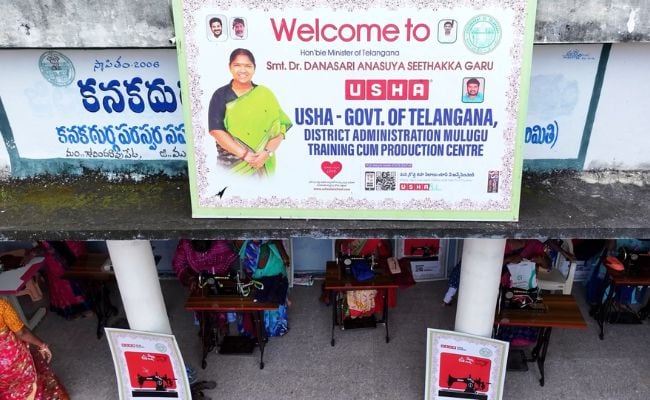
Transforming Lives in Telangana's Mulugu District The journey shifts to Mulugu, Telangana, where District Collector Sri T.S. Divakara, IAS, partnered with Usha to launch training centers for remote tribal women. "Tailoring creates a circular economy," he says, noting quick responsiveness from Usha's team. They've trained 80 women, who now stitch school uniforms, earning steadily and planning bulk apparel orders. Usha Entrepreneurs share triumphs: One woman earned Rs 5,000–6,000 monthly, funding her children's education without relying on her husband. T. Rajkumar, Usha's Program Coordinator, mobilized 30 from the poorest families, securing government work orders worth Rs 1 lakh. Prashanthi beams,
"In 14 days, I learned stitching types—Usha changed our lives."
Reviving Heritage in Meghalaya In Meghalaya, a six-year alliance with the Meghalaya State Rural Livelihoods Society (MSRLS) has set up 17 Training Cum Production Centres, skilling over 250 women. Ram Krishna, MSRLS CEO, praises,
"Usha's centers give women new livelihood options."
Shanlang Lyngdoh notes graduates launching their own units. Highlights include the Saras Aajivika Fair's fashion shows, where women showcase self-stitched designs, blending modern skills with Khneng embroidery—a fading art revived in two villages. Peter Passah, ADC Shillong, says,
"This empowers women to train others, stretching the craft nationwide."
Conrad Sangma emphasises localising livelihoods in this matrilineal society. A Blueprint for Nation-Building These stories—from West Bengal's inclusion drive to Mulugu's economic boost and Meghalaya's cultural revival—showcase Usha Silai Schools as more than trainers: they're knowledge partners fostering self-reliance, market linkages, and dignity. As Dr. Gopakumaran puts it, "Skills and livelihoods offer employability and entrepreneurship in high-demand fields like apparel." Through these synergies, India edges toward equitable growth, proving partnerships scale impact. Usha's 14-year legacy empowers thousands, ensuring no one is left behind in the march to Viksit Bharat.
Published: February 03, 2026 11:41 IST
also read
In Karnataka's Chikkballapur, Nutritional Rehabilitation Centres Are Pulling Children Out Of Malnutrition
Reported by Maya Sharma, Written by Aastha Ahuja#Reimagine Telethon: How Can We Protect The Vulnerable Children Affected By COVID-19? Experts, Social Workers & Celebrities Discuss
Written by Anisha BhatiaHow Odisha Government Is Taking The School To Children's Home, Ensuring Learning During COVID-19 Pandemic
Reported by Saurabh Gupta, Written by Aastha Ahuja