




- Home/
- Threading Hope: Sakuben Ahir's Journey From Challenges To Empowerment
Threading Hope: Sakuben Ahir's Journey From Challenges To Empowerment
Team NDTV | Updated: January 24, 2025 13:36 IST
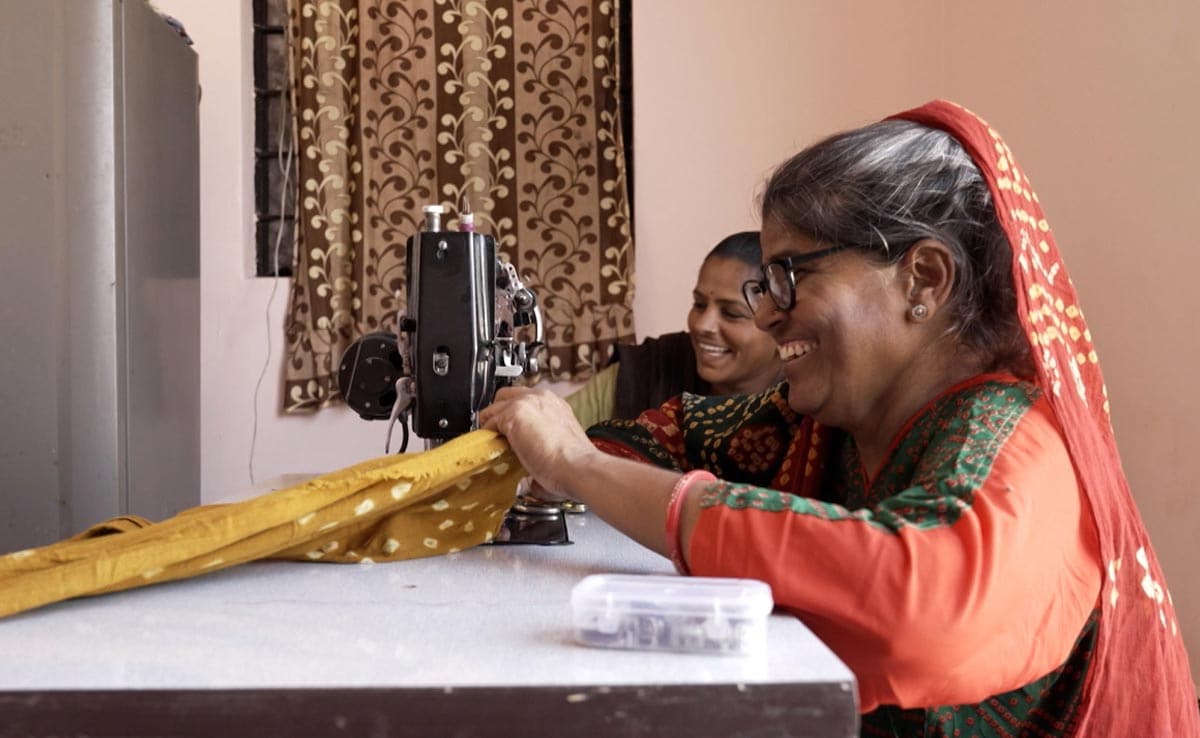
In Bhuj's Padhar Village lies the story of Sakuben Ahir who turned her challenges into opportunities
A life once confined is now unbound by a thread of hope. In the heart of Bhuj's Padhar Village lies a story of resilience and transformation—Sakuben Ahir, a remarkable woman who turned her challenges into opportunities. As a young girl, Sakuben dreamed as vast as the Kutch desert, but fate had other plans. A sudden ailment left her legs numb, altering her life forever. Reflecting on her struggles, Sakuben said,
I was 12 when my feet started turning numb. Despite multiple hospital visits and four surgeries in Udaipur, there was no improvement. My condition was so severe that I couldn't even walk to get myself water. But everything changed when I discovered sewing—it became my life. There were many hurdles. I didn't know what to do. But when I started learning to sew, it gave my life a new purpose. Before that, I was in such a bad state that I barely remember what I went through. I couldn't even walk to get myself a glass of water.
Also Read: Making Women Self-Reliant Through Usha-Common Service Centre Certification
From uncertainty and dependency, Sakuben's journey transformed when her mother encouraged her to learn embroidery. She gained confidence and skill through Usha Silai School, a programme designed to empower marginalised women. Sakuben said,
My mother asked me to learn embroidery. I started sewing and learned embroidery from her. Usha taught me how to sew.
The Usha Silai School's inclusive approach impacts individual lives and fosters societal progress. By empowering women from diverse and marginalised backgrounds, the programme enables them to gain confidence, achieve financial independence, and challenge stereotypes within their communities. Sakuben, who experienced complete immobility in her legs and restricted hand movement, received a customised sewing machine designed to suit her needs. After completing her training, she opened her own Silai School, teaching 20 students and earning Rs. 8,000-10,000 per month.
Geeta, a trainee at Sakuben's Silai School said,
Sakuben, a physically disabled woman near my house, is excellent at teaching sewing. I joined her classes and learned for six months. Now, I am self-sufficient and no longer need to ask my husband for money.
As her entrepreneurial spirit grew, Sakuben started taking orders for special occasions like Navratri and weddings in her village. Her expertise in stitching and design, combined with a deep understanding of cultural traditions, allows her to craft unique bridal outfits, preserving the vibrant heritage of her community. Through her dedication, Sakuben has not only transformed her own life but also uplifted others around her. Her skill in creating exquisite bridal outfits has earned her a respected space within the community.
Also Read: Usha Silai App - Teaching Women The Art Of Stitching And Sewing
Mary Rupa Tete, Vice President, Usha Social Services said,
The Usha Silai School programme is inclusive, supporting women from diverse backgrounds who have faced personal as well as economic challenges such as being single mothers, widows, rape survivors, HIV-positive, physically disabled, among many others. Over the last 13 years, the Usha Silai School programme have touched the lives of over 14 lakh women across India, with a sizable population of physically challenged women from Gujarat, HIV positive women from in and around Tripura and many tribal women from the Eastern, Central and Southern parts of India.
From feeling like a burden to becoming a pillar of strength, Sakuben's story is a reminder that change is possible when we believe in ourselves and support one another, and is a testament to the transformative power of the Usha Silai School programme.
Published: January 07, 2025 15:19 IST
also read
In Karnataka's Chikkballapur, Nutritional Rehabilitation Centres Are Pulling Children Out Of Malnutrition
Reported by Maya Sharma, Written by Aastha Ahuja#Reimagine Telethon: How Can We Protect The Vulnerable Children Affected By COVID-19? Experts, Social Workers & Celebrities Discuss
Written by Anisha BhatiaHow Odisha Government Is Taking The School To Children's Home, Ensuring Learning During COVID-19 Pandemic
Reported by Saurabh Gupta, Written by Aastha Ahuja