

- Home/
- Politics Of Rehabilitation: Why Wayanad Is In Focus Ahead Of Kerala Polls
Politics Of Rehabilitation: Why Wayanad Is In Focus Ahead Of Kerala Polls
Reported by Aswin Nandakumar | Updated: February 24, 2026 11:51 IST
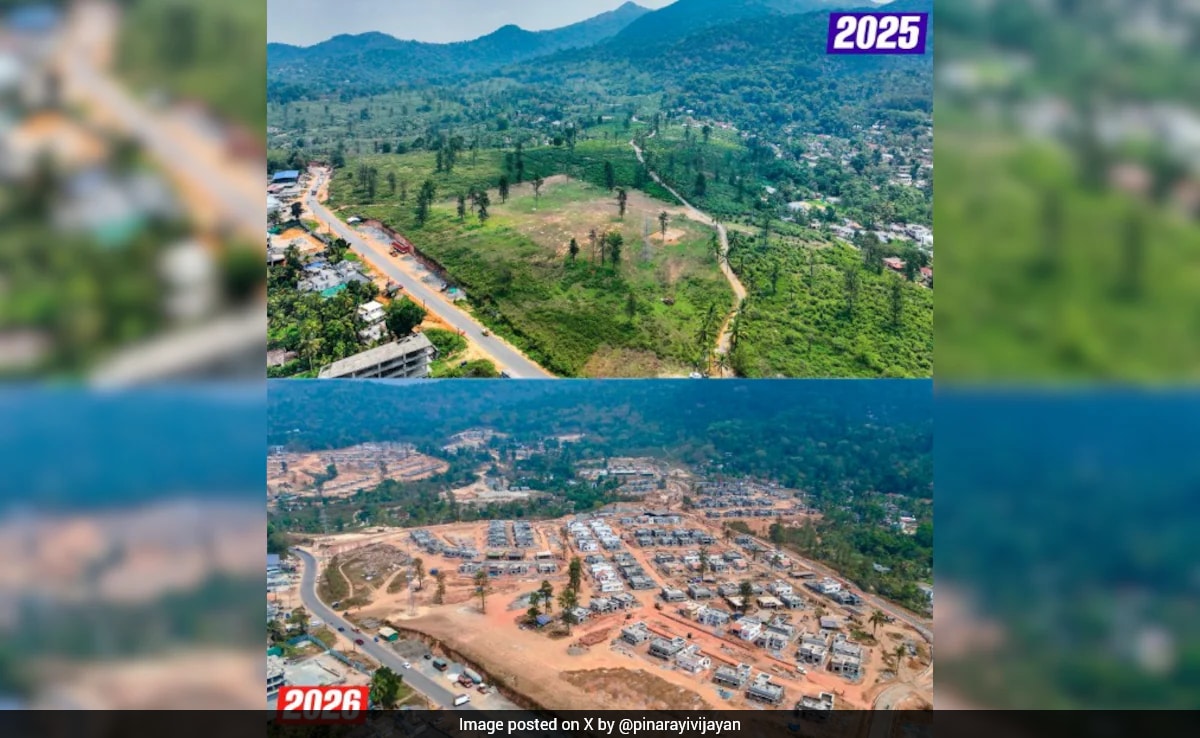
The Left government says the delay between the disaster and construction was unavoidable
Highlights
- The 2024 Wayanad landslides were the deadliest in Kerala's history
- What followed was not merely relief work, but a "political cold war" that persists 18 months later
- Now, as 178 newly built houses are ready for handover, major political parties are vying to claim credit
Thiruvananthapuram: 
The 2024 Wayanad landslides were the deadliest in Kerala's history. Official records submitted to Parliament confirmed 298 deaths, including 32 individuals declared dead months after disappearing. The villages of Mundakkai and Chooralmala were virtually erased; 1,555 houses and 136 public buildings were destroyed. It was more than a landslide - it was the total collapse of a local ecosystem.
What followed was not merely relief work, but a "political cold war" that persists 18 months later.

Now, as 178 newly built houses at Elstone Estate near Kalpetta are ready for handover, major political parties are vying to claim credit ahead of the Kerala Assembly elections.
In the coming days, a series of high-profile ceremonies will take place. From Chief Minister Pinarayi Vijayan to Leader of the Opposition Rahul Gandhi and Wayanad MP Priyanka Gandhi, party leaders are scheduled to hand over keys to victims in quick succession.
On February 25, Kerala will script a new chapter of resilience.
— Pinarayi Vijayan (@pinarayivijayan) February 19, 2026
The first phase of the Kalpetta Township, built for the survivors of the Mundakkai–Chooralmala landslide, will be inaugurated. This is not merely an inauguration. It is a solemn declaration that we honour our word… pic.twitter.com/ICfAmTuIjx
The government's model township, for which the Chief Minister laid the foundation stone in March 2025, aims to provide 410 houses. Each family is slated to receive 7 cents of land with a legal title, electricity, and water. However, as of October 2025, the Chief Minister's Disaster Relief Fund (CMDRF) has utilised only 21% of its collections-allotting Rs 165.87 crore out of Rs 773.98 crore received.
The government says the delay between the disaster and construction was unavoidable. The land belonged to Harrisons Malayalam Limited and Elstone Tea Estates Ltd.
In October 2024, these companies went to the Kerala High Court saying the Disaster Management Act allows only temporary occupation, not permanent takeover.
The high court on December 27, 2024, ruled in favour of the government, saying rehabilitation is a public purpose and private land can be acquired, but compensation must be paid under the LARR Act, 2013.
Even after that, work could not start immediately. The Geological Survey of India had to clear the land as safe from landslides. There were disputes over the final list of beneficiaries in early 2025.
Some families wanted to stay in Meppadi instead of moving to Kalpetta. The government also increased plot size from 5 cents to 7 cents in March 2025, forcing a redesign. Then the monsoon between June and October 2025 slowed down construction.
The ruling Left government says these are genuine reasons for delay.
But the opposition has attacked the government strongly.
Congress leaders including Opposition Leader VD Satheesan and MLA T Siddique said that even seven months after the disaster, the government had not produced a clear and complete beneficiary list. They questioned how houses could be built without clarity on who qualifies.
At the national level, Union Home Minister Amit Shah and BJP leaders accused the Kerala government of delaying submission of the official disaster assessment memo to the Centre by almost three and a half months. They claimed this delay stalled the release of central disaster funds. According to the BJP, the state cannot blame the Centre if it does not follow procedure on time.
The Left rejected this charge and said it followed due process. But the accusation widened the fight. Now it was not just Left versus Congress. It became State versus Centre as well.
Meanwhile, the Congress had its own promises to defend.
Soon after the disaster, Rahul Gandhi, who was then Wayanad MP, promised that the Congress would build 100 houses. The Youth Congress separately promised 30 houses. In all, the Congress spoke of building 230 houses. In August 2024, Karnataka Chief Minister Siddaramaiah announced that Karnataka would build 100 houses for Wayanad victims, setting aside around Rs 20 crore. This was met with resistance from the government as it required Karnataka to provide it to the Chief Minister's fund.
Taking on the Congress, in 2015, CPIM state secretary MV Govindan accused the Congress of quietly reducing its target from 230 to 100 houses. He called it a betrayal. He also alleged that Rahul Gandhi did not donate any money to the Chief Minister's Distress Relief Fund and challenged Congress to show proof of contributions.
Govindan further said that the 3.25 to 3.5 acres reportedly bought by Congress in Kunnambetta is not enough to build 100 good quality houses with roads and infrastructure. He described the plan as a publicity move.
The Congress leaders hit back.
They said the state government was hostile and did not give them the same land acquisition relaxations it used for its own township project. They argued that while the government took almost a year to finalise land using full state machinery, the Congress managed to identify and purchase land within four months without state support.
While the political heavyweights spar, the Muslim League has emerged as an efficient administrator, constructing 105 houses at Thrikkaipetta. They will hand over the first 51 houses on February 28. The state government follows immediately after, handing over its 178 houses on March 1.
Rahul Gandhi is finally laying foundation stone for the homes being made with congress party funds.
The clustering of events is not a coincidence. As elections approach, every party pivots from governance to finger-pointing: The Left claims Congress scaled back its promises. The Congress argues the Left actively sabotaged its initiatives. The BJP blames the state for stalling paperwork and central funds. Kerala counters that the Centre is playing politics.
In the middle of this political fight are the survivors. For them, what matters is simple. Are all promised houses built? Does compensation reach shop owners? Are people able to rebuild their lives with dignity?
The landslide was a natural disaster. But the rehabilitation has turned into a political battleground.
Published: February 24, 2026 11:43 IST
NDTV in partnership with UBER is launching a sustained campaign 'Roshan Dilli' to try and raise safety standards in India's capital, New Delhi.
Our focus is to try and improve lighting in public spaces in the city. Lighting is a key factor in shaping women's perceptions of safety
The initiative will provide a platform for all stakeholders to discuss our goal of improving safety standards, to start a conversation about safety of women in the country
It will also highlight various interventions and solutions that help to make women safe and put the spotlight on what more can be done.
The campaign will accentuate the need for Safety to be a shared responsibility
The need for gender sensitization and how law enforcement and civil society through checks and education can try and make women safer
We hope you will join us and help make New Delhi a safer city for women.


