


- Home/
- 14,000 Buses, 36,000 EV Chargers: Delhi's 4-Year Pollution Plan
14,000 Buses, 36,000 EV Chargers: Delhi's 4-Year Pollution Plan
Reported by Ishika Verma | Updated: January 17, 2026 05:35 IST
Chief Minister Rekha Gupta during a high-level review meeting at the Delhi Secretariat, Friday.
New Delhi:
The Delhi government on Friday laid out a four-year, deadline-driven plan to cut air pollution, placing its biggest bets on public transport, electric vehicles and aggressive dust control, while fixing clear timelines to clear the capital's three landfill sites.
Chief Minister Rekha Gupta, chairing a high-level review meeting at the Delhi Secretariat, said the government was working "12 months a year, seven days a week" to tackle pollution and had asked all departments to move strictly as per timelines.
Calling pollution control "a long fight", the Chief Minister said the plan was "clear, measurable and outcome-oriented" and aimed at bringing down PM2.5 levels over four years. She added that there were "no procedural hurdles or budget constraints" and that coordination with the Centre was ongoing.
Push for buses and last-mile travel
At the centre of the plan is a sharp expansion of Delhi's bus fleet, from the current strength to 14,000 buses by March 2029.
The rollout will be staggered: 6,000 buses by end-2026, 7,500 by 2027, 10,400 by March 2028, and the full 14,000 by 2029. Of these, 500 will be smaller 7-metre buses aimed at improving last-mile connectivity in dense neighbourhoods.
Officials said these buses will be linked with the Metro network. A pilot to integrate e-autos, bike taxis and feeder cabs at 10 major Metro stations is scheduled by January 31, 2026. At present, 100 electric feeder buses are already in service.
EV Policy 2.0: chargers to quadruple
The new EV Policy 2.0 focuses on Delhi's massive 5.8 million two-wheeler population, with incentives and scrappage benefits to push a shift to electric.
Public charging and battery-swapping points are set to jump from 9,000 to 36,000, while commercial vehicles will get interest subvention and support under the Centre's PM E-Drive scheme.
Traffic choke points under watch
To cut emissions caused by traffic jams, the government has identified 62 congestion hotspots. Work has already begun at 30 locations.
To strengthen on-ground management, 1,200 additional DTC personnel have been deployed to assist the Delhi Traffic Police.
Metro, RRTS expansion to ease road load
Public transport remains the backbone of the plan. The 395-km Delhi Metro network, which carries 6.5-7 million passengers daily, is set to expand by 206 km across upcoming phases. Officials expect ridership to double after Phase IV.
The NCRTC network will also grow to 323 km over the next four years, improving regional connectivity and reducing private vehicle use.
Rs 6,000 crore road revamp
The government has earmarked Rs 6,000 crore to rebuild or upgrade 3,300 km of roads across Delhi. This includes roads under PWD, MCD and those in unauthorised colonies.
The plan includes paved shoulders, landscaped medians and underground utility ducts to stop repeated road digging. Tenders are expected within two months, with a completion target of one year.
Dust control goes mechanised
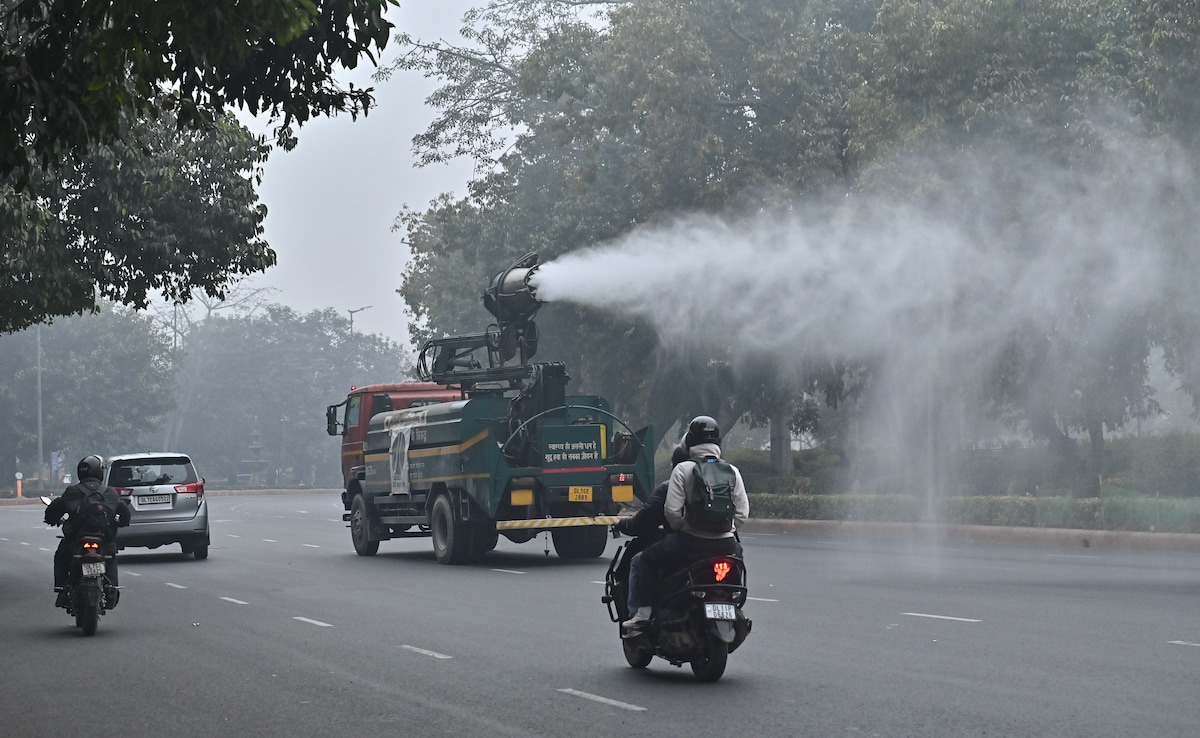
Road dust, one of Delhi's biggest pollution sources, is being tackled with machines, sprinklers and misting.
Currently, 76 mechanical road sweepers are in operation. Another 14 machines will be added by January 31, 2026, with 70 more approved under a Rs 2,300-crore project for narrow roads.
PWD is also rolling out two large projects worth Rs 4,000 crore, including 250 sprinkler-cum-anti-dust machines for regular dust suppression.
Environment Minister Manjinder Singh Sirsa said mist spray systems would be deployed on all PWD roads, especially at the 62 identified hotspots, to bring down PM2.5 levels.
Landfills get hard deadlines
Minister said that this time firm timelines have been set to clear Delhi's garbage mountains- Okhla by July 2026, Bhalswa by October 2026, and Ghazipur by December 2027.
The MCD has been given Rs 500 crore this year for waste management, with Rs 300 crore annually planned in future years. Sirsa added all fresh municipal waste would be processed through waste-to-energy plants by 2026–27.
Industry, green cover and waste burning
More than 1,000 polluting industrial units have already been sealed, and large industries have been told to install real-time emission monitoring systems.
The green push includes planting 3.5 million trees in four years, with 1.4 million saplings planned this year alone, and developing 365 acres of brown park areas.
To curb winter pollution, 15,500 electric heaters are being distributed to prevent biomass burning. A new construction waste processing plant is also coming up at Tehkhand.
Parking rules, ANPR and enforcement
Smart parking with pricing controls is being planned to discourage excessive private vehicle use, while multi-level parking facilities will be promoted in commercial and transit hubs.
To tighten enforcement, ANPR cameras are being installed at Delhi's border entry points to automatically identify polluting vehicles.
Environment Minister said the plan will be shared with the Supreme Court and the PMO, and coordination with neighbouring states will continue, as Delhi's air quality problem extends beyond city limits.
Published: January 17, 2026 05:35 IST
also read
 Written by Dr Sabine Kapasi | Tuesday September 29, 2026
Air pollution is often discussed as a cause of respiratory disease, but its effects extend to the heart and blood vessels.
- Edited by Debanish Achom | Monday September 28, 2026 , New Delhi
The steps include doubling parking charges, a complete ban on construction and demolition activity and work-from-home for government and private employees
- Written by Debosmita Ghosh | Friday September 25, 2026
Air purifiers are mainly designed to clean pollutants that are suspended in the air. A HEPA filter can trap very small particles and may help reduce indoor levels of particulate matter, dust, pollen and some other airborne particles. However, the performance of a purifier depends on several factors.
- Written by Dr Ankit Kumar Sinha | Friday September 25, 2026
To improve respiratory health, it is important to minimise exposure to polluted air, enhance indoor ventilation, adhere to workplace safety regulations, and promote physical activity.
- Tuesday September 22, 2026 , Mumbai
The court had on Monday taken suo motu (on its own) cognizance of the issue of severe noise and air pollution caused during processions.



................................ Advertisement ................................
Blog | Well Done, Delhi. You've Turned Lung Sacrifice Into A Badge Of HonourSaikat Kumar Bose
Monday November 10, 2025Till some years back, Delhiites would ask angry questions to those in power about the capitals annual tryst with toxic air. This has changed. Those in the driving seat dont see the need to answer now.
Opinion | Why Indians Have Just Given Up On Air Pollution CrisisTanushree Ganguly
Friday December 20, 2024While some may argue that people in Delhi are now more aware of air pollution than they were a decade back, my rebuttal would be that awareness does not mean that people are concerned.
Opinion | You Must Outrage Over Filthy Air More Than Once A YearJyoti Pande Lavakare
Tuesday December 10, 2024Delhi welcomed us with monsoon rains and mangos. We were home. Fast forward a couple of years, in the winter of 2012, I found myself in denial about something other parents, mostly expats, were calling toxic air.
Opinion | Delhi's Air Pollution Situation Is Like A Bad MarriageNishtha Gautam
Friday November 22, 2024On a good day, such as today, the AQI reading in Delhi is 407. We are jubilant at the sickly sunshine trickling through the slightly dissipated smog. At least its not 1600.
दिवाली... पराली... सियासी जुगाली!Ashwini kumar
Monday November 18, 2024दिल्ली-एनसीआर में प्रदूषण का समाधान तो आज तक मिला नहीं. हर साल चिंतित होकर हम-आप सांसों की तकलीफ के साथ-साथ दिल और ब्लड प्रेशर के मरीज भी क्यों बनें?


