


- Home/
- Exclusive: For 4 Seconds, Air India Phuket-Delhi Plane Had No Flight Controls
Exclusive: For 4 Seconds, Air India Phuket-Delhi Plane Had No Flight Controls
Reported by Vishnu Som | Updated: August 14, 2026 08:58 IST
Airbus linked the emergency on AI-2379 to a possible faulty pressure sensor
Highlights
- Airbus data showed a 4-second simultaneous loss of key flight controls on A-320 NEO jet
- Three hydraulic system failures caused uncontrollable drift of elevators and ailerons during the incident
- Co-pilot pushed side-stick forward during stall warning but controls were unresponsive initially
New Delhi : 
Airbus's initial reading of the Digital Flight Data Recorder (black box) of the A-320 jetliner, which violently dropped 300 feet on a flight from Phuket to New Delhi, indicated that there was a total, simultaneous loss of key control surfaces, including the elevators and ailerons, for a period of 4 seconds - with the spoilers also lost as a consequence of the same hydraulic failure.
During those 4 seconds, the elevators and ailerons of the A-320 NEO drifted on their own without any pilot command following multiple failures of the jet's three hydraulic systems, unprecedented in operations of this type of airliner. Hydraulics are critical to the operation of flight control surfaces, namely the elevators which pitch the nose up or down, the ailerons which roll the aircraft left or right by tilting the wingtips, and spoilers which reduce lift, add drag to help the aircraft descend or slow down (including braking on landing).
The autopilot system of the airliner then disconnected, and the co-pilot who was flying at the time pushed his control stick forward after the aircraft's systems are believed to have generated stall warnings in the cockpit. A stall is a potentially deadly scenario in which the wings of the aircraft stop producing enough lift to keep it flying.
Faced with the prospect of losing control of the aircraft, the co-pilot pushed his side-stick forward to drive down its nose, standard operating procedure when confronting a potential stall. But with no hydraulic power available, his side-stick inputs didn't translate to any nose-down movement until all 3 hydraulic systems recovered within a few seconds.
While this did restore control, the violent nose-down trajectory of the aircraft that followed appears to have caused injuries (some serious) to passengers and cabin crew, many of whom were flung to the roof of the jet.
NDTV has learned that data from the 7.8-year-old A-320 NEO aircraft was transmitted to Airbus's permanent support centre - AIRTAC (Airbus Technical Aircraft-on-Ground Centre), which runs 24 hours a day, 365 days a year and is based out of Toulouse in France.
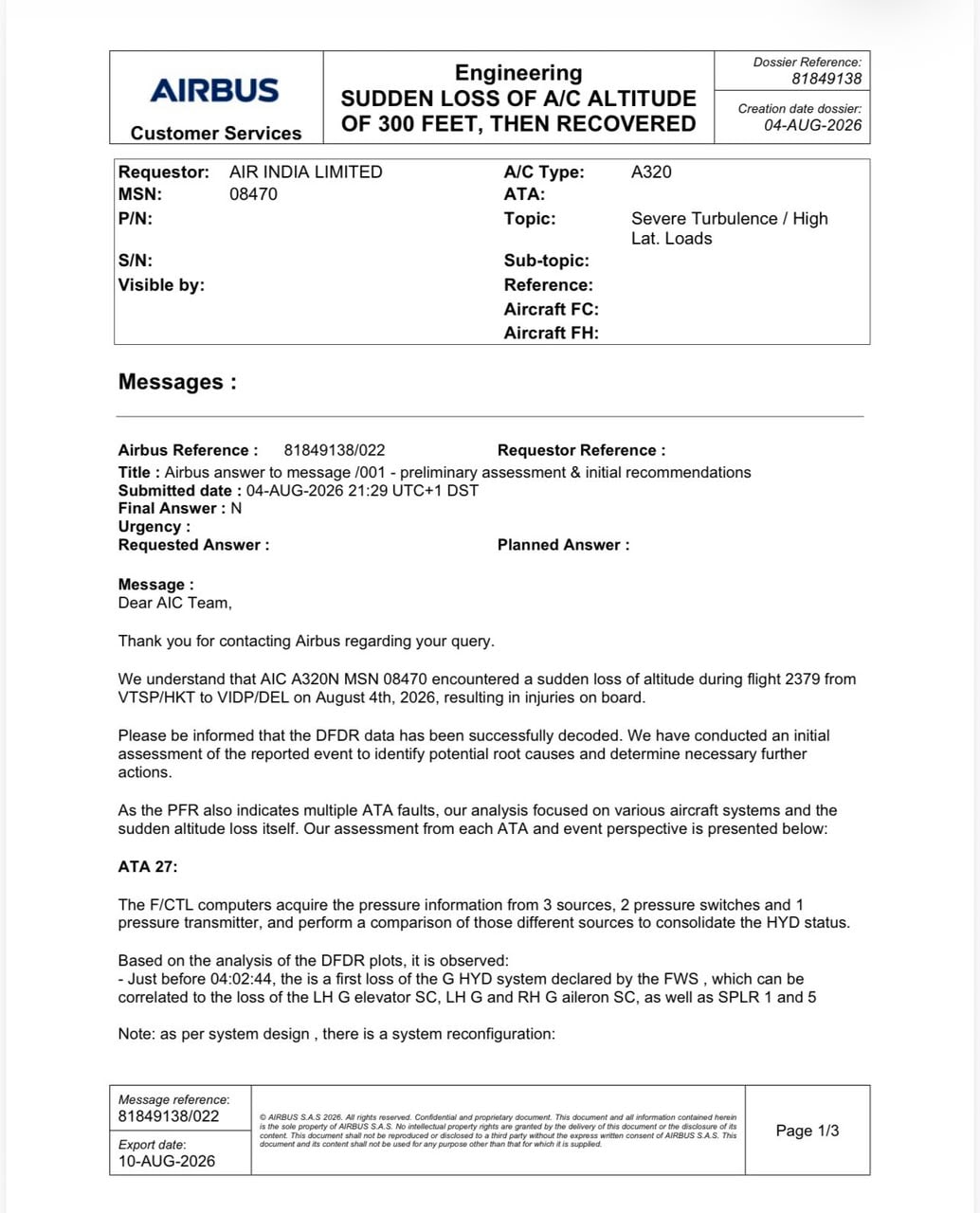
While some data may have been transmitted electronically to Airbus through a system called ACARS (Aircraft Communications Addressing and Reporting System), it is likely that the full set of data from the Digital Flight Data Recorder was downloaded by the airline after the jet landed and sent for immediate analysis.
The Airbus dossier with initial findings, which are referenced in this report, was sent back to Air India just after midnight on August 5, about 15-16 hours after the loss of control episode described above.
In its initial report, Airbus linked the emergency on AI-2379 to a possible faulty pressure sensor (a specific hydraulic pressure switch). However, these initial findings did not identify a definitive root cause. Neither did Airbus issue final recommendations.
Since then, experts from Airbus and the French Accident Investigator, the BEA, have arrived in New Delhi and have been able to access the aircraft on Thursday. NDTV has learned that new findings from the preliminary physical examination of the aircraft and its systems have been forwarded to India's AAIB (Aircraft Accident Investigation Bureau), the nodal agency overseeing the investigation.
There are no observations presently on whether the conduct of the pilot in command of the flight, Captain Sudeep Vashistha, is linked to the serious safety incident on the Phuket-Delhi flight, though those details continue to be investigated. Vashistha failed two urine tests he was asked to undergo after the flight landed. Marijuana has been detected in his system, and a cabin crew member aboard the flight is believed to have submitted a complaint alleging the pilot had earlier smoked 'pot'.
In the wake of Captain Vashistha testing positive for Marijuana use, Air India has ordered all pilots across Air India and Air India Express to take mandatory tests to confirm the absence of banned substances or medication in their bloodstream.
Published: August 14, 2026 07:14 IST
- Reported by Reet Kaur Sahni | Friday August 07, 2026
As per the ministry, prior Environmental Clearance becomes mandatory for data centres depending on their physical footprint under Schedule 8 of the EIA Notification, 2006.
- Written by Sambhav Kumar | Thursday August 06, 2026
Keerthy Suresh's 41-hour no-sleep stretch highlights the intense demands many professionals face, but experts warn that prolonged sleep deprivation should never become routine.
- Written by Sambhav Kumar | Wednesday August 05, 2026
Preliminary evidence suggests the blood filtration treatment could reduce some microplastic particles, though findings are limited and require more study.
- Monday August 03, 2026 , New Delhi
Study reveals black crust from pollution weakens Humayuns Tomb sandstone
- Written by Debosmita Ghosh | Saturday August 01, 2026
Lung cancer is often diagnosed at an advanced stage because its early symptoms are easy to overlook. A persistent cough is among the most commonly ignored warning signs.




................................ Advertisement ................................




Blog | Well Done, Delhi. You've Turned Lung Sacrifice Into A Badge Of HonourSaikat Kumar Bose
Monday November 10, 2025Till some years back, Delhiites would ask angry questions to those in power about the capitals annual tryst with toxic air. This has changed. Those in the driving seat dont see the need to answer now.
Opinion | Why Indians Have Just Given Up On Air Pollution CrisisTanushree Ganguly
Friday December 20, 2024While some may argue that people in Delhi are now more aware of air pollution than they were a decade back, my rebuttal would be that awareness does not mean that people are concerned.
Opinion | You Must Outrage Over Filthy Air More Than Once A YearJyoti Pande Lavakare
Tuesday December 10, 2024Delhi welcomed us with monsoon rains and mangos. We were home. Fast forward a couple of years, in the winter of 2012, I found myself in denial about something other parents, mostly expats, were calling toxic air.
Opinion | Delhi's Air Pollution Situation Is Like A Bad MarriageNishtha Gautam
Friday November 22, 2024On a good day, such as today, the AQI reading in Delhi is 407. We are jubilant at the sickly sunshine trickling through the slightly dissipated smog. At least its not 1600.
दिवाली... पराली... सियासी जुगाली!Ashwini kumar
Monday November 18, 2024दिल्ली-एनसीआर में प्रदूषण का समाधान तो आज तक मिला नहीं. हर साल चिंतित होकर हम-आप सांसों की तकलीफ के साथ-साथ दिल और ब्लड प्रेशर के मरीज भी क्यों बनें?


