


- Home/
- Delhi's Air Quality May Worsen Further Due To Volcanic Ash Drift From Ethiopia
Delhi's Air Quality May Worsen Further Due To Volcanic Ash Drift From Ethiopia
Indo-Asian News Service | Updated: November 25, 2025 17:50 IST
New Delhi:
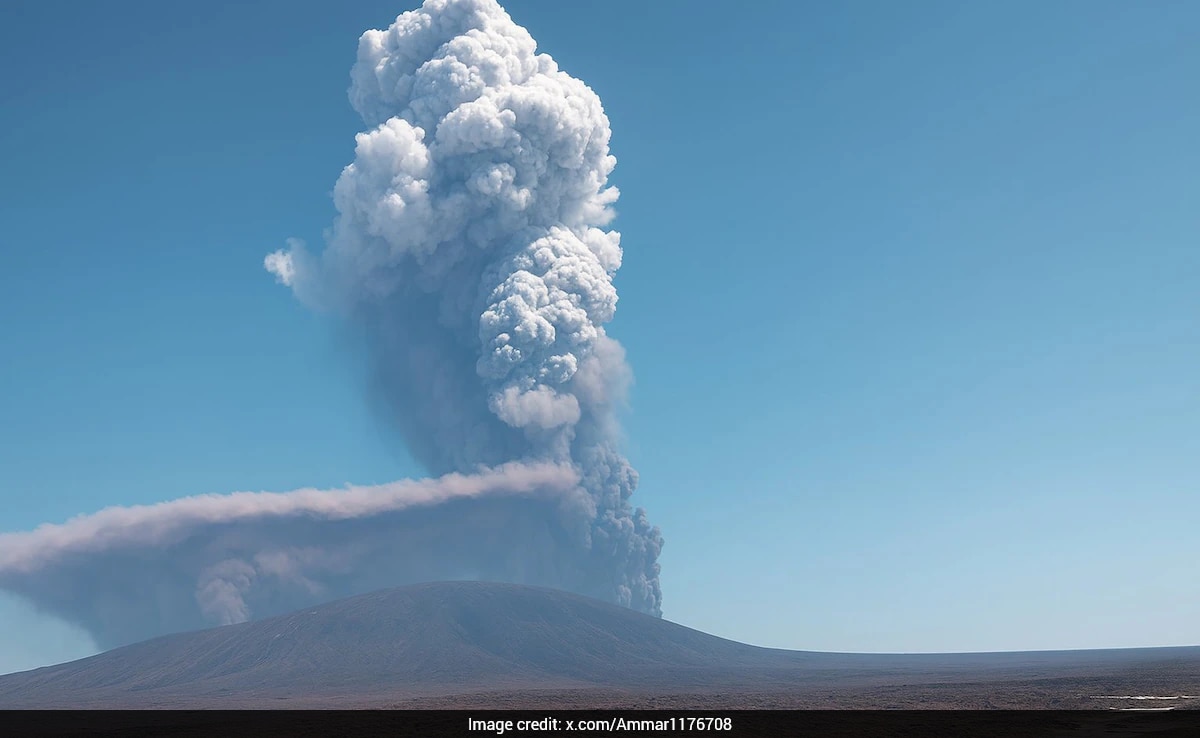
Even as Delhi is already reeling with air pollution for a month, the volcanic ash drifting from Ethiopia may further degrade the national capital's air quality, raising serious health concerns, said health experts here on Tuesday. Delhi-NCR's air quality remained in ‘very poor', and a thick layer of haze engulfed the national capital across Delhi and the National Capital Region, according to the Central Pollution Control Board. The situation is likely to be further exacerbated by the Hayli Gubbi volcano in Ethiopia's Afar region, which erupted for the first time in thousands of years.
It lofted a substantial ash column roughly 10-15 km into the atmosphere, sending plumes toward Yemen and Oman before drifting toward India.
With a speed of around 100-120 km/h at high altitude, the plume of ash reached Delhi, and then drifted over Gujarat, Rajasthan, Maharashtra, Punjab, and Haryana.
According to the latest update from the India Meteorological Department (IMD), it will move towards China next and is expected to leave India by 7:30 pm local time.
“Volcanic ash drifting from Ethiopia may further degrade Delhi's air quality by adding fine particles and toxic metals,” Dr Abhishek Shankar, Assistant Professor in Radiation Oncology at All India Institute of Medical Sciences (AIIMS), Delhi, told IANS.
“These ultrafine particles can penetrate deep into the lungs, aggravating respiratory issues, triggering asthma, and increasing vulnerability among children, older adults, and cancer patients, compounding the city's already critical pollution-related health risks,” he added.
The worsening air pollution has been causing noticeable health issues among Delhiites, including watery eyes, asthma symptoms, itchy skin, and throat irritation.
Prolonged exposure can lead to more severe conditions, such as persistent coughing, chest tightness, wheezing, and shortness of breath.
“Air pollution does not leave any part of the body unaffected. Our respiratory system is the most commonly affected -- nose, ears, throat, and lungs -- because they are in direct contact with the air. So, there are a lot of respiratory diseases,” Dr. Anant Mohan, Professor & Head, Department of Pulmonary Medicine and Sleep Disorders, AIIMS Delhi, told IANS.
“All other organs, from the brain to any part of the body, heart, vessels, it is possible for everyone to have a heart attack or stroke,” he added.
The expert noted that poor air quality levels affect small children, and even before birth. "No age is exempt in this. Nor is there any organ of the body left,” the expert noted, stating it to treat the poor air quality in the national capital as "an emergency".
Shankar noted that air pollution is emerging as an important risk factor for cancer, while a causal association has already been established for lung cancer and breast cancer.
“An increasing number of lung cancer cases among non-smoking females and young adults are largely attributed to air pollution, particularly Particulate Matter (PM) 2.5. Apart from increasing the risk for lung cancer, it also has an impact on outcome, but not much data from India on this,” the expert said.
Persistent exposure to toxic air triggers inflammation, oxidative stress, and DNA damage, leading to cancer development.
(This story has not been edited by NDTV staff and is auto-generated from a syndicated feed.)
Published: November 25, 2025 15:59 IST
also read
 Written by Ambika Singh Kahma | Friday June 19, 2026
NDTV Lifeline's first episode gives India a wake-up call to recognise sleep apnea as a critical public health issue
- Reported by Ishika Verma | Friday June 19, 2026 , New Delhi
The measures, outlined under a newly notified winter air quality management framework, are intended to help authorities, businesses and residents prepare in advance for the period between November and February, when Delhi's air quality typically dete
- Edited by Nikhil Pandey | Friday June 19, 2026
An unprecedented Ukrainian drone strike on a major Moscow oil refinery has caused a bizarre environmental crisis, with oily "black rain" falling over parts of the Russian capital.
- Written by Dr Anindita Singh | Monday June 15, 2026
From a clinical point of view, infertility often develops quietly, without noticeable symptoms, especially in the early stages, and the whole process can look normal from the outside.
- Written by Shreya Goswami | Monday June 15, 2026
Naseeruddin Shah's moving portrayal of a man with dementia in Imtiaz Ali's latest movie highlights the emotional and practical challenges faced by caregivers.





................................ Advertisement ................................


Blog | Well Done, Delhi. You've Turned Lung Sacrifice Into A Badge Of HonourSaikat Kumar Bose
Monday November 10, 2025Till some years back, Delhiites would ask angry questions to those in power about the capitals annual tryst with toxic air. This has changed. Those in the driving seat dont see the need to answer now.
Opinion | Why Indians Have Just Given Up On Air Pollution CrisisTanushree Ganguly
Friday December 20, 2024While some may argue that people in Delhi are now more aware of air pollution than they were a decade back, my rebuttal would be that awareness does not mean that people are concerned.
Opinion | You Must Outrage Over Filthy Air More Than Once A YearJyoti Pande Lavakare
Tuesday December 10, 2024Delhi welcomed us with monsoon rains and mangos. We were home. Fast forward a couple of years, in the winter of 2012, I found myself in denial about something other parents, mostly expats, were calling toxic air.
Opinion | Delhi's Air Pollution Situation Is Like A Bad MarriageNishtha Gautam
Friday November 22, 2024On a good day, such as today, the AQI reading in Delhi is 407. We are jubilant at the sickly sunshine trickling through the slightly dissipated smog. At least its not 1600.
दिवाली... पराली... सियासी जुगाली!Ashwini kumar
Monday November 18, 2024दिल्ली-एनसीआर में प्रदूषण का समाधान तो आज तक मिला नहीं. हर साल चिंतित होकर हम-आप सांसों की तकलीफ के साथ-साथ दिल और ब्लड प्रेशर के मरीज भी क्यों बनें?


