


- Home/
- Delhi Pollution Worsens, Air Quality Turns Severe, Thick Smog Covers City
Delhi Pollution Worsens, Air Quality Turns Severe, Thick Smog Covers City
Edited by Aastha Ahuja | Updated: December 14, 2025 06:54 IST

Delhi Pollution: At 6 am, Delhi reported Air Quality Index of 462, falling under the 'severe' category.
Highlights
- Delhi woke up to severe smog with an AQI of 462 recorded at 6 am
- All 40 monitoring stations in Delhi reported AQI above 400, falling in the severe category
- GRAP-4 has been invoked including vehicle bans and construction halts in Delhi-NCR
New Delhi: 
The national capital, Delhi, on Sunday woke up to a thick layer of smog, with air quality lingering in the 'severe' category. The Central Pollution Control Board (CPCB) recorded the Air Quality Index (AQI) at 462 at 6 am.
All 40 monitoring stations in Delhi show 'red', meaning AQI in the 'severe' category. Rohini in North West Delhi recorded AQI of 499 with particulate matter 2.5 (PM2.5) as the major pollutant, followed by Jahangirpuri and Vivek Vihar reporting AQI at 495.
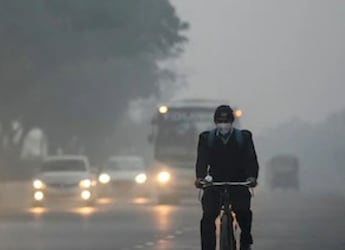
Several areas in Delhi also reported low visibility due to smog. Visuals from Patparganj in East Delhi, where AQI was recorded at 488 at 6 am, showed people driving slowly with headlights on.
#WATCH | Delhi | Visuals from the Patparganj section of NH-24 as a layer of toxic smog blankets the city.
— ANI (@ANI) December 14, 2025
AQI (Air Quality Index) around the area is 488, categorised as 'Severe', as claimed by CPCB (Central Pollution Control Board).
CAQM (Commission for Air Quality… pic.twitter.com/RAp43VUQ4f
Also Read | Why Doesn't India Report Air Quality (AQI) Measure Beyond 500?
The AQI is a public health tool designed to communicate air pollution levels or the quality of air. Eight pollutants namely particulate matter (PM) 10, PM2.5, Ozone (O3), Sulphur dioxide (SO2), nitrogen dioxide (NO2), carbon monoxide (CO), lead (Pb) and ammonia (NH3) act as major parameters in deriving the AQI of an area, as per the CPCB.
According to CPCB, an AQI within 0-50 is considered 'good,' 51-100 'satisfactory,' 101-200 'moderate,' 201-300 'poor', 301-400 'very poor,' and 401-500 'severe.' Each of these categories reflects the level of pollution and the associated health risks. For example, an AQI in the 'severe' category is hazardous even for healthy people, and one should avoid going out or exercising in the open.

Can AQI Cross 500?
India's AQI scale is capped at 500. Meaning, AQI beyond 500 will be grouped under the "severe" category, indicating a public health emergency.
"AQI above 400 is hazardous. It is assumed that the health impacts are similar at AQI 500 and AQI 900, so why show a higher number and create panic among people," says Professor Dr Gufran Beig, Chair Professor at the National Institute of Advanced Studies (NIAS).
There is no scientific justification for capping AQI at 500 despite the ability to calculate higher values, said Sunil Dahiya, Founder and Lead Analyst at Envirocatalysts.
"While it is true that long-term impacts are higher at lower concentration exposures and increase marginally at very high concentrations, but the immediate threats are way higher, leading to hospitalisation and medical emergencies for heart and respiratory patients and sensitive groups whenever pollution levels go way too high as observed during peak stubble burning episodes and around Diwali," added Dahiya.
Also Read | Explained: 350 vs 1,100, CPCB vs IQAir, Who Has Got Delhi's AQI Right
GRAP-3, Then GRAP-4: Delhi's Fight Against Pollution
To tackle rising levels of air pollution in Delhi-NCR, the Commission for Air Quality Management (CAQM) on Saturday imposed restrictions under Graded Response Action Plan (GRAP) stage 3 and later strengthened it to GRAP-4.
Explaining the reasons for the worsening AQI, the CAQM said the feeble Western Disturbance approaching north-west India was the main contributing factor, and not local emissions.
"This prevailing meteorological condition has (caused a) marked reduction in wind speed, at times becoming calm, a shift in wind direction from westerly to easterly, and an increase in moisture content in the lower atmosphere. Such conditions during the winter season are conducive to the formation of smog and fog, resulting in poor dispersion and trapping of pollutants near the surface. Owing to these adverse meteorological conditions, a sudden deterioration in air quality has been observed," it said.
Restrictions Under GRAP-4
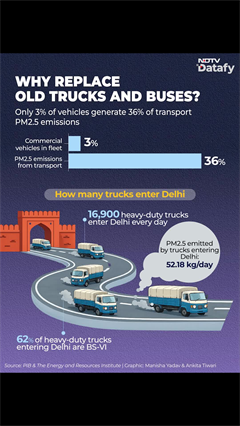
- Ban on the entry of non-essential trucks into Delhi except for those carrying essential goods or services, or those running on cleaner fuels such as LNG, CNG, electric, or BS-VI diesel.
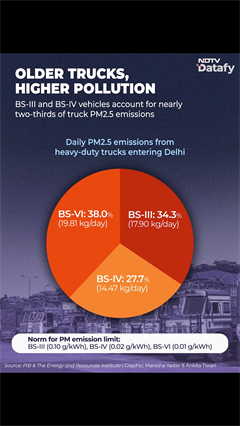
- Delhi-registered medium and heavy goods vehicles using diesel (BS-IV and older) are prohibited, except those involved in essential services. Light commercial vehicles registered outside Delhi and not meeting EV, CNG, or BS-VI diesel standards are also barred from entering the city unless essential.
- Ban on construction and demolition (C&D) activities including public projects like highways.
- State governments in Delhi-NCR may shift physical classes for students in Classes VI to IX and XI to online mode.
- Public, municipal, and private offices are recommended to operate with at least 50% staff working from home, and staggered timings may be introduced to reduce peak-hour traffic.
Published: December 14, 2025 06:54 IST
- Wednesday August 26, 2026
Almost the entire global population (99 per cent) breathes air containing pollutant levels exceeding the World Health Organization's air quality guidelines, with the highest exposures seen in low and middle-income countries, the researchers said.
- Reported by Reet Kaur Sahni | Friday August 07, 2026
As per the ministry, prior Environmental Clearance becomes mandatory for data centres depending on their physical footprint under Schedule 8 of the EIA Notification, 2006.
- Written by Sambhav Kumar | Thursday August 06, 2026
Keerthy Suresh's 41-hour no-sleep stretch highlights the intense demands many professionals face, but experts warn that prolonged sleep deprivation should never become routine.
- Written by Sambhav Kumar | Wednesday August 05, 2026
Preliminary evidence suggests the blood filtration treatment could reduce some microplastic particles, though findings are limited and require more study.
- Monday August 03, 2026 , New Delhi
Study reveals black crust from pollution weakens Humayuns Tomb sandstone



................................ Advertisement ................................


Blog | Well Done, Delhi. You've Turned Lung Sacrifice Into A Badge Of HonourSaikat Kumar Bose
Monday November 10, 2025Till some years back, Delhiites would ask angry questions to those in power about the capitals annual tryst with toxic air. This has changed. Those in the driving seat dont see the need to answer now.
Opinion | Why Indians Have Just Given Up On Air Pollution CrisisTanushree Ganguly
Friday December 20, 2024While some may argue that people in Delhi are now more aware of air pollution than they were a decade back, my rebuttal would be that awareness does not mean that people are concerned.
Opinion | You Must Outrage Over Filthy Air More Than Once A YearJyoti Pande Lavakare
Tuesday December 10, 2024Delhi welcomed us with monsoon rains and mangos. We were home. Fast forward a couple of years, in the winter of 2012, I found myself in denial about something other parents, mostly expats, were calling toxic air.
Opinion | Delhi's Air Pollution Situation Is Like A Bad MarriageNishtha Gautam
Friday November 22, 2024On a good day, such as today, the AQI reading in Delhi is 407. We are jubilant at the sickly sunshine trickling through the slightly dissipated smog. At least its not 1600.
दिवाली... पराली... सियासी जुगाली!Ashwini kumar
Monday November 18, 2024दिल्ली-एनसीआर में प्रदूषण का समाधान तो आज तक मिला नहीं. हर साल चिंतित होकर हम-आप सांसों की तकलीफ के साथ-साथ दिल और ब्लड प्रेशर के मरीज भी क्यों बनें?


