


- Home/
- Delhi Air Stays Toxic Even As No PUC, No Fuel Drive Enters Second Day
Delhi Air Stays Toxic Even As No PUC, No Fuel Drive Enters Second Day
| Updated: December 19, 2025 23:15 IST

Even then, the 24-hour average AQI stood in the ‘very poor’ category at 374, marginally higher than 373 recorded a day earlier
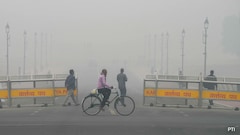
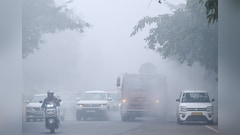
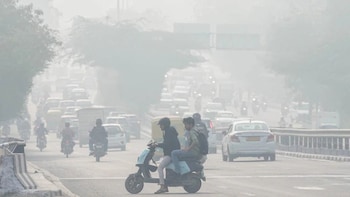
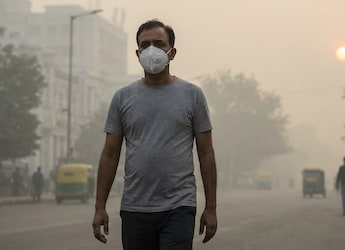
Delhi's air quality remained 'very poor' for the fourth consecutive day on Friday and is forecast to deteriorate to the 'severe' category by tomorrow, while long queues were seen outside pollution under control centres on the second day of the 'No PUC, No Fuel' enforcement drive in the city.
As part of measures to tackle worsening air pollution, authorities here have banned the entry of non-Delhi private vehicles below BS-VI standards and enforced the 'No PUC, No Fuel' rule.
Official data showed that in the past 24 hours, enforcement teams have issued around 11,776 challans against polluting and non-compliant vehicles as part of an aggressive crackdown on emission sources across Delhi.
Even then, the 24-hour average AQI stood in the ‘very poor' category at 374, marginally higher than 373 recorded a day earlier. Eleven of the 40 monitoring stations in the city have recorded 'severe' air quality, while 29 stations recorded AQI in the ‘very poor' range.
Anand Vihar recorded the highest AQI at 430, according to data from the Central Pollution Control Board's (CPCB) SAMEER app.
Environment Minister Manjinder Singh Sirsa said the government has adopted a multi-sector strategy combining enforcement, dust control, waste management, and vehicle regulation, which has led to a notable improvement in AQI levels compared to previous winters.
As part of the anti-pollution drive, 5,037 vehicles were checked at the national capital's border points between 8 pm on Thursday and 8 am on Friday to see if they met BS-VI norms. As many as 419 vehicles were returned, and 374 were prosecuted.
Around 2,800 vehicles were identified without valid PUC certificates between 6 am on Thursday and 6 am on Friday, a senior Transport Department official told PTI.
Meanwhile, nearly one lakh pollution-related complaints have been registered with multiple civic and enforcement agencies in Delhi over the past five years, according to official data. The Transport Department, Delhi Fire Services, and the Delhi Transport Corporation (DTC) reported 100 per cent disposal of complaints received during the period.
A total of 99,435 pollution-related complaints were received till 11 am on December 18 this year, of which 86,984 were resolved, while 12,451 remain pending across various departments, according to data from the Green Delhi App compiled by the Delhi Pollution Control Committee (DPCC).
A day after pollution-under-control (PUC) certificates were made mandatory for refuelling at petrol pumps, commuter awareness appeared to have improved, with many people producing the required documents without being asked.
Nischal Singhania, the president of the Delhi Petrol Dealers' Association, told PTI that queues at PUC certification centres remained unchanged, while fuel sales had taken a hit in some border areas.
"Earlier, there was uncertainty about how long the 'No PUC, No Fuel' rule would continue. Now, it is clear that it will remain in force till GRAP-IV is in place. Sales have dipped in border areas. Pump owners in Badarpur reported a decline yesterday, and the trend has continued," he said.
Singhania, however, said compliance levels had improved. "Customers are themselves taking out their PUC certificates while coming to refuel. This is a positive sign," he said.
Despite the overall increase in awareness, checks were not uniformly enforced across the city. At a few petrol pumps, commuters reported that no verification was carried out on Friday.
A man refuelling his vehicle at a petrol pump on Rohtak Road said he could buy fuel without being asked for the PUC certificate, and there was no visible police or enforcement presence at the site.
Bhushan Singh, travelling from Gulabi Bagh to his workplace, said the situation at the fuel pump he visited was "like any other day".
Meanwhile, teams from the traffic police and transport department were deployed at city entry points, toll plazas and petrol pumps to check PUC certificates and BS-VI compliance.
Traffic personnel were also stationed at key intersections with smart number plate recognition devices to verify documents and issue challans, even as some motorists requested leniency during the checks.
Several motorists approaching the Bijwasan toll plaza on the Dwarka Expressway were seen slowing down abruptly after spotting enforcement barricades and Delhi Traffic Police personnel positioned just ahead of the toll point.
As traffic personnel flagged down vehicles for document verification, a noticeable number of cars could be seen taking sudden U-turns, heading back towards the Gurugram side to evade inspection.
The scene near the toll plaza reflected heightened enforcement under the ongoing restrictions, with traffic police teams stationed strategically on the carriageway.
(With inputs from PTI)
Published: December 19, 2025 23:15 IST
also read
Air Pollution Alert: Bathinda Records AQI Of 771; 10 Indian Cities In 'Hazardous' Category
Author: Vishesh NagarPakistan's Diwali Pollution Claim Backfires As Its Own Agency Points To 16,714 Farm Fires
Author: Niharika RajDelhi Teenager's Project To Turn Fans Into Air Purifiers Wins Prestigious Global Grant
Author: NDTV Profit Desk
 Reported by Ankita Tiwari | Wednesday November 11, 2026 , New Delhi
According to a Centre for Science and Environment (CSE) report, the average PM2.5 concentration during the week before Diwali stood at 236 micrograms per cubic metre, almost double the 120 ug/m3 recorded in 2025. It was also the highest pre-Diwali average in three years.
- Wednesday November 11, 2026 , New Delhi
The transport sector is expected to be the largest contributor to pollution on Wednesday, while the impact of stubble burning is anticipated to increase on Thursday, potentially worsening air quality further over the next few days, according to Indian Institute of Tropical Meteorology models.
- Reported by Himanshu Shekhar Mishra, Edited by Anindita Sanyal | Wednesday November 11, 2026 , New Delhi
Air pollution in Delhi-NCR has worsened during the onset of winter (from October to mid-November) this year. This has been revealed in a new analysis by the Centre for Science and Environment or CSE, an organisation that monitors environmental issues.
- Written by Vishesh Nagar | Wednesday November 11, 2026
All 10 cities in the ranking fall under the 'Hazardous' category, with Bathinda recording the highest AQI, followed by Rewari and Faridkot.
- Written by Debosmita Ghosh | Wednesday November 11, 2026
Recent AQI data has also shown how pollution can change between night, early morning and daytime hours. In Delhi, pollution increased after sunset and in the early hours following Diwali, while levels fell later in the morning.

................................ Advertisement ................................


Opinion | Delhi Has Every Pollution Control Policy - Except One That Works
Monday November 09, 2026Every November, Delhi performs the same ritual. We check the AQI before stepping outdoors, children are kept indoors, masks reappear, schools consider shutting, construction is restricted, and emergency meetings are convened. Politicians blame the weather, neighbouring states, farmers, or firecrackers. And then, as the season changes, the urgency d...
दीवाली की चौखट पर दिल्ली में सांसों का संकट: 30 साल की स्टडी ने हरियाली को लेकर क्या बताया?
Thursday November 05, 2026अध्ययन में हरियाली की मात्रा के साथ उसके फैलाव और आपसी जुड़ाव को भी महत्वपूर्ण पाया गया. जिन इलाकों में हरियाली ज्यादा बिखरी हुई थी, वहां सतही तापमान अधिक रहा. इसके विपरीत, बड़े और आपस में जुड़े हरित क्षेत्रों में तापमान कम पाया गया.
Opinion: Why Delhi's Smog Can't Be Fixed From SpaceDavid Fickling, Bloomberg
Monday October 19, 2026The clearest sign that Delhi is on a path to cleaner air would be a decline in the amount of paddy grown nearby, and therefore the acreage liable to be burned each year.
Don't Normalise Air Purifiers As Delhi Chokes | The Reason Why
Thursday December 11, 2025More than 90 cities in the world's top 100 polluting list are in India. With every passing year, the AQI is rising, reaching 'hazardous' levels.
Blog | Well Done, Delhi. You've Turned Lung Sacrifice Into A Badge Of HonourSaikat Kumar Bose
Monday November 10, 2025Till some years back, Delhiites would ask angry questions to those in power about the capitals annual tryst with toxic air. This has changed. Those in the driving seat dont see the need to answer now.



Comments
