


- Home/
- Delhi's Cloud Seeding Trial 3rd Such Exercise In City Since 1957
Delhi's Cloud Seeding Trial 3rd Such Exercise In City Since 1957
Press Trust of India | Updated: October 28, 2025 23:40 IST
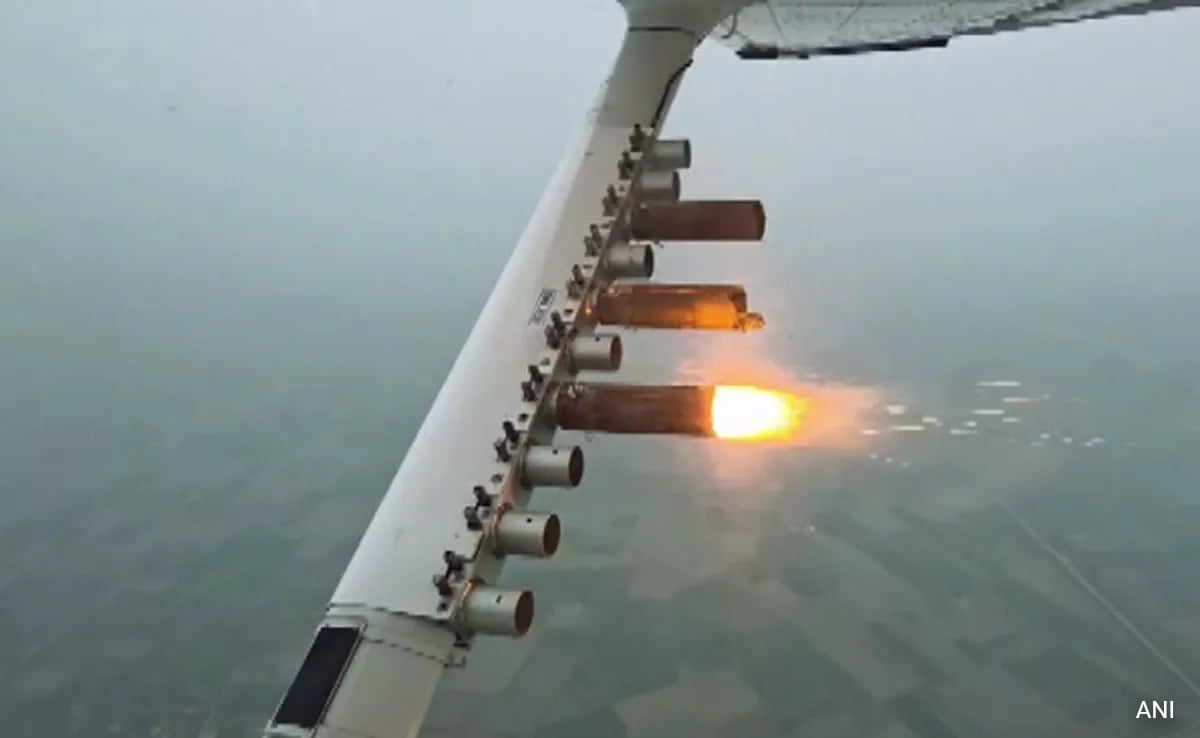
Over the years, research on cloud seeding has expanded across the country.
New Delhi:
After a gap of 53 years, Delhi once again conducted an artificial rain experiment, this time to ease the city's air pollution crisis.
The first trial was conducted during the monsoon of 1957, with the second attempt traced back to the winter of the early 1970s, climate scientist Roxy Mathew Koll from the Indian Institute of Tropical Meteorology, Pune, told PTI.
On Tuesday, the Delhi government, in collaboration with IIT-Kanpur, conducted the cloud-seeding trial in parts of the national capital, marking the third such experiment, with more trials planned over the next few days, Environment Minister Manjinder Singh Sirsa said.
According to officials, the aircraft took off from Kanpur and covered areas such as Burari, north Karol Bagh, and Mayur Vihar before landing at the Meerut airfield.
"The Cessna aircraft took off from Kanpur, released eight fire flares, and the trial lasted for about half an hour," Sirsa said in a video statement.
The trial is part of the Delhi government's broader strategy to mitigate deteriorating air quality in the national capital during the winter months.
According to an Indian Institute of Tropical Meteorology (IITM) report, the second trials conducted in 1971-72 were carried out at the National Physical Laboratory campus, covering roughly a 25-km radius over central Delhi.
At that time, silver iodide particles released from ground-based generators acted as tiny nuclei around which moisture condensed to form raindrops, the report said.
Twenty-two days were identified as favourable for the experiment between December 1971 and March 1972. Of these, seeding was conducted on 11 days, while the remaining 11 days were kept as control days for comparison, the IITM report noted.
Preliminary analysis of the data indicated a tendency for increased rainfall on the seeded days, suggesting that artificial rain could indeed be triggered under suitable weather conditions, it added.
Over the years, research on cloud seeding has expanded across the country.
New centres were established near Madras (now Chennai) and Pune, where clouds could be seeded both from the ground and through aircraft, according to the report.
Under IITM's Cloud Aerosol Interaction and Precipitation Enhancement Experiment (CAIPEEX) programme, scientists have spent more than a decade studying clouds and rainfall in different parts of the country.
During CAIPEEX Phase IV (2017-2019), IITM scientists conducted experiments in Maharashtra's Solapur, a rain-shadow region that receives limited rainfall. Over two years, 276 clouds were studied to test the effectiveness of cloud seeding, the report said.
Cloud seeding, according to IITM, is a technique in which cloud-forming particles are introduced into clouds to enhance rainfall.
There are two main types -- hygroscopic and glaciogenic. Hygroscopic seeding is done in warm clouds, where tiny seed particles attract water vapour, helping droplets merge and grow until they fall as rain.
Glaciogenic seeding is carried out in cold clouds, where silver iodide particles form ice crystals near the cloud top, which later melt and fall as rain, the report noted.
The results from the CAIPEEX IV experiment showed that hygroscopic seeding increased rainfall by up to 46 per cent in some areas, and by an average of 18 per cent over an area of 100 square kilometres, the annual report noted.
According to IITM, in Solapur alone, the technique contributed about 867 million litres of additional water.
Cloud seeding uses advanced technology aircraft equipped with flares release seeding material into suitable clouds, ground-based radars track cloud movements, and automatic rain gauges measure rainfall on the ground.
Scientists analyse real-time data to select the most suitable clouds for seeding, ensuring maximum efficiency, the report added.
Globally, cloud seeding is practised in more than 56 countries, including Australia, China, Russia, Thailand, the UAE, and the United States, where it is used for weather modification, rainfall enhancement, and even pollution reduction.
Additionally, this time, the project, approved by multiple departments, including the Directorate General of Civil Aviation (DGCA), aims to assess whether artificial rain can serve as a viable solution to tackle rising pollution levels during the winter.
The Delhi Cabinet approved a proposal on May 7 to conduct five cloud-seeding trials at a total cost of Rs 3.21 crore.
(Except for the headline, this story has not been edited by NDTV staff and is published from a syndicated feed.)
Published: October 28, 2025 19:35 IST
 Written by Shreya Goswami | Thursday October 01, 2026
October's changing temperatures, dry air, dust and rising pollution can leave Delhi-NCR residents with a scratchy throat, cough or hoarseness.
- Written by Dr Shivanshu Raj Goyal | Thursday October 01, 2026
Since most people spend a lot of time indoors, the air quality indoors becomes essential in relation to respiratory health. Considering different environments, air inside can contain dirt, allergens and several pollutants from multiple sources.
- Wednesday September 30, 2026 , France
In a new analysis covering the first eight months of 2026, the European Union's Copernicus Climate Atmosphere Monitoring Service (CAMS) highlighted the close relationship between climate change and air pollution.
- Reported by Reet Kaur Sahni | Tuesday September 29, 2026
Starting November 1, petrol and diesel vehicles registered outside Delhi and not meeting BS-VI standards will be banned from entering the city, though CNG and electric vehicles are exempt.
- Written by Dr Sabine Kapasi | Tuesday September 29, 2026
Air pollution is often discussed as a cause of respiratory disease, but its effects extend to the heart and blood vessels.



................................ Advertisement ................................

Blog | Well Done, Delhi. You've Turned Lung Sacrifice Into A Badge Of HonourSaikat Kumar Bose
Monday November 10, 2025Till some years back, Delhiites would ask angry questions to those in power about the capitals annual tryst with toxic air. This has changed. Those in the driving seat dont see the need to answer now.
Opinion | Why Indians Have Just Given Up On Air Pollution CrisisTanushree Ganguly
Friday December 20, 2024While some may argue that people in Delhi are now more aware of air pollution than they were a decade back, my rebuttal would be that awareness does not mean that people are concerned.
Opinion | You Must Outrage Over Filthy Air More Than Once A YearJyoti Pande Lavakare
Tuesday December 10, 2024Delhi welcomed us with monsoon rains and mangos. We were home. Fast forward a couple of years, in the winter of 2012, I found myself in denial about something other parents, mostly expats, were calling toxic air.
Opinion | Delhi's Air Pollution Situation Is Like A Bad MarriageNishtha Gautam
Friday November 22, 2024On a good day, such as today, the AQI reading in Delhi is 407. We are jubilant at the sickly sunshine trickling through the slightly dissipated smog. At least its not 1600.
दिवाली... पराली... सियासी जुगाली!Ashwini kumar
Monday November 18, 2024दिल्ली-एनसीआर में प्रदूषण का समाधान तो आज तक मिला नहीं. हर साल चिंतित होकर हम-आप सांसों की तकलीफ के साथ-साथ दिल और ब्लड प्रेशर के मरीज भी क्यों बनें?


