


- Home/
- Missing Census, Poor Maintenance: Experts On Factors Behind Delhi Tree Falls
Missing Census, Poor Maintenance: Experts On Factors Behind Delhi Tree Falls
Reported by Reet Kaur Sahni | Updated: July 06, 2026 14:01 IST
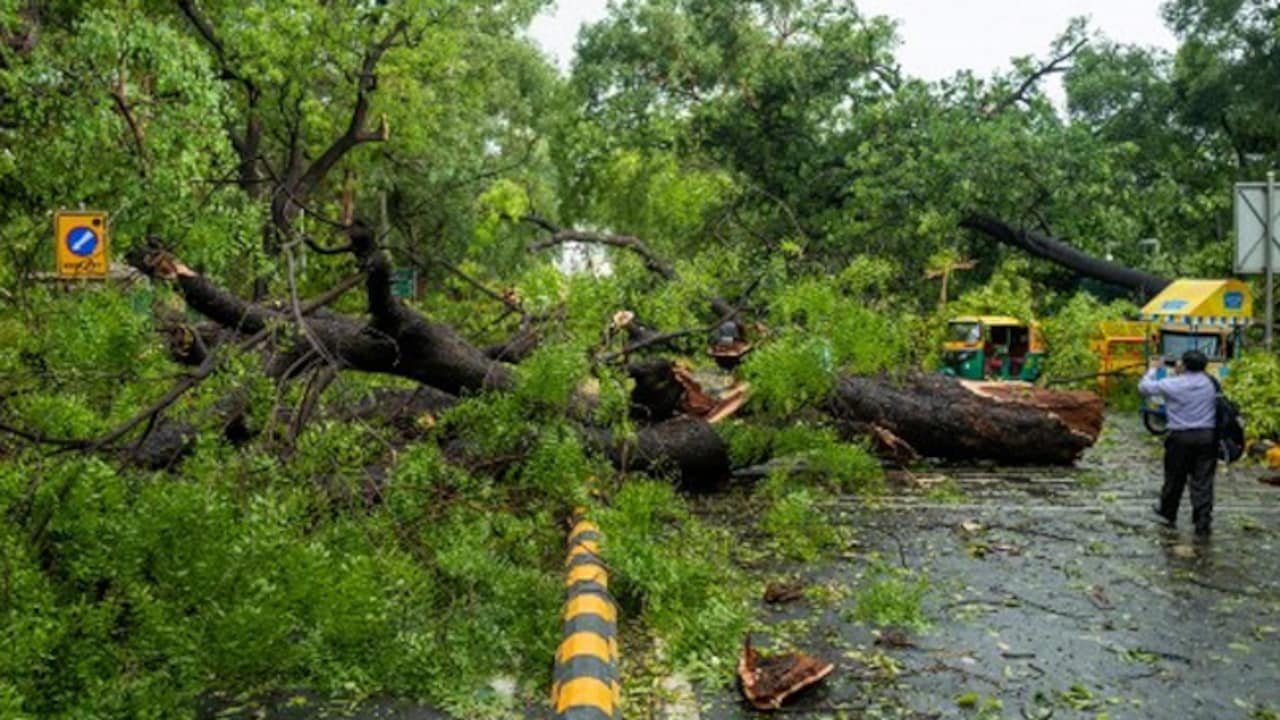
One of the major causes for the trees to fall could be aging, diseases and internal rotting.
Highlights
- Eleven-year-old Vihaan Srivastava died when a tree fell on his school bus in Mumbai
- Experts cite decay, poor roots, bad pruning, and location as main causes of tree falls
- Tree roots suffer from concretisation, harming water and oxygen supply to the tree
New Delhi:
In Mumbai's Chembur, an eleven-year-old boy named Vihaan Srivastava was killed when a massive, uprooted tree crashed directly onto his school bus. Just a few days later, in Maharashtra's Mira Bhayandar, a motorcyclist Rahul Patil died after a coconut tree fell on his moving two-wheeler. And the list of tragedies keeps writing itself. But these incidents are not isolated or unheard of. Every monsoon we see the same headlines: Trees crushing cars, falling on houses, damaging infrastructure, power grids. These incidents raise serious questions on what makes trees fall repeatedly.
Experts attribute the fall of trees to 4 major reasons.
1. Decay And Disease
One of the major causes for the trees to fall could be aging, diseases and internal rotting. More times than often, these signs may not be visible to the naked eye. A compromised foundation exacerbates risk of a tree fall. A weakened internal structure could easily bend or break under pressure from heavy winds and rainfall. Despite looking healthy on the outside, a tree could have a completely hollow structure on the inside.
Experts recommend conducting a tree census and health audits for early detection and treatment of the tree's issues, rather than it falling to its death. Eco restoration practitioner Padmavati Dwivedi, says, "Across the country there is no annual tree health maintenance regime. With increased concretization, compaction around trees, natural ageing, diseases and other human pressures on trees in cities, it's very important to ensure a regular tree care schedule to minimize these mishaps."
Interestingly Dwivedi herself conducted Delhi's first citizen-led tree census in Sarvodaya Enclave over a decade ago. Speaking on the need for such audits, she adds, "The Delhi Preservation of Trees Act, 1994 points out to tree census as an important measure for giving trees identity to protect them. This exercise also gives an opportunity to observe them closely to maintain their health and longevity."
However, despite the law being in force for more than three decades, no city-wide scientific census has ever been carried out.
2. Poor Root Support And Concretisation
Roots are the critical link that keep the tree standing and stable. Any damage to the root means an inevitable damage to the tree's physical support system. To protect the roots from getting damaged, experts actively advocate against concretisation of them.
Environmentalist Bhavreen Kandhari warns against the risks of concretisation. "When a tree gets concreted, there is no room for water & oxygen to seep in. Ultimately this leads to the roots getting weak and the tree falling." Further the activist stressed heavily on the law stating that the concept is not merely a direction but a law that the officials must work towards implementing.
The National Green Tribunal mandates that all trees must be free of concrete within a minimum 1-metre radius of their trunks. This breathing space allows for essential water and air to trickle in. Concreting beyond the 1-metre limit and green belt violates NGT and environmental norms.
Often, individuals cut through a tree's deep roots to lay down pavement pipes, build structures which directly harm the health of the tree. Alternatively, roots that circle and grow around the tree instead of outward could also choke the tree, cut off nutrients, and also create a weak point at ground level.
Not just the roots, the soil conditions in which the root spreads also play a huge role. Trees growing in shallow soils may be unable to grow deep roots to hold themselves firmly. Too much water soaking in or strong winds blowing could cause the roots' grip to further loosen in the soil and the tree to fall.
3. Poor Pruning And Bad Planning
Ultimately how a tree is cared for is what dictates its health and survival. The branches are as much a part of the tree as the rest of the structure. Therefore, the idea of pruning too cannot be random and must be carried out after a diligent assessment of the tree. For instance, cutting off the main upper trunk or topping could remove the tree's main food producing crown. This could lead to the tree deteriorating in structure and nutritional health and dying.
Environmentalist Bhavreen Kandhari notes, "Nature doesn't need pruning. Pruning occurs to protect citizens and infrastructure, on its own, the tree doesn't need it. Therefore, the process must not be random and damage the tree."
Remarking on the need for trained officials to oversee pruning, Kandhari said, "It is easier to cut a tree than help save it. Just cutting branches is not the solution, the health of the tree must be carefully assessed by trained officials. NDMC was supposed to provide tree ambulances with trained officials to oversee this very task, but this has still not come through."
4. Location And Climate
Climate change across the world is inducing newer, off-beat conditions. Sometimes nature may throw more weight at a tree than it can possibly handle. High winds often force the roots, trunk to give in, thereby causing the tree to fall.
The location at which a tree grows also plays a very crucial role in determining its health. Trees that grow in dense forests protect one another from the wind. When tree cover is cleared for housing or roads, the trees that are left behind are suddenly exposed to intense winds that they weren't equipped to deal with.
In colder conditions where there is snow, the ice may nest at the branches of the trees thereby burdening it and causing it to fall. Planting of trees also cannot be at random and must be undertaken keeping the nutrient requirements and weather conditions needed in mind.
The Way Forward
As trees fall one after the other, environmentalists stress on the need to prevent such avoidable tragedies than villainise trees which are known to be the giver of lives and not the taker of them. Urging the civil society to come out and help, Eco restoration practitioner Padmavati Dwivedi said, "Trees cannot be protected without the involvement of citizens at the colony level. There has to be a partnership between citizens and government agencies to ensure trees are protected and live long."
Published: July 06, 2026 12:29 IST
 Reported by Reet Kaur Sahni | Friday August 07, 2026
As per the ministry, prior Environmental Clearance becomes mandatory for data centres depending on their physical footprint under Schedule 8 of the EIA Notification, 2006.
- Written by Sambhav Kumar | Thursday August 06, 2026
Keerthy Suresh's 41-hour no-sleep stretch highlights the intense demands many professionals face, but experts warn that prolonged sleep deprivation should never become routine.
- Written by Sambhav Kumar | Wednesday August 05, 2026
Preliminary evidence suggests the blood filtration treatment could reduce some microplastic particles, though findings are limited and require more study.
- Monday August 03, 2026 , New Delhi
Study reveals black crust from pollution weakens Humayuns Tomb sandstone
- Written by Debosmita Ghosh | Saturday August 01, 2026
Lung cancer is often diagnosed at an advanced stage because its early symptoms are easy to overlook. A persistent cough is among the most commonly ignored warning signs.


................................ Advertisement ................................

Blog | Well Done, Delhi. You've Turned Lung Sacrifice Into A Badge Of HonourSaikat Kumar Bose
Monday November 10, 2025Till some years back, Delhiites would ask angry questions to those in power about the capitals annual tryst with toxic air. This has changed. Those in the driving seat dont see the need to answer now.
Opinion | Why Indians Have Just Given Up On Air Pollution CrisisTanushree Ganguly
Friday December 20, 2024While some may argue that people in Delhi are now more aware of air pollution than they were a decade back, my rebuttal would be that awareness does not mean that people are concerned.
Opinion | You Must Outrage Over Filthy Air More Than Once A YearJyoti Pande Lavakare
Tuesday December 10, 2024Delhi welcomed us with monsoon rains and mangos. We were home. Fast forward a couple of years, in the winter of 2012, I found myself in denial about something other parents, mostly expats, were calling toxic air.
Opinion | Delhi's Air Pollution Situation Is Like A Bad MarriageNishtha Gautam
Friday November 22, 2024On a good day, such as today, the AQI reading in Delhi is 407. We are jubilant at the sickly sunshine trickling through the slightly dissipated smog. At least its not 1600.
दिवाली... पराली... सियासी जुगाली!Ashwini kumar
Monday November 18, 2024दिल्ली-एनसीआर में प्रदूषण का समाधान तो आज तक मिला नहीं. हर साल चिंतित होकर हम-आप सांसों की तकलीफ के साथ-साथ दिल और ब्लड प्रेशर के मरीज भी क्यों बनें?


