


- Home/
- Thick Layer Of Toxic Froth Resurfaces On Yamuna River In Delhi
Thick Layer Of Toxic Froth Resurfaces On Yamuna River In Delhi
Press Trust of India | Updated: January 12, 2026 00:17 IST
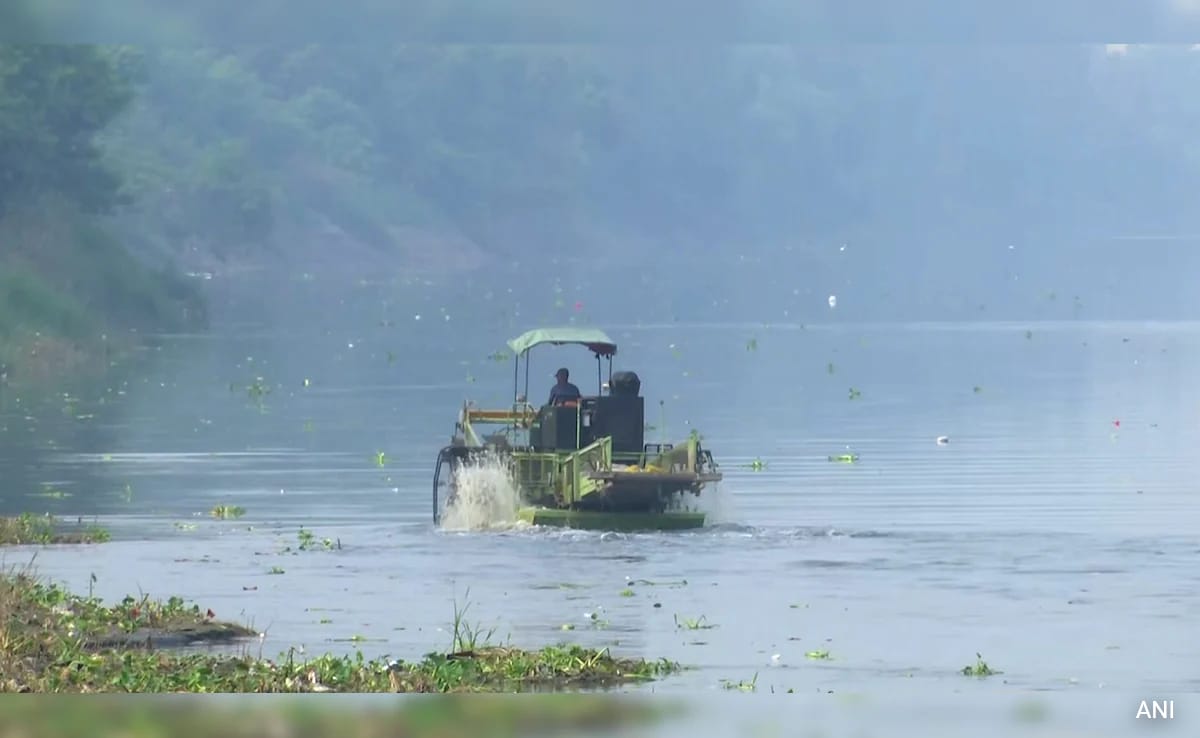
The froth accumulated heavily around boats moored along the riverbank.
A thick layer of toxic froth resurfaced at the Yamuna ghat in Kalindi Kunj here on Sunday, making large stretches of the river nearly invisible, even as experts reiterated that it is disruptive for the river's ecology.
The froth accumulated heavily around boats moored along the riverbank, clinging to their sides.
Dust particles were also visibly embedded in the froth that settled along the riverbank.
In addition to the froth, garbage was scattered along the riverbank. The waste included plastic materials, discarded bottles, flowers, chopped human hair and even blades.
Environmentalist Pankaj Kumar, who carries out a cleanliness drive every Sunday at the Kalindi Kunj ghat, claimed that the water in December and January has been a lot more polluted than it was before the Chhath festival in October last year.
"During the Chhath festival, there was a strong collective effort to clean the Yamuna river; had the government sustained that momentum, the condition of the river would've vastly improved in months," Kumar told PTI.
The Delhi Pollution Control Committee's (DPCC) latest report on the Yamuna's water quality -- based on samples collected on December 3, 2025 -- records Biological Oxygen Demand (BOD) levels of 25 mg/l at ITO Bridge, 24 mg/l at ISBT Bridge, and 17 mg/l at Okhla Barrage, against the DPCC's prescribed safe limit of 3 mg/l.
BOD is a crucial indicator of a river's health and its capacity to support aquatic life.
On the other hand, fecal coliform bacteria levels -- measured as most probable number (MPN) -- were recorded at 92,000 at ISBT Bridge, 54,000 at Nizamuddin Bridge, and 35,000 at ITO Bridge, as per the December report.
Fecal coliform, an indicator of sewage contamination, has a desirable limit of 500 units per 100 ml and a permissible limit of 2,500 units per 100 ml, as prescribed by the Central Pollution Control Board (CPCB).
The CPCB classifies BOD levels between 20-30 mg/l as "severe".
On Thursday, a bench of National Green Tribunal (NGT) Chairperson Justice Prakash Shrivastava and expert member A Senthil Vel noted that the Delhi government's report on liquid waste management identified the discharge of treated, partially treated, and untreated sewage through various drains as the main cause of water pollution in the Yamuna, particularly between Wazirabad Barrage and Asgharpur village.
Pollution at Delhi's Yamuna ghats is creating serious health risks, with toxic froth along the river emitting a strong stench, Atul Kumar of the Earth Warriors group said.
He said volunteers cleaning the riverbanks at Kalindi Kunj ghat every Sunday face these hazards while witnessing people who continue to dump waste directly into the river.
"Public awareness about river pollution is low, and government measures are insufficient. Although official documents set out restrictions and penalties for dumping waste into the river, these are rarely visible on-site, and most citizens do not check them online," Kumar told PTI, adding that proper signage and stricter monitoring are urgently needed to tackle the problem.
The CPCB and NGT have prohibited dumping waste into the river except at designated disposal sites and imposed a Rs 5,000 penalty under the "polluter pays" principle.
Vishwas Dwivedi, another volunteer at the 'Earth Warriors' group noted that the toxic froth at the Yamuna doesn't just harm human health but also disturbs the river's ecology.
"The froth blanket prevents natural sunlight from reaching the riverbed, resulting in degraded water quality. There are aquatic plants that act as natural filters, absorbing phosphates and sulphates and creating healthier aquatic environments," Dwivedi told PTI.
"If these plants do not receive sunlight, they will die and, in turn, contribute to further contamination of the water," he added.
(Except for the headline, this story has not been edited by NDTV staff and is published from a syndicated feed.)
Published: January 12, 2026 00:17 IST
also read
 Edited by Astitva Raj | Monday January 12, 2026
In the video, Evans, known as "Aussie Bhai" on Instagram, was seen removing the filter from his air purifier.
- Press Trust of India | Friday January 09, 2026 , New Delhi
The PM2.5 assessment for 2025 ranks Byrnihat (Assam), Delhi, and Ghaziabad (Uttar Pradesh) as India's top three most polluted cities with annual concentrations of 100 g/m, 96 g/m, and 93 g/m, respectively.
- Written by Shreya Goswami | Wednesday January 07, 2026
A study by Jawaharlal Nehru University finds that Delhi's polluted winter air carries high levels of antibiotic-resistant bacteria or superbugs far above safe limits, posing public health risks, especially for vulnerable groups and those with chronic
- Reported by Nupur Dogra | Tuesday January 06, 2026 , New Delhi
The Commission for Air Quality Management or CAQM, was strongly reprimanded by the Supreme Court today, which said the pollution body was not taking the issues raised by the court seriously.
- Written by Shreya Goswami | Tuesday January 06, 2026
Bronchial asthma often worsens in winter due to cold air, pollution and infections.

................................ Advertisement ................................
Blog | Well Done, Delhi. You've Turned Lung Sacrifice Into A Badge Of HonourSaikat Kumar Bose
Monday November 10, 2025Till some years back, Delhiites would ask angry questions to those in power about the capitals annual tryst with toxic air. This has changed. Those in the driving seat dont see the need to answer now.
Opinion | Why Indians Have Just Given Up On Air Pollution CrisisTanushree Ganguly
Friday December 20, 2024While some may argue that people in Delhi are now more aware of air pollution than they were a decade back, my rebuttal would be that awareness does not mean that people are concerned.
Opinion | You Must Outrage Over Filthy Air More Than Once A YearJyoti Pande Lavakare
Tuesday December 10, 2024Delhi welcomed us with monsoon rains and mangos. We were home. Fast forward a couple of years, in the winter of 2012, I found myself in denial about something other parents, mostly expats, were calling toxic air.
Opinion | Delhi's Air Pollution Situation Is Like A Bad MarriageNishtha Gautam
Friday November 22, 2024On a good day, such as today, the AQI reading in Delhi is 407. We are jubilant at the sickly sunshine trickling through the slightly dissipated smog. At least its not 1600.
दिवाली... पराली... सियासी जुगाली!Ashwini kumar
Monday November 18, 2024दिल्ली-एनसीआर में प्रदूषण का समाधान तो आज तक मिला नहीं. हर साल चिंतित होकर हम-आप सांसों की तकलीफ के साथ-साथ दिल और ब्लड प्रेशर के मरीज भी क्यों बनें?


