

- Home/
- Genrobotics Medical & Mobility Brings Robotics To Rehabilitation Across Ages
Genrobotics Medical & Mobility Brings Robotics To Rehabilitation Across Ages
Team NDTV | Updated: February 02, 2026 15:57 IST
New Delhi:
Genrobotics Medical & Mobility is the healthcare‑focused division of Genrobotics, a Kerala-based Indian robotics and AI company that builds advanced robotic solutions for real‑world problems. This division focuses on designing robotic rehabilitation technology to help people with mobility challenges, recover movement and walk independently. It's a part of a larger group, Genrobotics, that also works on robotics for sanitation tech, oil and gas, and robotics and AI research.
What Genrobotics Does
Founded in 2015, Genrobotics began as a college project where they developed a wearable exoskeleton. Since then, they've grown and created innovative solutions for real-world problems. In healthcare, Genrobotics Medical & Mobility helps patients heal or get back their movement more quickly than usual therapy. The goal is to help patients walk or move on their own without needing as much help from others. The company uses advanced, human-friendly robots to make therapy easier, safer and more effective.
How Does Genrobotics Work In Medicine?
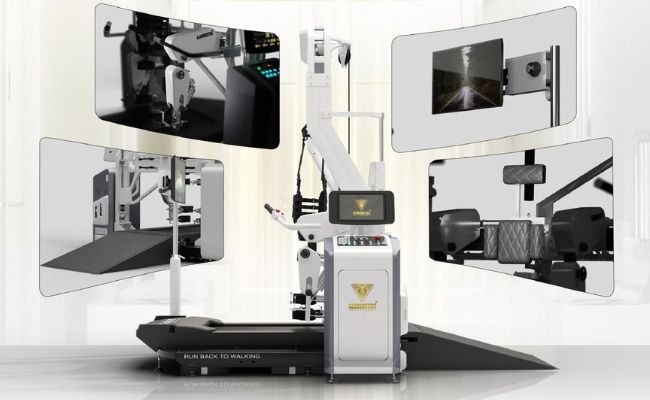
The main product from Genrobotics Medical & Mobility is called G‑Gaiter, a robotic walking trainer. This solution is used by hospitals and rehabilitation centers to help patients recover walking ability after conditions such as stroke, spinal cord injury or other movement issues. G-Gaiter is a wearable system that guides the legs through natural walking patterns, helping patients practice safely. Its standout feature is repeatable and consistent training, which helps the body relearn proper walking movements.
G-Gaiter Line-Up
From children to adults, G-Gaiter offers different robotic walking trainers designed to meet the needs of different patients. G-Gaiter Standard is designed for adults, which helps patients regain strength, balance and confidence while learning to walk again. G-Gaiter Paediatric is designed for children with child-friendly ergonomics and therapy modes. This provides gentle yet effective rehabilitation for the youngest patients. G-Gaiter Advanced is designed for both pediatric and adult use. The advanced model seamlessly adjusts to treat both children and adults, making it an ideal choice for comprehensive rehabilitation centers.
Genrobotics In Medical Care
Kerala became the first Indian state to use robotic rehabilitation technology at primary healthcare centers. A Robotic Assisted Gait Trainer, called G-Gaiter, was set up at the Noolpuzha Family Health Center in Wayanad. This robot helps patients practice walking safely and recover movement.
G-Gaiter Exoskeleton vs End-Effector Systems
G-Gaiter Exoskeleton supports each joint individually, so walking feels natural. It also helps maintain posture, balance, and knee safety. Unlike traditional End-Effector systems, which lack joint-specific support and have limited accuracy, G-Gaiter helps keep your body upright and balanced while walking.
Rashid Karimbanakkal, Co-Founder Of Genrobotics
Rashid Karimbanakkal is a co-founder and director of Genrobotic Innovations. He completed his B.Tech from the University of Calicut and earned a Master's in International Business from Bharathiar University in 2020. He co-founded Genrobotic Innovations in 2017, a company focused on using advanced robotics and AI to solve important social challenges. The company specializes in creating medical and mobility solutions that help people recover movement and improve their quality of life.
Vimal Govind MK, Co-Founder Of Genrobotics
Another co-founder is Vimal Govind MK, who completed his B.Tech from the University of Calicut in 2016. He is also the CEO of Genrobotic Innovations. Speaking to The Week, he said, "With the G-Gaiter, we can efficiently control all limbs, providing a natural walking pattern. This repeated practice helps the brain relearn the correct walking pattern."
Published: February 02, 2026 15:57 IST
also read
Uber Teams Up With NGO Manas Foundation To Conduct Gender Sensitisation Workshops For Partner Drivers
Reported by Ruby Dhingra, Edited by Aishwarya UpadhyayMeet Suganthi, A Woman Uber Driver Who Is Achieving Her Dreams By Driving A Cab Through The Streets Of Bengaluru
Reported by Maya SharmaTo Ensure Safety Of Women, Travel In Delhi Buses And Metro Made Free By Chief Minister Arvind Kejriwal
Edited by Deepshikha Ghosh
NDTV in partnership with UBER is launching a sustained campaign 'Roshan Dilli' to try and raise safety standards in India's capital, New Delhi.
Our focus is to try and improve lighting in public spaces in the city. Lighting is a key factor in shaping women's perceptions of safety
The initiative will provide a platform for all stakeholders to discuss our goal of improving safety standards, to start a conversation about safety of women in the country
It will also highlight various interventions and solutions that help to make women safe and put the spotlight on what more can be done.
The campaign will accentuate the need for Safety to be a shared responsibility
The need for gender sensitization and how law enforcement and civil society through checks and education can try and make women safer
We hope you will join us and help make New Delhi a safer city for women.


