


- Home/
- Winter Yet To Set In, But Delhi's AQI More Than Doubles In 3 Days
Winter Yet To Set In, But Delhi's AQI More Than Doubles In 3 Days
Written by Amit Chaturvedi | Updated: October 19, 2026 13:05 IST
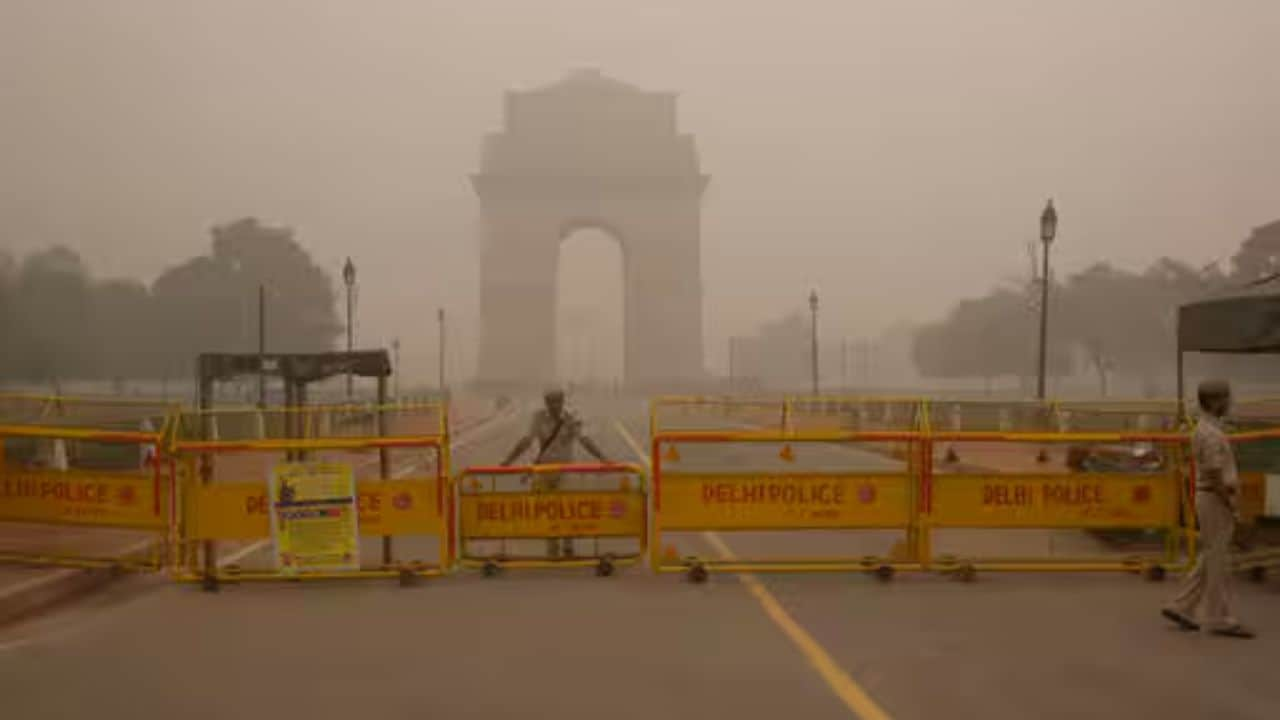
Delhi's AQI deteriorates significantly during the winter season. (File Photo)
Highlights
- Delhi's AQI more than doubled from 90 on Friday to 187 on Sunday due to dry weather and slow winds
- Temperature dropped to 17.1°C on Sunday, 1.3°C below normal after monsoon withdrawal
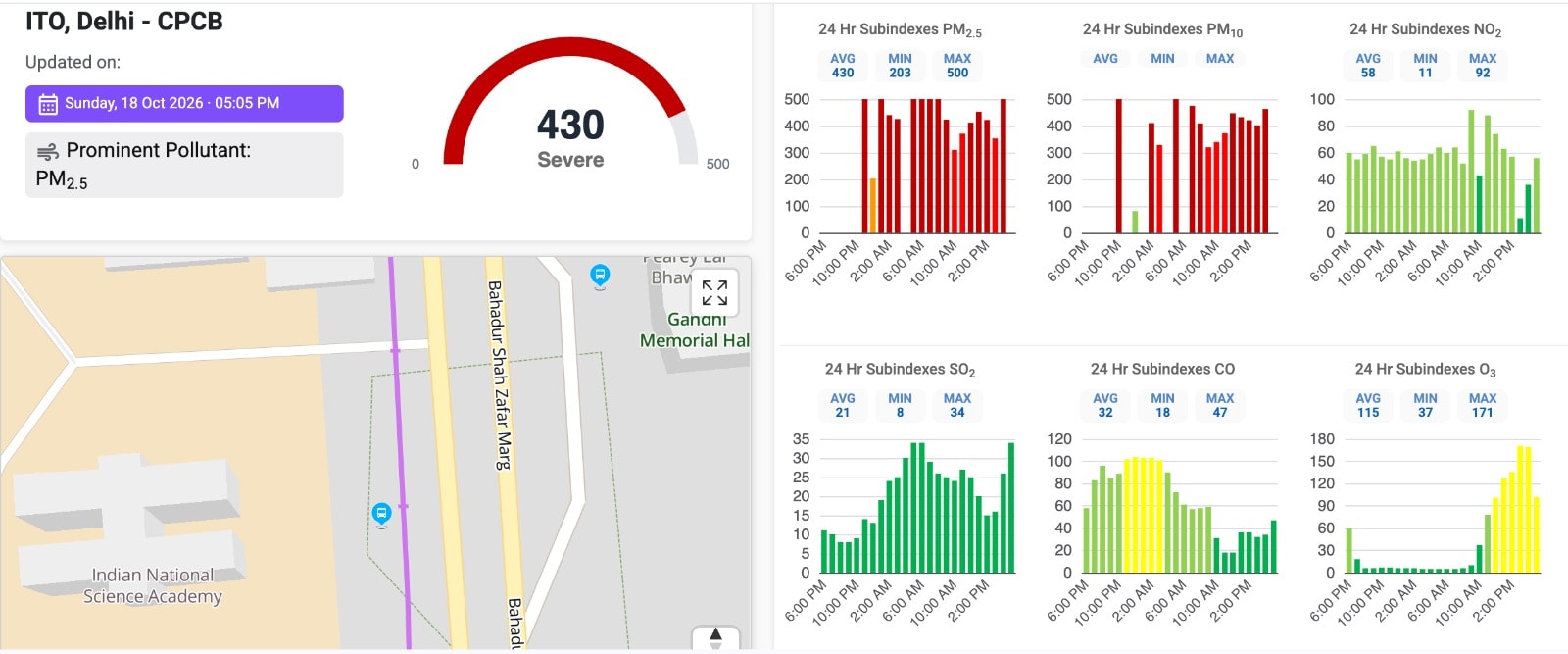
- Twenty-two city locations recorded poor air quality Sunday; ITO station hit severe 430 AQI
A slight nip in the air signals the changing season, but winter is yet to arrive in Delhi. Yet, the national capital's air quality has deteriorated sharply over the past three days. Since Friday, Delhi's Air Quality Index (AQI) more than doubled as dry weather and slower winds allowed pollutants to accumulate. From 90 on Friday, the national capital's AQI rose to 159 on Saturday and 187 on Sunday, according to Central Pollution Control Board (CPCB) data.
Meanwhile, the temperature in Delhi and the national capital region (NCR) has fallen following the withdrawal of the monsoon. On Sunday, Delhi's temperature settled at 17.1 degrees Celsius, 1.3 degrees below the season's normal, the India Meteorological Department (IMD) said.
However, with no rainfall forecast over the coming week, air quality is expected to remain a concern.
Twenty two monitoring locations across the city recorded poor air quality on Sunday, indicating that pollution levels were already elevated in several areas. The worst air quality of 430 was recorded at ITO, placing it in the severe category.
On Saturday, Anand Vihar reported an AQI of 348, while Mundka recorded 227 and Jahangirpuri registered 212. Chandni Chowk recorded 188, while Vivek Vihar and Rohini both reported 187. Punjabi Bagh recorded 171, followed by Narela at 165, CRRI Mathura Road at 158 and Dwarka Sector 8 at 155.
On Monday, Delhi's AQI is expected to deteriorate to the poor category for the first time this season.
How Much Has AQI Risen Since October 1?
Delhi's AQI at Delhi's ITO station at 5 pm on October 1 was 132, according to CPCB data. In Jahangirpuri, the number stood at 216; for Punjabi Bagh, the same number was 178. In Anand Vihar, among Delhi's most polluted points, the 5 pm AQI on October 1 was surprisingly 96. This shows that in the 18 days of this month, the air quality has deteriorated significantly - that too, just before the winter season.
And the sharpest recent increase came after Friday's relatively clean-air reading.
The CPCB classifies AQI readings of 101-200 as moderate, 201-300 as poor, 301-400 as very poor and 401-500 as severe.
Why Is Delhi's Air Quality Worsening?
The immediate reasons include the absence of rain, slower wind speeds and emissions from local sources, including vehicles, road dust and construction activity. Rain and stronger winds can help disperse pollutants. As these conditions subside after the monsoon, emissions from everyday activities begin to accumulate closer to the ground.
The changing weather also plays a role. As winter approaches, cooler temperatures, lower mixing heights and stagnant winds can make it harder for pollutants to disperse.
What The Government Says
However, Delhi has recorded 211 days of good, satisfactory and moderate air quality so far this year, its best performance since 2016, except for the COVID-affected year 2020, Environment Minister Manjinder Singh Sirsa said on Saturday.
With more than two months remaining in the year, the national capital has already surpassed the total number of good-to-moderate air quality days recorded in most previous years, including 200 in 2025, 209 in 2024, 206 in 2023, 159 in 2018 and 110 in 2016.
The minister added that the number of days with poor, very poor and severe air quality had declined from 168 during the corresponding period in 2016 to 79 this year.
Published: October 19, 2026 13:03 IST
also read
Pakistan's Own Agency Busts Its 'Diwali Firework' Pollution Theory As AQI Crosses 600
Edited by Sanstuti NathAir Pollution Is As Big A Public Health Emergency As COVID: Former WHO Chief
Reported by Vedika Sud Sachdeva, Edited by Aastha Ahuja'Pollution Subsides': Yogi Adityanath Defends Bursting Of Crackers On Diwali
Edited by Debanish Achom
 Delhi AQI: Is Toxic Air Making You Tired? Impact Of Air Pollution On Energy, Sleep And ConcentrationWritten by Debosmita Ghosh | Wednesday November 11, 2026
Fine particles such as PM2.5 can enter deep into the lungs and lead to inflammation and oxidative stress in the body. Prolonged exposure may also affect the cardiovascular system and overall physical health.
- Written by Niharika Raj | Wednesday November 11, 2026
A Pakistani air quality body has found no evidence linking Lahore's post-Diwali smog to fireworks in India, pointing instead to thousands of crop-residue fires in Pakistan's own Punjab.
- Written by Sambhav Kumar | Wednesday November 11, 2026
Morning chest heaviness should not automatically be attributed to air pollution. Persistent or worsening symptoms warrant medical evaluation, particularly if accompanied by coughing, wheezing or breathlessness.
- Edited by Sanstuti Nath | Wednesday November 11, 2026 , Islamabad
The Pakistan report said the available evidence did not support attributing Lahore's poor air quality after Diwali to fireworks across the border.
- Written by Sneha Mordani , Edited by Sambhav Kumar | Wednesday November 11, 2026
India should retain the AQI for public advisories but must publish uncapped PM2.5 and PM10 concentrations alongside it. An index may have a ceiling. Pollution does not.


................................ Advertisement ................................


Opinion | Delhi Has Every Pollution Control Policy - Except One That Works
Monday November 09, 2026Every November, Delhi performs the same ritual. We check the AQI before stepping outdoors, children are kept indoors, masks reappear, schools consider shutting, construction is restricted, and emergency meetings are convened. Politicians blame the weather, neighbouring states, farmers, or firecrackers. And then, as the season changes, the urgency d...
दीवाली की चौखट पर दिल्ली में सांसों का संकट: 30 साल की स्टडी ने हरियाली को लेकर क्या बताया?
Thursday November 05, 2026अध्ययन में हरियाली की मात्रा के साथ उसके फैलाव और आपसी जुड़ाव को भी महत्वपूर्ण पाया गया. जिन इलाकों में हरियाली ज्यादा बिखरी हुई थी, वहां सतही तापमान अधिक रहा. इसके विपरीत, बड़े और आपस में जुड़े हरित क्षेत्रों में तापमान कम पाया गया.
Opinion: Why Delhi's Smog Can't Be Fixed From SpaceDavid Fickling, Bloomberg
Monday October 19, 2026The clearest sign that Delhi is on a path to cleaner air would be a decline in the amount of paddy grown nearby, and therefore the acreage liable to be burned each year.
Don't Normalise Air Purifiers As Delhi Chokes | The Reason Why
Thursday December 11, 2025More than 90 cities in the world's top 100 polluting list are in India. With every passing year, the AQI is rising, reaching 'hazardous' levels.
Blog | Well Done, Delhi. You've Turned Lung Sacrifice Into A Badge Of HonourSaikat Kumar Bose
Monday November 10, 2025Till some years back, Delhiites would ask angry questions to those in power about the capitals annual tryst with toxic air. This has changed. Those in the driving seat dont see the need to answer now.



