


- Home/
- India's Air Pollution Watch Has Blind Spots: Inactive Monitoring Stations
India's Air Pollution Watch Has Blind Spots: Inactive Monitoring Stations
Reported by Ankita Tiwari | Updated: November 13, 2026 17:29 IST
Despite the expansion of the pollution monitoring network, gaps remain
As Delhi's air quality plunges back into the "very poor" category with an AQI crossing 300, serious questions are emerging over India's capacity to accurately monitor the deepening crisis.
On November 12, a significant share of the country's air-quality monitoring stations were not functioning, according to data from the Central Pollution Control Board (CPCB).
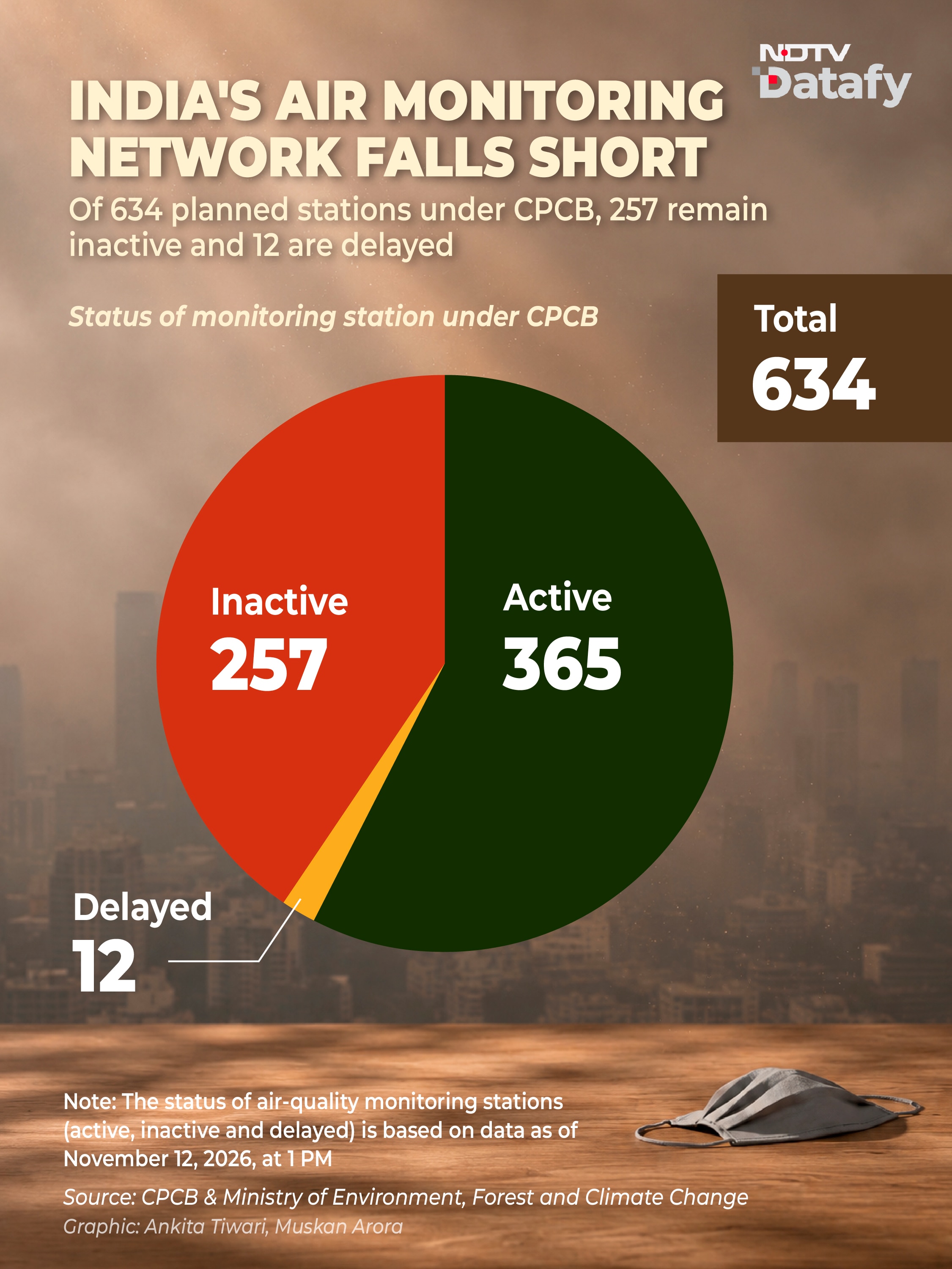
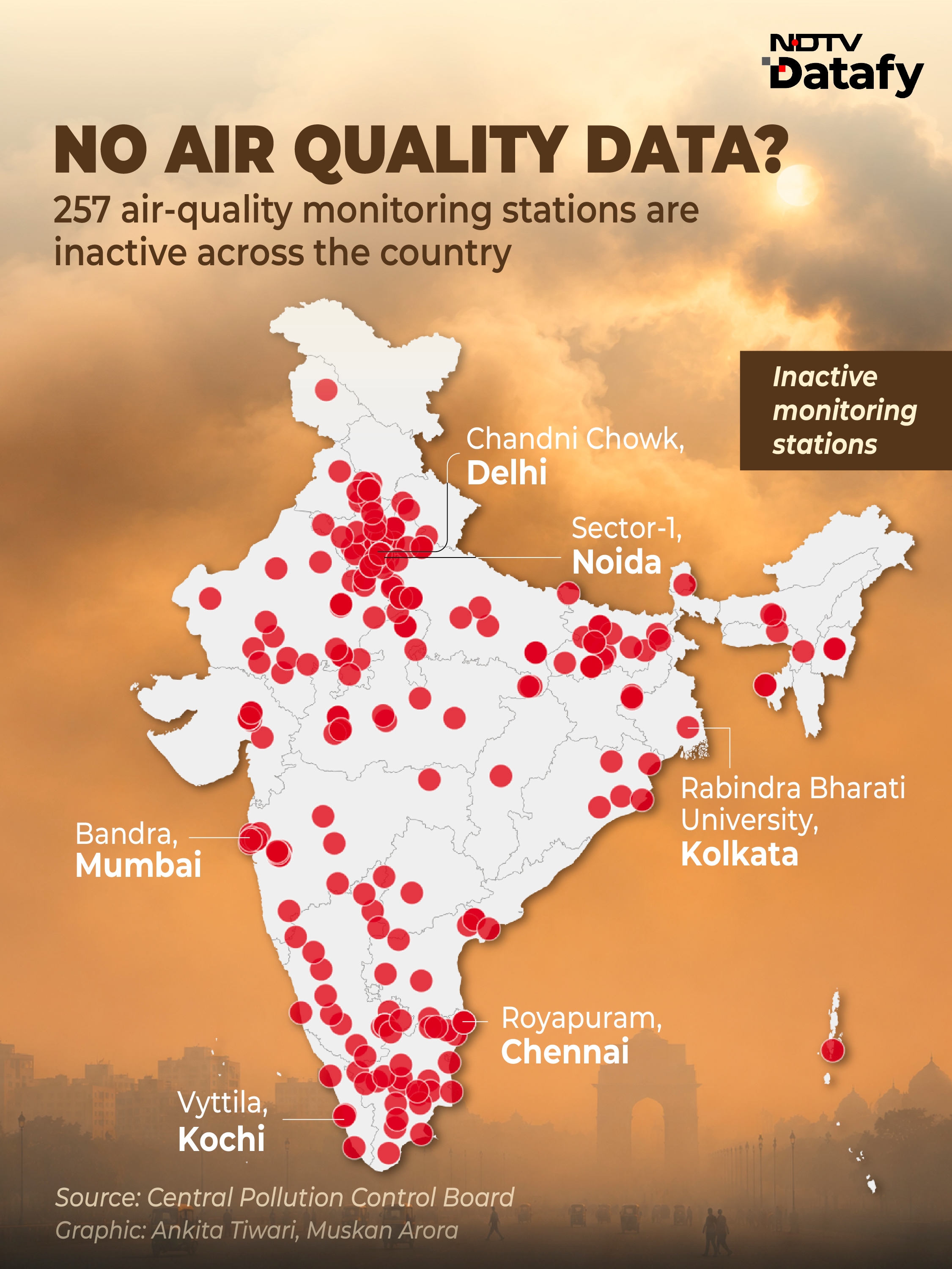
According to the station-status dataset reviewed at 1 pm, 634 monitoring stations were listed, of which 365 were active, 257 inactive and 12 marked as delayed. This means that about 40.5 per cent of the stations were inactive, while another 1.9 per cent were reporting delayed data.
The figures highlight a potential gap in India's air-quality monitoring network at a time when pollution remains a major public-health concern across several regions.
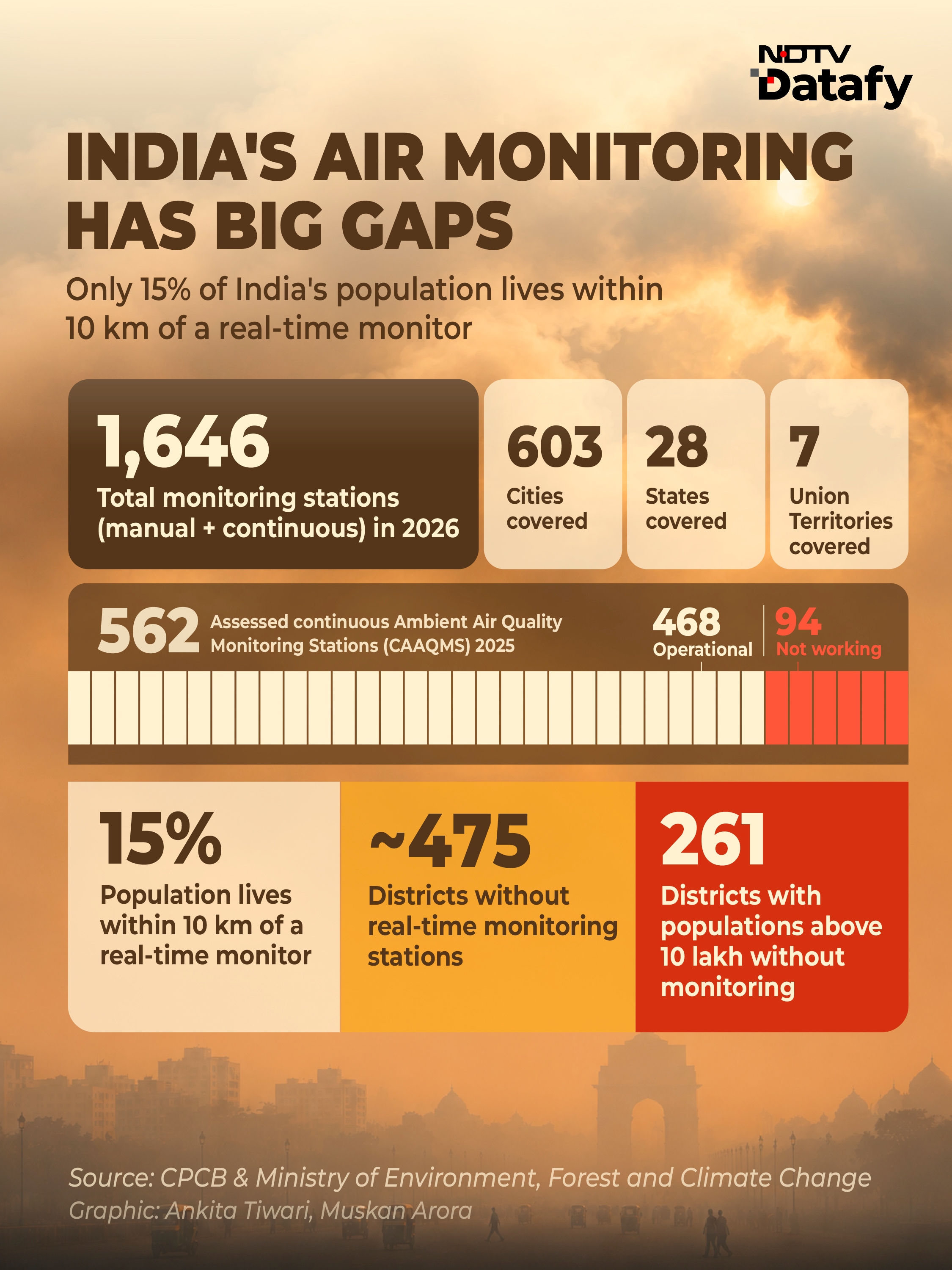
India's population is estimated at around 147.7 crore in 2026. As of March 2026, the country had 1,646 manual and continuous air-quality monitoring stations spread across 603 cities. That translates to roughly one monitoring station for every nine lakh people.
This scarcity directly violates the CPCB's own population-based mandates:
Cities with 1-5 lakh residents: Minimum of 4 stations.
Cities with 5-10 lakh residents: Minimum of 6 stations.
Cities with 10-50 lakh residents: Minimum of 8 stations.
Mega-cities (Above 50 lakh residents): Minimum of 16 stations.
Despite the expansion of the monitoring network, gaps remain. A report released by the Centre for Science and Environment (CSE) in September 2025 found that only 15 per cent of India's population lived within 10 km of a real-time air-quality monitoring station. The report also noted that more than 64 per cent of districts lacked an air-quality monitoring network, while 261 districts with populations exceeding 10 lakh had no monitoring stations.
States With The Highest Share Of Inactive Stations
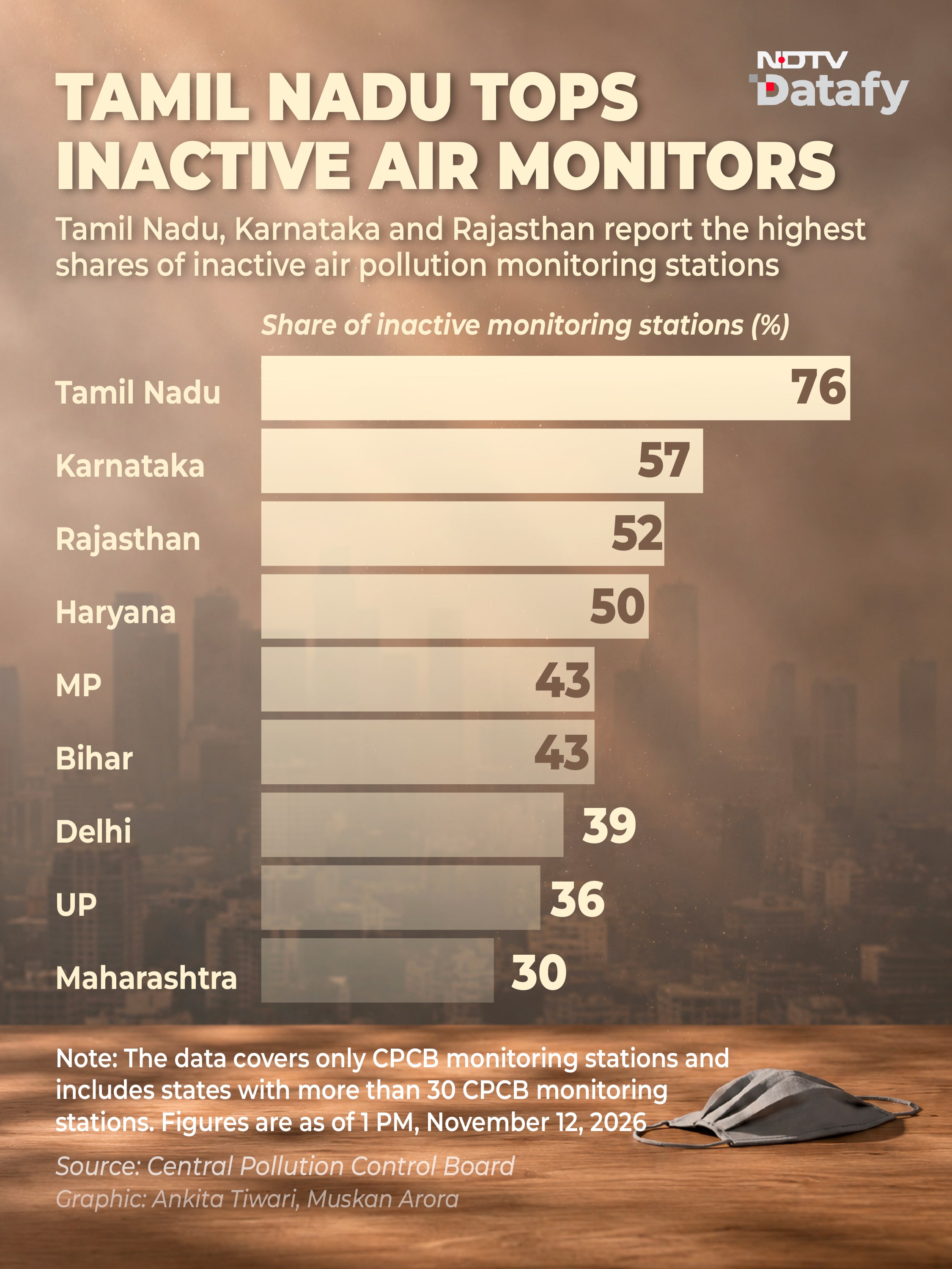
Among states with more than 30 monitoring stations, Tamil Nadu recorded the highest share of inactive stations, with 76 per cent not functioning. Karnataka followed with 57 per cent, Rajasthan with 52 per cent and Haryana with 50 per cent.
Madhya Pradesh and Bihar each reported 43 per cent inactive stations, while Delhi recorded 39 per cent. The figures suggest that monitoring gaps extend well beyond the National Capital Region and affect multiple states across the country.
Why Are So Many Stations Inactive?
The data offers little insight into why a large number of stations are inactive. During a review of station-status records, entries such as "Overflowthen" and "Utilisation" appeared in the dataset. However, the available records do not explain what these terms mean or whether they are linked to stations being marked inactive.
The analysis also found a discrepancy in the inactive-station count. The figures displayed on the CPCB webpage differed from those obtained through the downloadable Excel file. While the downloaded dataset showed 257 inactive stations, the number displayed online appeared different.
NDTV has contacted the CPCB seeking clarification on the reasons behind the inactive status of stations, the meaning of the entries found in the dataset, and the discrepancy between the website and downloadable records. A response is awaited.
Published: November 13, 2026 17:29 IST
 Reported by Ankita Tiwari | Friday November 13, 2026
Data highlight a potential gap in India's air-quality monitoring network at a time when pollution remains a major public-health concern across several regions.
- Written by Debosmita Ghosh | Friday November 13, 2026
If you have hypertension, heart disease or other cardiovascular risk factors, monitoring your blood pressure regularly can be a good thing during prolonged periods of severe pollution.
- Edited by Madhumanti Pait Chowdhury | Friday November 13, 2026
"Will someone please tell me what this strange burnt-fuel smell in the air is?" asked Juhi Chawla
- Written by Sneha Mordani | Friday November 13, 2026
As air pollution continues to threaten the health of the capital, the question is no longer simply whether schools should close.
- Friday November 13, 2026
Air quality index (AQI) in Delhi was "hazardous" at 334, making it the most polluted global major city, according to Swiss group IQAir, which measures air quality levels based on the concentration of toxins



................................ Advertisement ................................
Opinion | Delhi Has Every Pollution Control Policy - Except One That Works
Monday November 09, 2026Every November, Delhi performs the same ritual. We check the AQI before stepping outdoors, children are kept indoors, masks reappear, schools consider shutting, construction is restricted, and emergency meetings are convened. Politicians blame the weather, neighbouring states, farmers, or firecrackers. And then, as the season changes, the urgency d...
दीवाली की चौखट पर दिल्ली में सांसों का संकट: 30 साल की स्टडी ने हरियाली को लेकर क्या बताया?
Thursday November 05, 2026अध्ययन में हरियाली की मात्रा के साथ उसके फैलाव और आपसी जुड़ाव को भी महत्वपूर्ण पाया गया. जिन इलाकों में हरियाली ज्यादा बिखरी हुई थी, वहां सतही तापमान अधिक रहा. इसके विपरीत, बड़े और आपस में जुड़े हरित क्षेत्रों में तापमान कम पाया गया.
Opinion: Why Delhi's Smog Can't Be Fixed From SpaceDavid Fickling, Bloomberg
Monday October 19, 2026The clearest sign that Delhi is on a path to cleaner air would be a decline in the amount of paddy grown nearby, and therefore the acreage liable to be burned each year.
Don't Normalise Air Purifiers As Delhi Chokes | The Reason Why
Thursday December 11, 2025More than 90 cities in the world's top 100 polluting list are in India. With every passing year, the AQI is rising, reaching 'hazardous' levels.
Blog | Well Done, Delhi. You've Turned Lung Sacrifice Into A Badge Of HonourSaikat Kumar Bose
Monday November 10, 2025Till some years back, Delhiites would ask angry questions to those in power about the capitals annual tryst with toxic air. This has changed. Those in the driving seat dont see the need to answer now.



