


- Home/
- The School Bell Can Wait, Children Need Protection From Toxic Air First
The School Bell Can Wait, Children Need Protection From Toxic Air First
Written by Sneha Mordani | Updated: November 13, 2026 13:02 IST
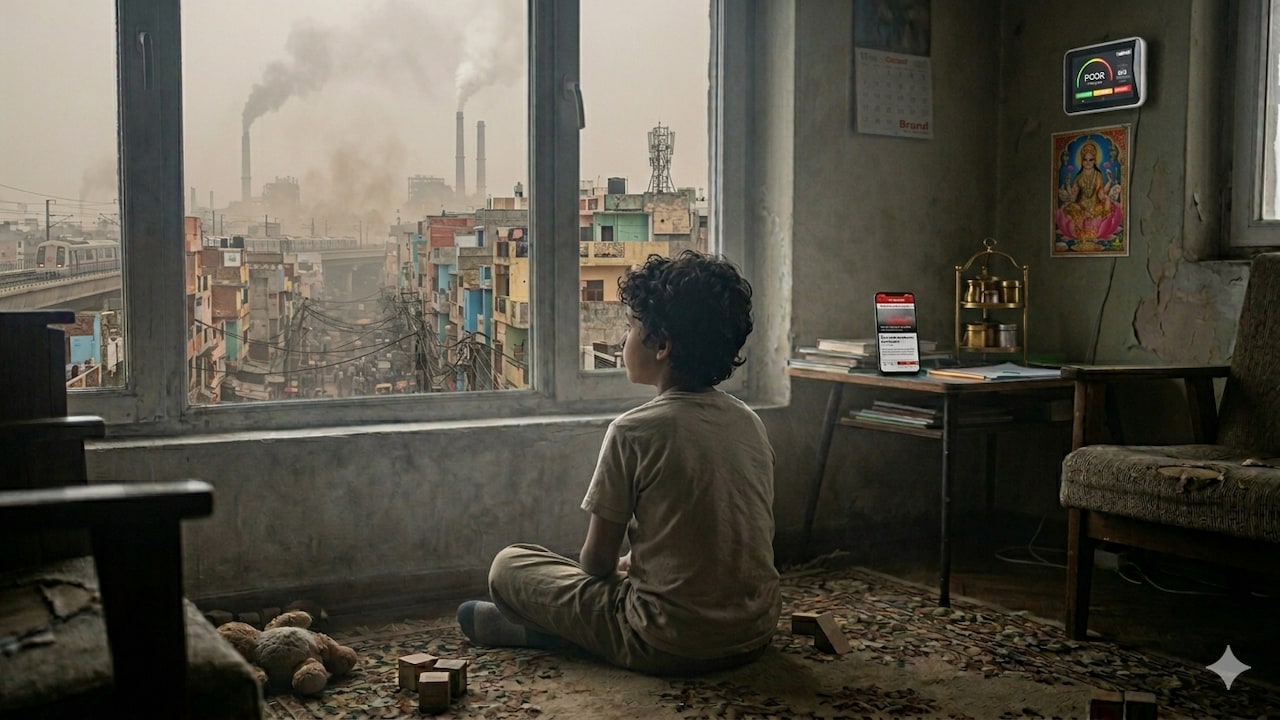
Air pollution impact on child health is immense
Highlights
- Children in Delhi-NCR face toxic air exposure during their school commute and before classes start
- Their developing lungs and proximity to ground-level pollutants increase vulnerability to pollution
- Experts call for delayed school start times and hybrid learning during severe pollution episodes
For children in Delhi-NCR, the school day begins with an exposure they have little choice about. Long before classrooms fill up, thousands of children are travelling through a city blanketed in toxic air. They wait for school buses, walk along congested roads and breathe pollutants even before their first lesson begins.
As air pollution continues to threaten the health of the capital, the question is no longer simply whether schools should close. It is whether our schools are doing enough to protect children from an environmental hazard that could affect their health for decades.
Children are not miniature adults. Their developing lungs, smaller bodies and longer lifetime exposure make them particularly vulnerable to polluted air.
Dr Dhiren Gupta, Respiratory and Allergy Specialist and Paediatrician at Sir Ganga Ram Hospital, while speaking to NDTV explained why children face a disproportionate risk.
"When we talk about children, it is important to understand how they are different from adults. Their lungs are not yet fully developed. If I have 20 years left in my life, a child has another 80 years ahead. This means they could be exposed to these pollutants and suffer their effects throughout their lives. The long-term adverse effects of pollution will also affect children.
"Secondly, children are shorter in height. Pollution is present in higher concentrations closer to the ground. Since children are shorter, they are closer to the ground, where pollutant concentrations can be higher. This makes them more vulnerable." he says.
The concern is not limited to children who already have asthma or respiratory conditions. Even otherwise healthy children can experience irritation of the eyes and airways, coughing, breathing difficulties and worsening respiratory symptoms. Repeated exposure during the years when their organs are developing raises concerns about long-term consequences. "There has been a 5 time increase in childhood asthma cases in the last few years in this region" Dr Gupta adds.
Dr Sanjeev Bagai, Paediatric Nephrologist at Nephron Clinic, believes that the response needs to be far more decisive. He has called for schools to remain closed across age groups during periods of severe pollution.
"Children have a unique disadvantage. Their lung functional capacity and pulmonary reserve are lower than those of adults. Their immune systems are also still developing, making them more vulnerable to toxic exposure."
He also points to children's faster respiratory rates, which can increase the amount of polluted air they inhale relative to their body size. Dr. Bagai believes early-morning school schedules deserve particular scrutiny. "Children must be protected, especially during early-morning school timings. We need to defer school timings."
His warning is stark: "We are a Marlboro country. We are smoking without smoking."
But keeping schools closed indefinitely is neither a sustainable educational policy nor a long-term solution. The answer must be to make schools safer and ensure that children's health is not compromised in the name of maintaining routine.
READ | Delhi AQI: How 'Very Poor' Air Quality Impacts Even Those Without Asthma
The School Timetable Needs To Change
A school opening at 7 am or 7.30 am cannot operate as though the air outside is business as usual. Schools and education authorities must consider delaying morning classes to 9.30 am or later during severe pollution episodes, particularly when early-morning exposure is a concern.
"For the time being, school timings have to be deferred to atleast 9.30 am when the sun is out and the ground level pollution settles " Dr Bagai says.
The response must go beyond changing the school bell.
Schools need clear air-pollution protocols, including
- DELAYED SCHOOL TIMINGS: Shift opening hours during severe pollution episodes.
- HYBRID LEARNING: Enable online classes when outdoor air quality becomes hazardous.
- NO OUTDOOR ACTIVITIES: Suspend morning assemblies, sports and physical education during high-pollution periods.
- CLEANER CLASSROOMS: Invest in appropriate air filtration and ventilation systems.
- SAFER COMMUTES: Reduce children's exposure to traffic emissions while waiting for buses and travelling to school.
- REAL-TIME MONITORING: Track local and indoor air quality instead of relying exclusively on citywide AQI readings.
- HEALTH PROTOCOLS: Ensure schools can identify children experiencing breathing difficulties and other pollution-related symptoms.
Most importantly, schools need predetermined pollution thresholds that trigger preventive action. They should not have to wait for an emergency or the highest stages of GRAP before protecting children.
Education Cannot Come At The Cost Of Health
Delhi's pollution crisis is no longer just an environmental issue. It is a child-health issue, an education issue and a question of public safety.
Children cannot decide when they leave home, which route their school bus takes or how polluted the air is outside their classrooms. Those decisions rest with adults and institutions responsible for their safety.
Parents should not have to choose between sending their children to school and protecting them from toxic air. This is what most of us are having have to do now because the damage caused by years of exposure to polluted air may not be so easily reversed.
\r\n
\r\n
Disclaimer: This content including advice provides generic information only. It is in no way a substitute for a qualified medical opinion. Always consult a specialist or your own doctor for more information. NDTV does not claim responsibility for this information.
Published: November 13, 2026 12:56 IST
also read
Delhi AQI Crosses 400: Best Antioxidant And Omega-3 Rich Foods To Lower Pollution-Induced Internal Inflammation
Written by Varsha VatsDelhi AQI: How 'Very Poor' Air Quality Impacts Even Those Without Asthma
Written by Debosmita GhoshDelhi Air Pollution: How Long Does It Actually Take Your Lungs To Recover?
Written by Debosmita Ghosh
 Written by Sneha Mordani | Friday November 13, 2026
As air pollution continues to threaten the health of the capital, the question is no longer simply whether schools should close.
- Friday November 13, 2026
Air quality index (AQI) in Delhi was "hazardous" at 334, making it the most polluted global major city, according to Swiss group IQAir, which measures air quality levels based on the concentration of toxins
- Written by Varsha Vats | Friday November 13, 2026
Exposure to heavily polluted air can lead to respiratory issues. Within hours, it can cause coughing, wheezing, a scratchy throat, burning or watery eyes, and shortness of breath.
- Edited by Prateek Shukla | Friday November 13, 2026
From lost working hours and rising medical bills to employees struggling through illness, air pollution is quietly becoming a major business expense.
- Written by Maanya Manchanda | Friday November 13, 2026
The Air Quality Index (AQI) is used to communicate the quality of the air and the potential health risks associated with exposure to pollutants.


................................ Advertisement ................................
Opinion | Delhi Has Every Pollution Control Policy - Except One That Works
Monday November 09, 2026Every November, Delhi performs the same ritual. We check the AQI before stepping outdoors, children are kept indoors, masks reappear, schools consider shutting, construction is restricted, and emergency meetings are convened. Politicians blame the weather, neighbouring states, farmers, or firecrackers. And then, as the season changes, the urgency d...
दीवाली की चौखट पर दिल्ली में सांसों का संकट: 30 साल की स्टडी ने हरियाली को लेकर क्या बताया?
Thursday November 05, 2026अध्ययन में हरियाली की मात्रा के साथ उसके फैलाव और आपसी जुड़ाव को भी महत्वपूर्ण पाया गया. जिन इलाकों में हरियाली ज्यादा बिखरी हुई थी, वहां सतही तापमान अधिक रहा. इसके विपरीत, बड़े और आपस में जुड़े हरित क्षेत्रों में तापमान कम पाया गया.
Opinion: Why Delhi's Smog Can't Be Fixed From SpaceDavid Fickling, Bloomberg
Monday October 19, 2026The clearest sign that Delhi is on a path to cleaner air would be a decline in the amount of paddy grown nearby, and therefore the acreage liable to be burned each year.
Don't Normalise Air Purifiers As Delhi Chokes | The Reason Why
Thursday December 11, 2025More than 90 cities in the world's top 100 polluting list are in India. With every passing year, the AQI is rising, reaching 'hazardous' levels.
Blog | Well Done, Delhi. You've Turned Lung Sacrifice Into A Badge Of HonourSaikat Kumar Bose
Monday November 10, 2025Till some years back, Delhiites would ask angry questions to those in power about the capitals annual tryst with toxic air. This has changed. Those in the driving seat dont see the need to answer now.



